Introduction
We live in a world that makes pleasure easy to reach. A phone can deliver novelty every few seconds. Food can be engineered to keep us eating after hunger is gone. Shopping, gambling, pornography, video games, and streaming are available without much effort or delay.
The brain that meets this world is much older than the technology. It was built to help us seek what mattered for survival. Dopamine is part of that system.
Most people have heard dopamine described as the pleasure chemical. That is useful shorthand, but it misses something important. Dopamine has a great deal to do with wanting, anticipation, and the drive to pursue a reward. It helps decide what gets our attention and what we are willing to work for.
That makes dopamine essential. It also means our daily habits are training the system, whether we mean to train it or not.

Dopamine helps us pursue what matters
Dopamine is a neurotransmitter, a chemical messenger used by the brain. It has roles in movement, learning, motivation, and reward. Without enough dopamine activity, the drive to go after even a basic need can fall apart. Anna Lembke puts the distinction plainly in Dopamine Nation. Dopamine may be more involved in desiring the reward than in enjoying the reward once it arrives.
I find that distinction helpful because wanting can feel like pleasure before we have received anything. You hear the ding of a particular notification, you see the package is almost here, or maybe you dream about the upcoming vacation. Anticipation starts pulling us forward.
This is normal biology. Dopamine helps us get out of bed and engage with life. It supports the effort required to learn something, complete a task, exercise, or pursue a relationship. A life without desire and motivation would not be healthy.
Unfortunately, the modern environment can pull at this system all day long. It’s easy to create a life where rewards arrive all too quickly, with little work, and another is always waiting. Our repeated choices teach the dopamine system what deserves attention. Eventually, those choices can influence what feels worth doing.
Pleasure has an aftereffect
In Dopamine Nation, Lembke describes pleasure and pain as two sides of a balance. When a pleasurable experience tips the balance in one direction, the brain works to restore equilibrium, or its usual level. That correction can feel like restlessness, craving, irritability, or a low mood after the pleasure has passed.
This helps explain why the second helping, the next purchase, or one more hour online may feel less satisfying than expected. We keep reaching for another reward because the brain wants relief from the discomfort that followed the last one.
Repeated high stimulation can also make ordinary rewards seem dull. A walk or a usually fulfilling conversation now has to compete with experiences designed to be intense and immediate. Over time, we may need more stimulation to get the same response. Lembke describes this as tolerance and, in more severe cases, a dopamine deficit state in which everyday pleasures lose some of their appeal.
Huberman makes a similar point in the interview transcript I reviewed for this article. He describes dopamine peaks as being followed by troughs, with larger and more frequent peaks capable of leaving a person feeling depleted and under-stimulated. His practical concern is the pattern that follows. People often respond to the trough by seeking another strong stimulus, which can drive them farther and farther from their usual baseline.
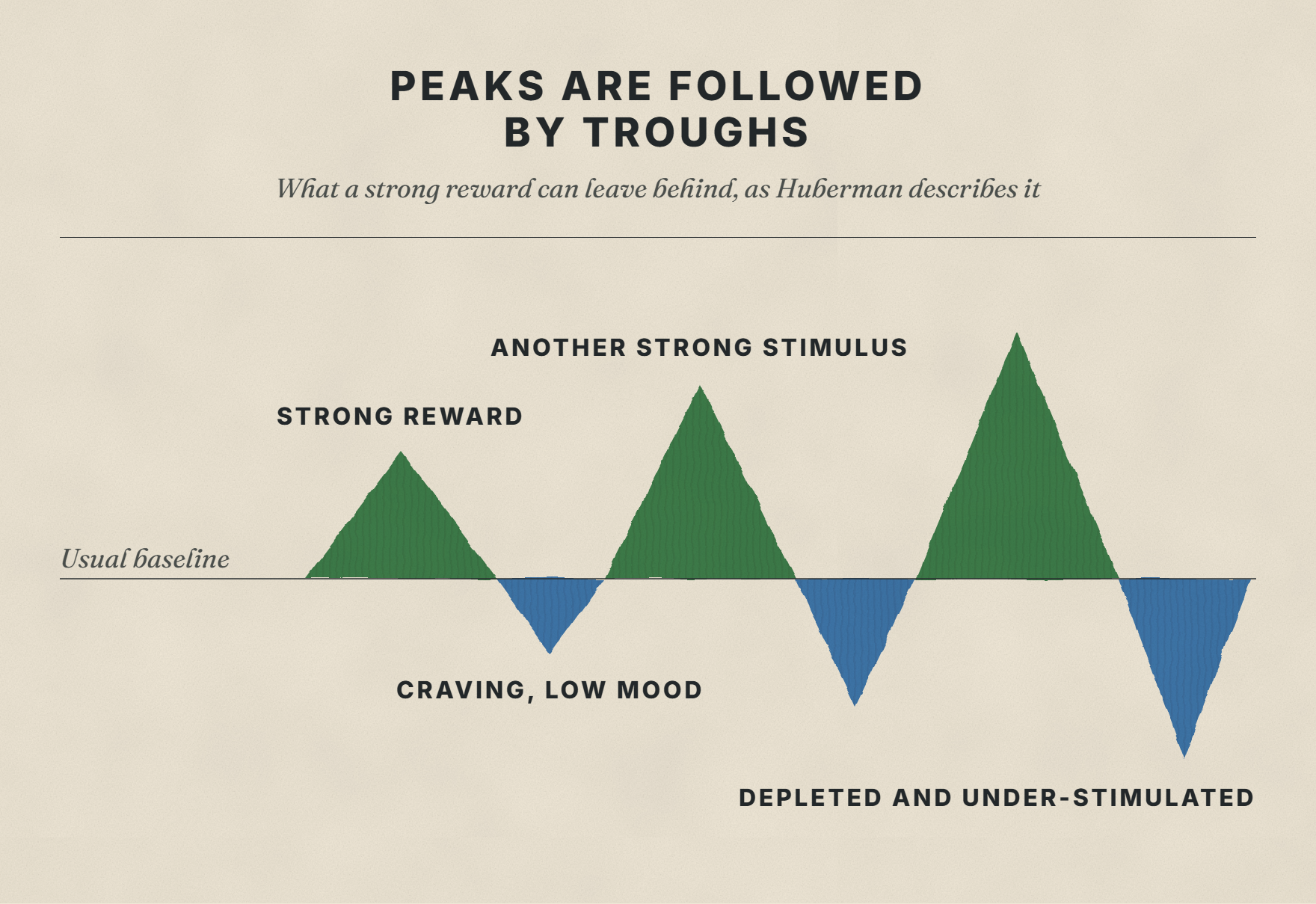
An illustration of the pattern Huberman describes in the interview cited below. The shape is conceptual, not measured data.
Energy follows a daily rhythm
I also think dopamine makes more sense when we place it beside cortisol. Cortisol is usually called a stress hormone, which makes it sound harmful. We need it. Cortisol helps organize alertness and energy across the day, and a healthy rise early in our waking period helps move the body from sleep into activity.
Huberman has spent years explaining how light, sleep timing, movement, and stress shape this daily rhythm. His new book, Protocols, brings many of those practices together around sleep, stress control, light, focus, and motivation.
Morning light is one simple example. Light entering the eyes early in the day helps time the morning cortisol rise and the circadian clock, the internal system that coordinates when we feel alert and when we become ready for sleep.
Dopamine does not replace that clock, but our pursuit of stimulation can interfere with the way we experience it. A late night of scrolling can delay sleep. Poor sleep can make effort harder the next day. When energy falls, quick rewards become more tempting. We can end up needing stimulation to push through a tough time that wouldn’t have been all that tough had we stopped scrolling earlier the night before.
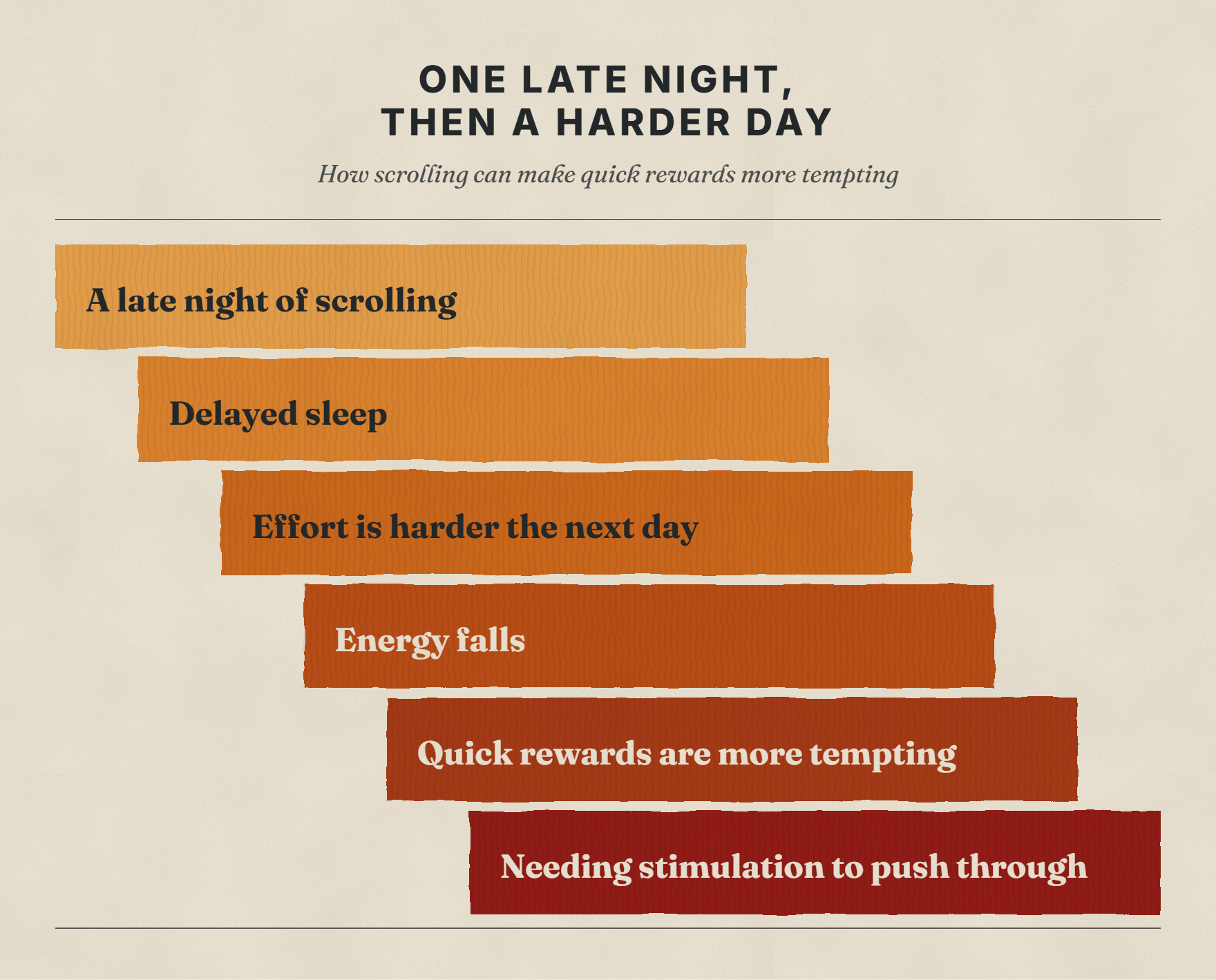
An illustration of the sequence described above. It shows how one late night can lead to more stimulation seeking the next day, not a measured result.
I am comfortable making a broad point here. Cortisol helps regulate our daily energy pattern, while dopamine helps direct what we pursue with that energy. They are part of a larger system, and neither hormone acts alone. For an introductory discussion, the useful lesson is that reward, stress, light, sleep, and motivation all affect one another.
Pay attention before you try to control it
The phrase "dopamine detox" has become popular, but we cannot remove dopamine from the brain, nor would we want to. Lembke uses periods of abstinence in a clinical setting to help some patients restore balance and see their behavior more clearly. She also warns that abrupt abstinence is not appropriate for everyone, especially when serious addiction or withdrawal risk is involved.
For most people, a better first step is observation. Notice which rewards leave you satisfied and which ones create an immediate desire for more. Pay attention to what you reach for when you are tired, bored, lonely, or anxious. Look at whether a habit supports tomorrow's energy or crushes it.
A few practical changes can reveal a lot. Keep the phone away during the first part of the morning. Get outside for daylight soon after waking. Make some rewards follow effort rather than precede it. Allow parts of the day to be less stimulating.
That is where I would begin. Dopamine is necessary, and pleasure is not the enemy. We should understand how often we are pressing the reward button and what happens afterward. Once we can see the pattern, we have a better chance of deciding what deserves our attention. That takes practice, especially when we have the option to push that button at any moment. Awareness, like much of life, is the first step.
References
Huberman, Andrew D. Interview transcript, The Diary of a CEO. Cleaned transcript filed in Sage Brain, accessed September 2026.
Huberman Lab. "The Daily Blueprint." Accessed September 8, 2026. https://www.hubermanlab.com/daily-blueprint
Lembke, Anna. Dopamine Nation: Finding Balance in the Age of Indulgence. Dutton, 2021.
Simon & Schuster. "Protocols: An Operating Manual for the Human Body," by Andrew D. Huberman. Accessed September 8, 2026. https://www.simonandschuster.com/books/Protocols/Andrew-D-Huberman/9781668032145
Watch
Andrew Huberman: Controlling Your Dopamine for Motivation, Focus, and Satisfaction (32 minutes) (https://youtu.be/XeN6eGO6FVQ)
Ready to start restoring your health?
The membership is $300 a month, month to month. You get a written plan, teaching, and coaching. Sage does not diagnose you or give you a personal medical reading.
See the membershipMore from Sage Matters
Working with dopamine instead of chasing it
In the first article, I described dopamine as part of the system that teaches the brain what to want. That raises the practical question. If our habits
READ ARTICLE
Testosterone, Explained: The Forms, The Routes, And Why We Use Daily Microdosing
A plain-English guide to testosterone forms, delivery routes, peak-and-trough problems, and why Sage Matters uses daily subcutaneous microdosing.
READ ARTICLE
Low testosterone and the problem with normal
Why normal lab ranges can miss the clinical picture when symptoms, timing, free testosterone, and SHBG are ignored.
READ ARTICLE
The Growth Hormone Paradox
Why One of Medicine's Most Powerful Immune Regenerators Is a Federal Felony to Distribute
READ ARTICLE