
Introduction
In the first article, I described dopamine as part of the system that teaches the brain what to want. That raises the practical question. If our habits are training this system, can we train it in a better direction?
I think we can, but not by trying to keep dopamine high all day.
Dopamine is not a happiness meter. It is involved in motivation, learning, attention, movement, and the willingness to work for a possible reward. The goal is not to maximize it. The goal is to help the brain place value on activities that support our health and well-being.
That requires a different approach. We have to pay attention to what triggers the pursuit, what reward follows, and what the experience teaches us to do next time.

Dopamine helps assign value
The brain is constantly making rough calculations. Is this worth my attention? Is it worth the effort? Should I repeat it?
Dopamine is involved in those calculations. It helps energize pursuit and helps the brain learn from the difference between what it expected and what actually happened. A reward that is better than expected strengthens learning. A reward that disappoints us can weaken it. Once a reward becomes predictable, the signal begins to shift toward the cue that announces it. (Salamone and Correa 2024; Webber et al. 2021)
This is why the sight of the phone can create an urge before we have read a message. The smell of food can start the pursuit before we are hungry. Opening a shopping site can produce anticipation before anything has been purchased.
The cue itself has acquired value.
The same biology can work for us. Shoes placed by the door can become a cue to walk. A checked box can make progress visible. A regular meeting with a friend can make exercise harder to skip. These actions give the brain a clearer path toward something we have decided is important.
Start with one behavior, not dopamine itself
Trying to "control dopamine" is too vague. We cannot feel a dopamine concentration, and we cannot accurately judge it from moment to moment.
Choose one behavior instead. It might be checking the phone during work, eating late at night, avoiding exercise, or repeatedly searching for stimulation when a task becomes difficult.
For several days, write down four things:
What was the cue?
What did I feel or expect?
What did I do?
How did I feel ten minutes later and the next morning?
This separates anticipation from satisfaction. Many high-stimulation habits are attractive before we do them and disappointing afterward. Seeing that difference on paper can weaken the automatic story that the reward will make us feel better.
It also keeps the project manageable. We are changing one learned loop, not rebuilding the nervous system in a weekend. (And if you read that exercise above and thought “Yeah right, I won’t be doing that.” then make it simpler. Just focus on today, identify the behavior, and ask those questions. Doing the smallest version of this exercise is better than not doing it at all. Who knows, it may lead you to doing the full exercise.)
Make the unwanted reward less convenient
Anna Lembke uses the term self-binding for barriers we create while our judgment is clear. These barriers protect us when the cue appears and our priorities temporarily change. (Lembke 2021)
Physical barriers are simple. Keep the phone outside the bedroom. Do not store the food you tend to overeat within easy reach. Remove saved payment information from shopping sites. Log out of the app that repeatedly steals your attention.
Time barriers also help. Decide that social media is available after lunch but not before. Establish a kitchen closing time. Put entertainment inside a defined window instead of allowing it to fill every open minute.
Friction is good, we want friction, a little friction creates a pause between wanting and acting. That pause gives the thinking part of the brain time to rejoin the decision.
If the behavior involves alcohol, opioids, benzodiazepines, or another substance that can produce dangerous withdrawal, do not attempt abrupt abstinence without medical guidance. Severe compulsive behavior also deserves professional help. Self-binding is useful, but it is not a substitute for treatment.
Put effort before the reward
Dopamine helps connect anticipated reward with the effort required to reach it. We can use that relationship.
Complete a focused work period before checking messages. Prepare a healthy meal before opening the streaming service. Let the pleasant activity mark completion rather than provide constant stimulation during every step.
This does not mean every healthy activity must feel unpleasant. It means we should be careful about adding several rewards to an activity before the activity has a chance to become rewarding on its own.
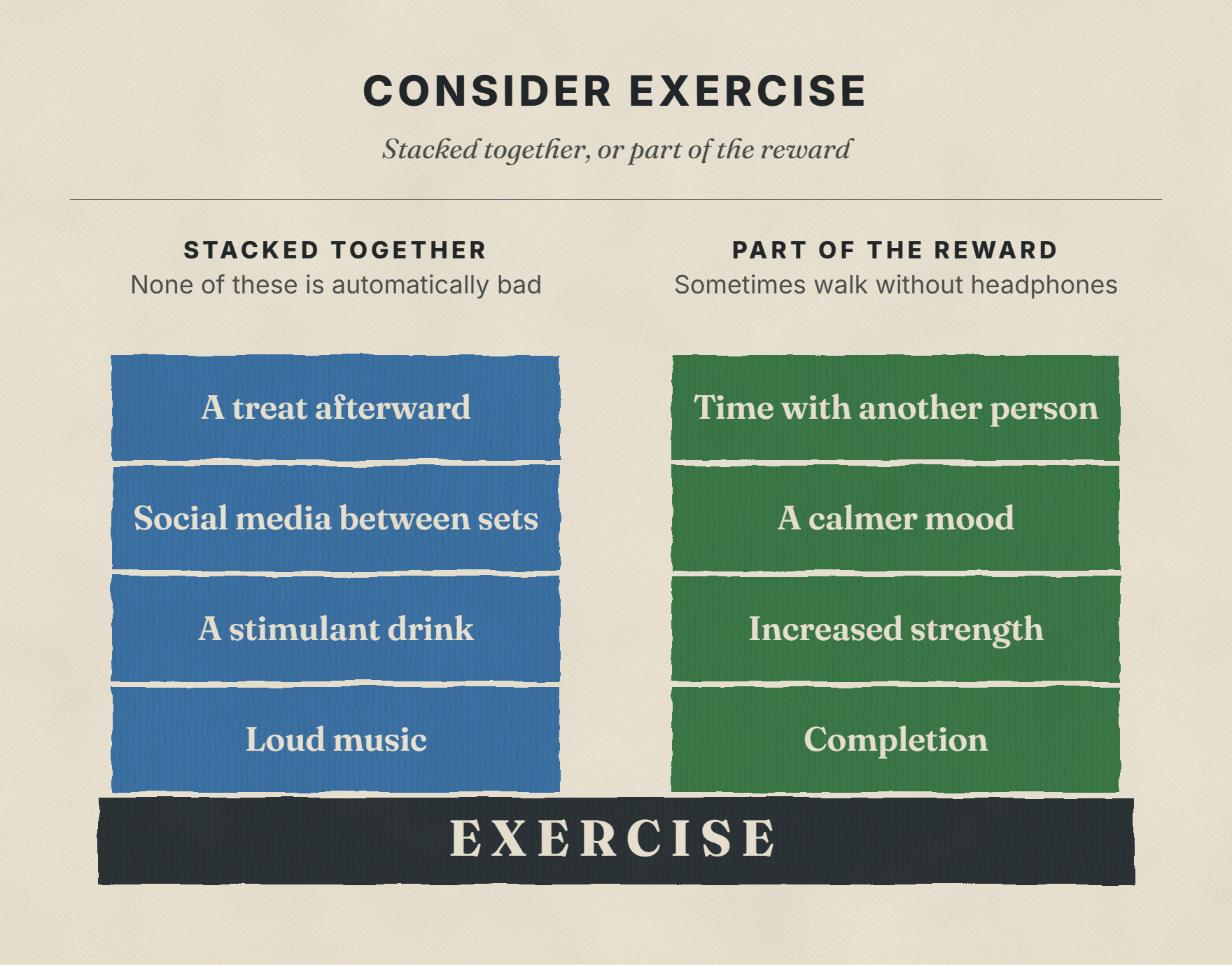
Consider exercise with loud music, a stimulant drink, social media between sets, and a treat afterward. None of these is automatically bad. Stacked together every time, however, they may teach the brain that movement alone is not enough.
Sometimes walk without headphones. Sometimes train without turning the session into a major event. Let completion, increased strength, a calmer mood, or time with another person become part of the reward.
Use small wins, but do not make them completely predictable
A distant goal often does not provide enough immediate feedback. "Improve my health" is important, but it is too far away to guide a Tuesday morning.
Break the action into visible units. Walk for ten minutes. Write one page. Prepare tomorrow's breakfast. Put a check on the calendar when it is done.
Progress itself can become rewarding. The brain learns that effort leads somewhere.
I would avoid paying myself for every healthy choice. If every walk earns dessert and every work period earns a phone check, the external prize can become the real reason for the behavior. Instead, acknowledge the win and vary the added reward. Some days the completed action is enough. On other days, pair it with something modest that you enjoy.
The goal is to strengthen the behavior, not create a new dependency around the prize.
Protect the biological foundation
Behavioral tools work better when the body is not fighting exhaustion.
Morning light helps set the circadian clock and supports the normal early-day rise in alertness. Regular movement supports mood and brain health. Sleep gives the nervous system time to recover and makes deliberate choices easier the next day. Regular meals built around whole foods may reduce the swings in hunger and energy that make quick rewards more attractive.
These practices are not dramatic, which is part of their value. They reduce the need to manufacture energy with constant novelty, caffeine, food, or digital stimulation.
I would start with a consistent waking time, outdoor light early in the day, daily movement, and a repeatable bedtime routine. These are not dopamine hacks. They create the conditions in which the reward system has a better chance to work normally.
Learn to stay with the trough
After a strong reward, we may feel flat, restless, or disappointed. The usual response is to reach for another reward.
That is the moment to practice waiting.
Set a timer for ten minutes. Take a walk, breathe slowly, stretch, or do a simple task that does not provide another intense hit of stimulation. Notice the urge, but release it.
Huberman has discussed non-sleep deep rest as one way to shift into a calmer state. A brief guided body scan or Yoga Nidra practice may be useful when fatigue and agitation are driving reward-seeking. I see this as a recovery tool, not a way to force dopamine upward.
The ability to tolerate a temporary low state matters. If every dip is immediately covered with food, scrolling, shopping, or another stimulant, we never learn that the feeling can pass on its own.
Consider a planned reset
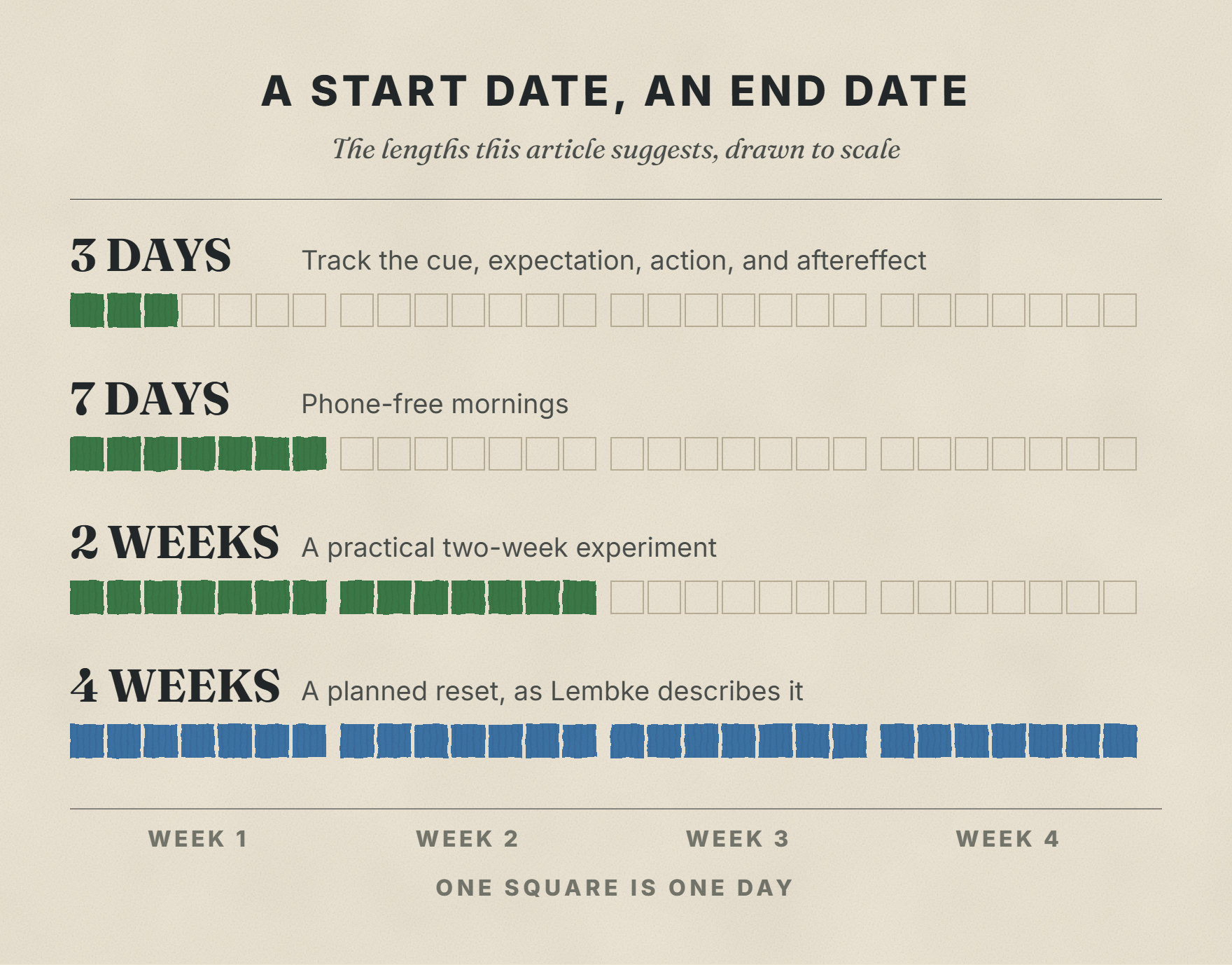
When one behavior has become difficult to control, a defined period away from it can provide useful information. Lembke often describes a four-week period of abstinence in her clinical work. That is long enough for many patients to move beyond the initial discomfort and see their mood and cravings more clearly.
Not every habit requires four weeks. A person who checks the phone too often might begin with phone-free mornings for seven days. Someone who has lost control of online shopping might remove the apps and stop browsing for a month.
Choose a clear rule, a start date, an end date, and a plan for the moments when the urge appears. Tell someone you trust. At the end, decide whether moderation is realistic or whether the boundary needs to remain.
A reset is an experiment, not a purification ritual. We are not removing dopamine. We are learning what happens when a powerful cue and reward are no longer available on demand.
Use connection as part of the intervention
Compulsive habits thrive in secrecy. Healthy routines are easier to maintain when another person knows what we are trying to do.
This can be as simple as a morning text, a standing walk, or a weekly conversation about what worked and what did not. The other person is not there to police us. Honest reporting makes the behavior visible and reduces the quiet bargaining that happens when no one else knows the plan.
Social connection is also a reward worth protecting. A conversation, shared meal, or walk with a friend may not produce the intensity of a digital feed, but it often leaves us in a better state afterward.
A practical two-week experiment
If I wanted to begin without making life complicated, I would use this plan:
Choose one behavior that repeatedly takes more than it gives.
Track the cue, expectation, action, and aftereffect for three days.
Add one barrier between the cue and the behavior.
Put one useful effort before a chosen reward.
Protect morning light, movement, and sleep as consistently as possible.
Practice waiting ten minutes when the urge appears.
Report the result to one trusted person.
Review the notes after two weeks and adjust one thing.
The outcome is not perfection. I would look for fewer automatic choices, better awareness of the urge, and more satisfaction from ordinary activities.
Dopamine is not a tool we hold in our hands. It is part of the machinery that learns from what we repeatedly do. We influence it by arranging our environment, placing effort and reward in a better order, recovering properly, and practicing the ability to wait.
That is a slower approach than chasing a hack. It is also more useful. We are teaching the brain that the life we want to build is worth pursuing.
References
Lembke, Anna. Dopamine Nation: Finding Balance in the Age of Indulgence. Dutton, 2021.
Huberman, Andrew D. Interview transcript, The Diary of a CEO. Cleaned transcript filed in Sage Brain, accessed September 2026.
Salamone, John D., and Mercè Correa. "The Neurobiology of Activational Aspects of Motivation: Exertion of Effort, Effort-Based Decision Making, and the Role of Dopamine." Annual Review of Psychology, 2024. https://pubmed.ncbi.nlm.nih.gov/37788571/
Webber, Heather E., et al. "Using Pharmacological Manipulations to Study the Role of Dopamine in Human Reward Functioning: A Review of Studies in Healthy Adults." Neuroscience & Biobehavioral Reviews, 2021. https://pubmed.ncbi.nlm.nih.gov/33202256/
Ready to start restoring your health?
The membership is $300 a month, month to month. You get a written plan, teaching, and coaching. Sage does not diagnose you or give you a personal medical reading.
See the membershipMore from Sage Matters

Dopamine is teaching your brain what to want
Dopamine is teaching your brain what to want
READ ARTICLE
Testosterone, Explained: The Forms, The Routes, And Why We Use Daily Microdosing
A plain-English guide to testosterone forms, delivery routes, peak-and-trough problems, and why Sage Matters uses daily subcutaneous microdosing.
READ ARTICLE
Low testosterone and the problem with normal
Why normal lab ranges can miss the clinical picture when symptoms, timing, free testosterone, and SHBG are ignored.
READ ARTICLE
The Growth Hormone Paradox
Why One of Medicine's Most Powerful Immune Regenerators Is a Federal Felony to Distribute
READ ARTICLE