
Introduction
I'm a Christian. I have been most of my life. I've never believed that my faith and my health existed in separate categories. Your spiritual life isn't disconnected from your physical body. They're connected. What happens in your relationship with God affects how your body works, how you handle stress, how you age. I've always believed that.
What's changed is that science is starting to catch up. Over the past two decades, researchers at Harvard, Duke, Johns Hopkins, and the NIH have been measuring what many of us already knew from experience: spiritual practices produce real biological effects. We're talking about death rate reductions as large as quitting smoking. There are brain structure changes you can see on MRI scans, and immune system boosts you can measure in saliva samples.
The question is how does spirituality affect your health? What are the actual mechanisms? What pathways connect prayer to stress hormones, or church attendance to longevity, or fasting to cellular repair? That's what I want to look at.

The mortality data changed the conversation
Tyler VanderWeele runs the Human Flourishing Program at Harvard's School of Public Health. He's not a pastor. He's an epidemiologist who studies cause and effect. In 2016, his team published an analysis of the Nurses' Health Study that followed 74,534 women for 16 years. The finding was stark: women who attended religious services more than once per week had 33% lower death rates compared to those who never attended. That's one-third.
The effect held across different causes of death. Heart disease deaths were 27% lower. Cancer deaths were 21% lower. Even after accounting for smoking, diet, exercise, social networks, depression, and dozens of other factors, the link remained.
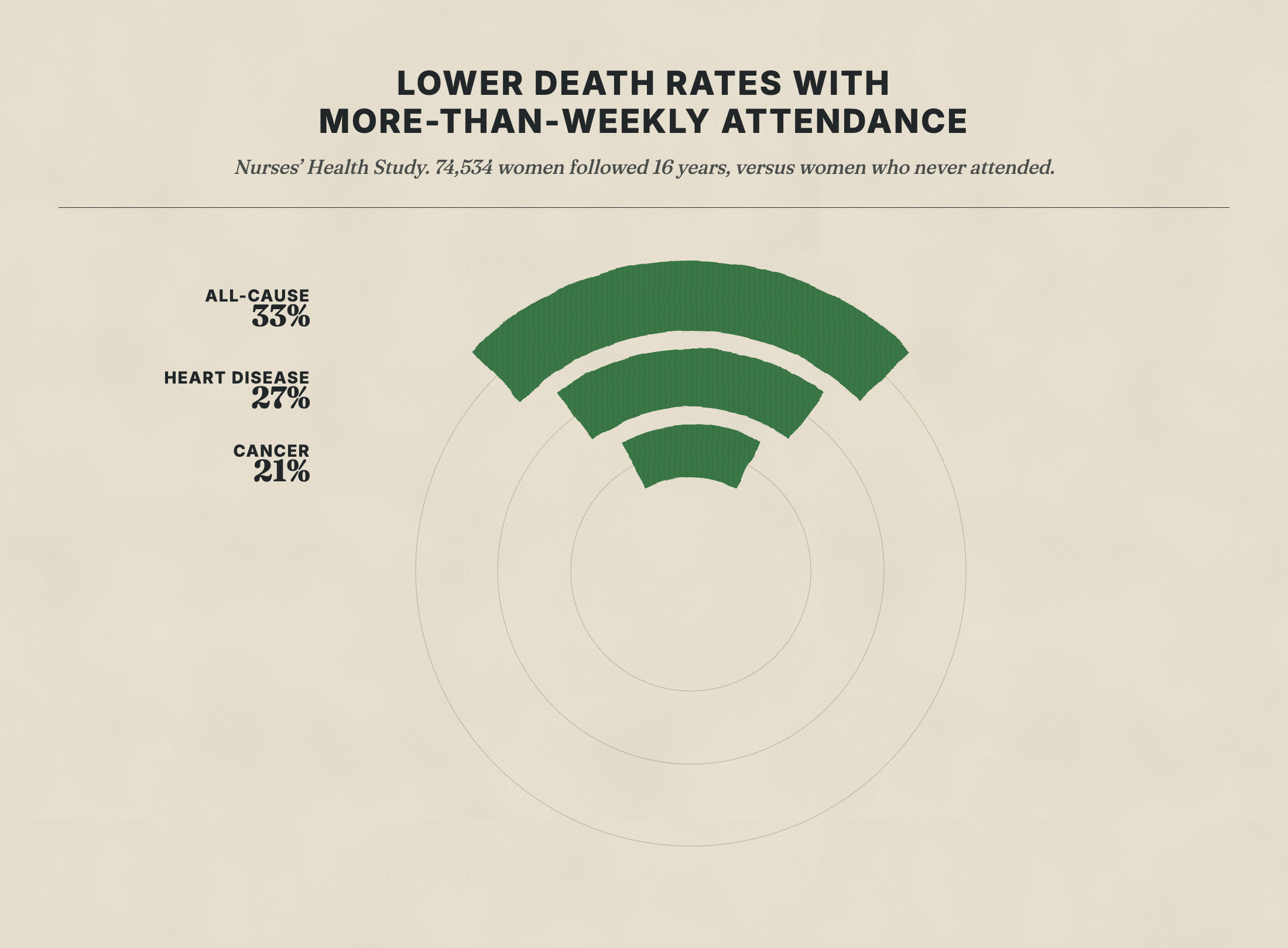
Li, Stampfer, Williams, VanderWeele. JAMA Internal Medicine, 2016. 74,534 women followed 16 years. Radiating fan: sweep scaled to the raw percent from zero. Death rates for more-than-weekly attendance versus never.
This wasn't a one-time finding. The Alameda County Study tracked 5,286 people for 28 years and found 36% lower death rates for frequent religious service attenders. When VanderWeele combined data from three large studies totaling over 91,000 participants, the consistent finding was 26% lower death rates for weekly attendance.
The dose-response pattern is clear. Never attending is the baseline. Less-than-weekly attendance shows 11-15% reduction. Weekly attendance shows 18-26% reduction. More-than-weekly attendance shows 30-33% reduction. One analysis estimated this translates to about seven extra years of life.
Mental health outcomes tell a similar story. The same Nurses' Health Study found five times lower suicide rates among women attending services weekly or more. A 2020 JAMA Psychiatry study showed 68% lower risk of deaths from despair (suicide, drug overdose, alcohol-related death) in women and 33% lower in men. Depression rates run 20-30% lower among regular attenders.
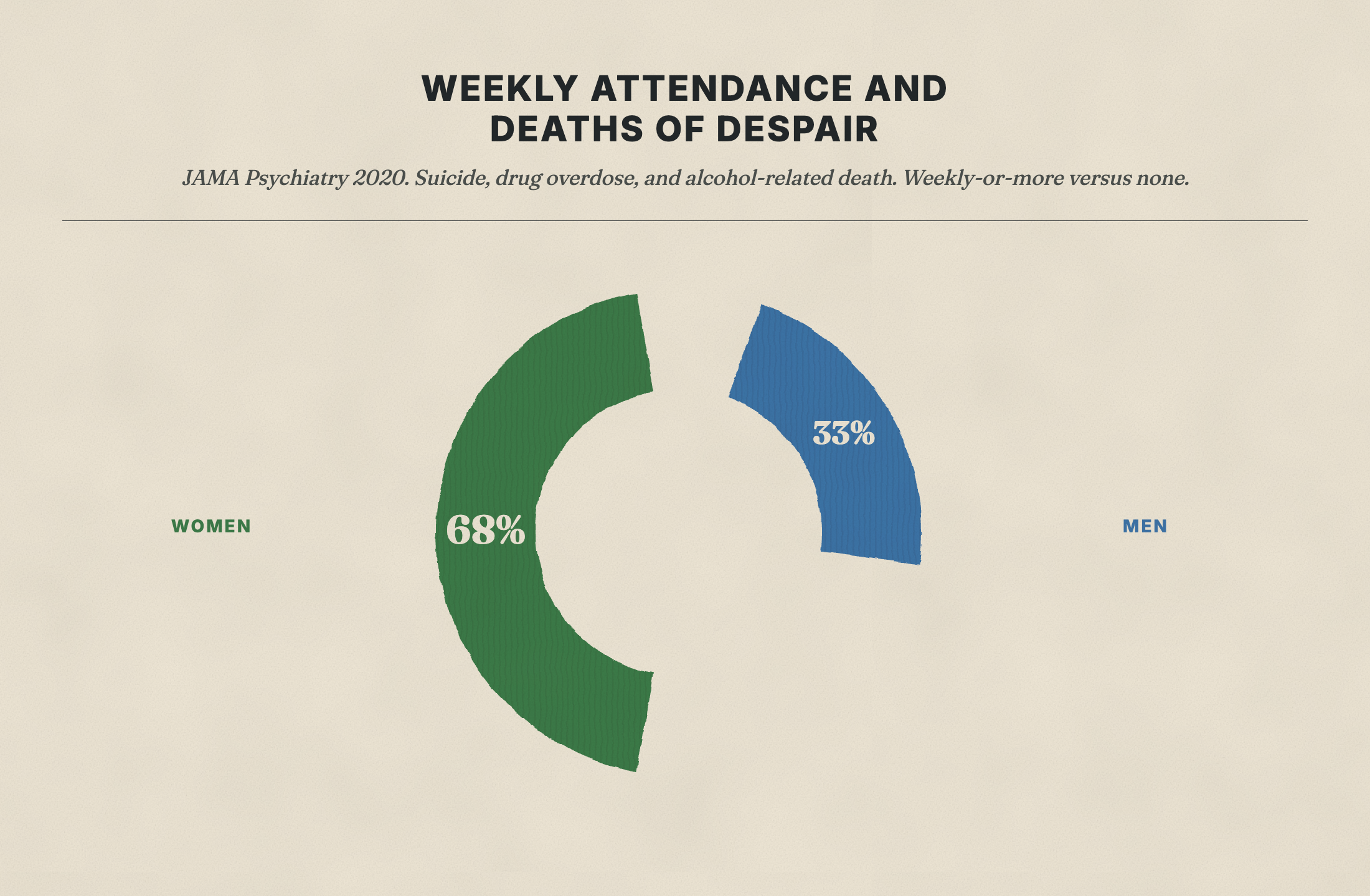
JAMA Psychiatry 2020. Split ring: arc length scaled to the raw percent. Two groups, not a shared whole. Weekly-or-more attendance versus none. 68% lower risk in women, 33% lower in men.
Going to church means you're around people. Maybe friendship is doing all the work.
VanderWeele's research suggests otherwise. Social support explains only about 25% of the death rate reduction. Religious service attendance predicts how long you'll live more strongly than being married, having close friends, or hours spent in social groups. Something about religious participation seems to work through pathways that regular social activities don't match.
What's actually happening in the body
Harold Koenig at Duke University has spent 40 years studying the biological effects of religious practice. His research, along with work from other institutions, shows several mechanisms working at the same time.
First, inflammation. Duke studies found religious service attenders were about 50% less likely to have high interleukin-6 (IL-6), a key inflammation marker linked to heart disease, cancer, and faster aging. A 12-year follow-up showed IL-6 levels partly explained the survival benefit. National health data showed non-churchgoers had much higher allostatic load, a combined measure of stress on multiple body systems.
Second, stress hormones. Regular religious participation links to lower cortisol, especially the blunted morning cortisol spike that signals chronic stress. Actual trials of prayer interventions show measurable cortisol drops, with the biggest effects in those starting with high levels.
Third, behavior patterns. Religious communities tend to discourage smoking, heavy drinking, and risky behaviors while encouraging healthy habits. These behavioral norms get reinforced through social accountability in ways that individual health advice typically doesn't.
Fourth, psychological strength. Religious frameworks provide systems for making meaning that help people understand suffering, keep hope during illness, and find purpose beyond physical limits. This psychological dimension affects biological stress responses through well-known mind-body pathways.
The striking finding is that these mechanisms work simultaneously. You're getting social support and stress reduction and behavioral guidance and meaning-making all at once, reinforced weekly through group practice. That combination appears to be what secular alternatives struggle to match.
Your brain on prayer
Andrew Newberg pioneered brain imaging of spiritual practices at Thomas Jefferson University. His SPECT scans of Franciscan nuns during prayer showed consistent patterns: increased frontal lobe activity (focused attention), increased activation in language areas during verbal prayer, and decreased activity in the posterior parietal region (the area responsible for your sense of physical boundaries).
The posterior parietal cortex processes spatial information and maintains your sense of where your body ends and the world begins. When activity there drops during deep prayer or meditation, people report feeling "at one" with something larger than themselves. That feeling matches measurable brain activity.
A 2025 review of prayer brain imaging studies found something even more interesting: prayer activates Theory of Mind networks, the same brain systems used during talking with other people. Your brain processes prayer like conversation with another person, using the social thinking circuits involved in understanding intentions, emotions, and relationships.
This suggests prayer may work in the brain like attachment behavior, similar to how infants relate to caregivers. Research on religious coping shows people with secure attachment styles toward God show better stress handling, while those with anxious or avoidant attachment styles toward God show worse outcomes. The nature of the relationship seems to matter as much as whether it exists.
Meditation research provides supporting evidence. The landmark Harvard study led by Sara Lazar showed eight weeks of mindfulness practice increased gray matter in the hippocampus (memory and learning) and decreased it in the amygdala (fear and stress). That amygdala shrinkage matched participants' reported stress reduction. Participants practiced just 27 minutes daily for measurable structural changes.
The default mode network offers another window. This network turns on during mind-wandering and self-focused thinking. It's linked to rumination—the repetitive negative thinking that marks depression and anxiety. Experienced meditators show consistent quieting of this network. Since mind-wandering predicts unhappiness in studies that track moment-to-moment experience, reducing it may directly improve mood.
Herbert Benson at Harvard documented what he called the relaxation response: the opposite of the stress response. Prayer and meditation trigger it reliably. Oxygen use drops. Heart rate slows. Blood pressure decreases. The calming part of your nervous system (parasympathetic) increases activity. The changes are as measurable as those from cardiovascular exercise, just in the opposite direction.
Trials confirm prayer's effects on mental health. A six-week study of person-to-person prayer sessions found major improvements in depression and anxiety scores, with effects lasting at one-month follow-up. Another trial comparing spiritual meditation to secular meditation found the spiritual version produced greater anxiety reduction and doubled pain tolerance in a cold-water test.
Fasting triggers cellular repair
Religious fasting has been practiced for thousands of years, but the biological mechanisms have only recently been clearly shown. Fasting triggers a metabolic switch. After 10-14 hours without food, liver glycogen runs out and the body shifts from burning glucose to burning fatty acids and making ketone bodies. This switch turns on autophagy, the cellular cleanup process that breaks down damaged proteins and cellular parts.
Ramadan fasting provides extensive human data. Combined analyses of over 85 studies across 23 countries show consistent patterns: reduced waist size, lower blood pressure, improved HDL cholesterol (the good kind), and reductions in inflammation markers including IL-6 and TNF-α. A 2023 analysis found significant cortisol decreases during Ramadan fasting periods.
Christian fasting practices have also been studied directly. The Daniel Fast, a 21-day plant-based fast, has been examined in controlled trials. Richard Bloomer's research showed blood pressure reductions, 23% decreases in LDL cholesterol (the bad kind), improvements in blood sugar, and better insulin function measured by HOMA-IR. A six-month follow-up showed lasting benefits with about 80% of people sticking with it.
The cellular mechanisms go beyond weight loss. Fasting activates sirtuins and AMPK, proteins linked to longevity that boost mitochondrial function and cellular stress resistance. It suppresses mTOR signaling, the growth pathway that when constantly elevated links to cancer and faster aging. Mark Mattson's research at Johns Hopkins showed fasting increases brain-derived neurotrophic factor (BDNF), supporting brain cell health and possibly explaining thinking benefits.
Cancer research represents the most striking application. The DIRECT trial in Nature Communications split 131 breast cancer patients into two groups: chemotherapy alone or chemotherapy plus a fast-mimicking diet. The fasting group showed much higher rates of complete or near-complete tumor response. The proposed mechanism: fasting reduces IGF-1 and other growth factors, starving cancer cells of signals they need while protecting normal cells through what researchers call differential stress resistance. Normal cells enter a protected state during fasting, but cancer cells don't have that ability.
The same mechanisms may explain fasting's effects on chemotherapy side effects. A 2023 combined analysis found therapeutic fasting during chemotherapy significantly reduced nausea, vomiting, and fatigue while preserving quality of life. The biology suggests fasting puts normal cells into a protected state, making them tougher against chemotherapy's toxicity while leaving cancer cells vulnerable.
Time-restricted eating, where you eat only during a consistent daily window, appears to work through body clock timing as much as calorie restriction. Satchin Panda's research at the Salk Institute shows even without reducing total calories, time-restricted eating improves metabolic markers by syncing eating with the body's internal clock. This may explain why traditional religious fasting patterns, which often involve regular daily rhythms, show metabolic benefits.
The safety profile matters. Common side effects include headache, difficulty concentrating, and irritability. Fasting may temporarily increase some inflammation markers during the fast itself, returning to normal after eating resumes. It's not safe for people with diabetes especially if on insulin, during pregnancy, with eating disorder history, or in frail health. But dropout rates in trials don't differ between fasting and control groups, suggesting most healthy adults tolerate it well.
Group singing and immune function
Group singing gets less research attention than prayer or meditation, but the existing evidence shows striking immune effects. A study of professional choir members found secretory immunoglobulin A (S-IgA), the antibody that protects the mouth, nose, and throat from infection, increased 150% during rehearsals and 240% during performances. The key finding: only active singing produced this effect. Listening to music did not.
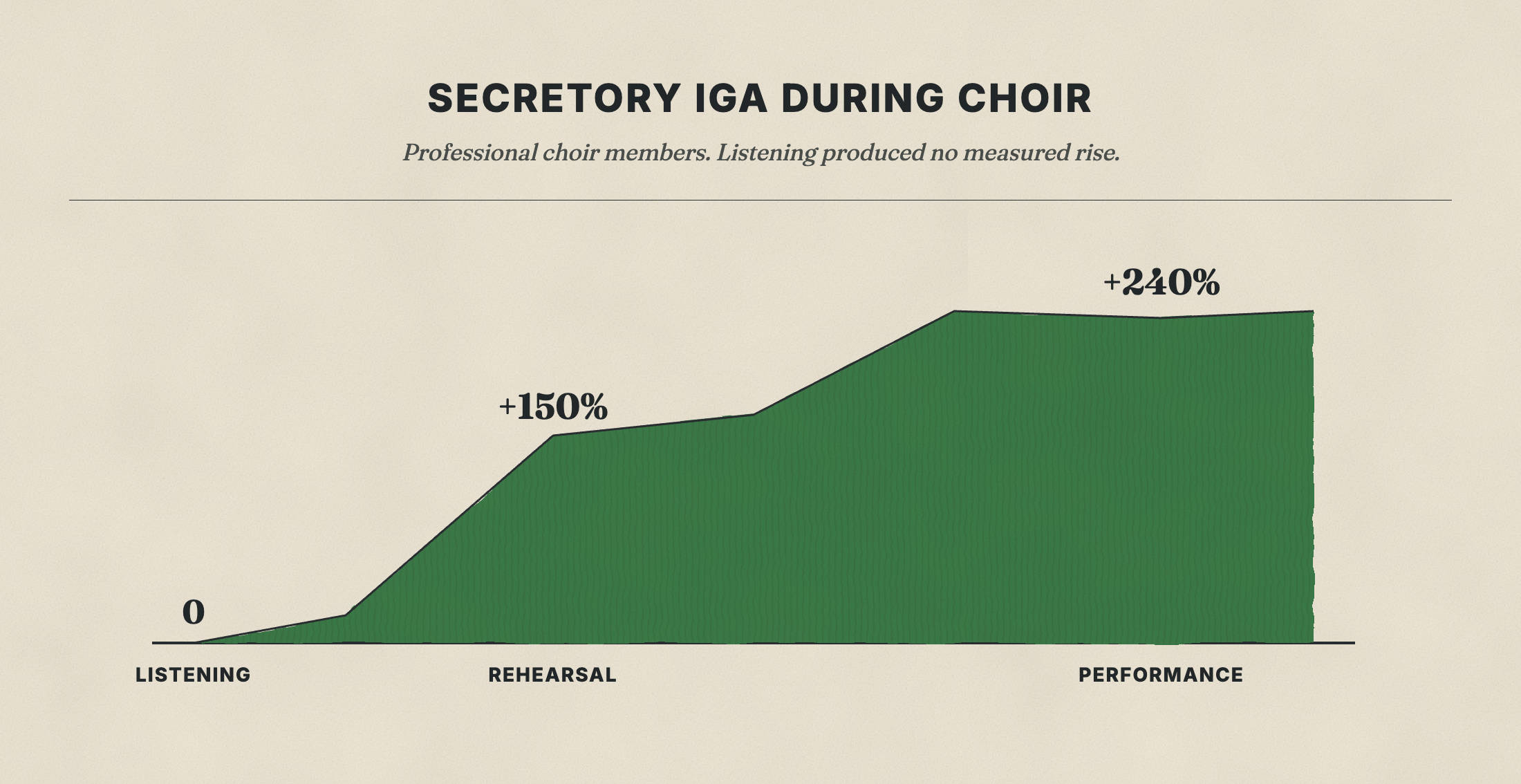
Beck et al., Music Perception, 2000; Kreutz et al., Journal of Behavioral Medicine, 2004. Mountain: secretory IgA in professional choir members. Listening produced no rise.
Cancer research extends these findings to sick populations. Researchers measured immune markers in 193 participants across five choirs that included cancer patients, caregivers, and bereaved caregivers. One hour of group singing increased multiple immune signaling molecules (cytokines) while reducing cortisol. The pattern suggested cortisol reduction was relieving the immune suppression that chronic stress produces.
The difference between group and individual singing shows social bonding mechanisms. Both forms reduce cortisol, but only group singing increases oxytocin and produces better mood elevation. Oxytocin, the hormone linked to social bonding, trust, and attachment, appears to be the key factor. Separate research found singing together improved emotional state and social connectedness more than speaking together, suggesting something specific about musical coordination.
Robin Dunbar's research on endorphins provides an evolutionary view. Active music performance, singing, dancing, drumming, triggers endorphin release you can measure through pain tolerance increases. Passive listening does not. His comparison of charismatic religious services with group singing and Anglican prayer meetings without music found higher pain thresholds in the charismatic context. The implication: rhythmic group activities may have evolved to strengthen social bonds through brain chemical mechanisms.
Heart health research adds another dimension. Hymn and chant singing produce much higher heart rate variability than humming, driven by slow, coordinated breathing. Heart rate variability reflects the calming part of your nervous system and predicts heart health. The finding that coordinated breathing activity occurs in most religious traditions suggests cultures independently evolved toward practices that produce measurable body benefits.
What about scripture reading?
Scripture reading is a major gap in the research. Despite its central role in Christian and Jewish practice, very few studies have looked at its biological effects. Most evidence comes from religious coping research rather than direct measurement.
Kenneth Pargament's research on religious coping distinguishes between positive styles, working with God, seeking spiritual support, religious reframing. That contrasts with negative styles such as feeling punished by God, spiritual struggle, and religious doubt. Combined analyses show positive coping links to better mental health outcomes, while negative coping links to 19-28% higher death risk.
The limited research on scripture reading specifically gives mixed results. One study found it buffered stress-health relationships. Another found the opposite: reading scripture for health guidance made distress worse. A 2022 paper explained this by looking at mental frameworks. For those not viewing the world as fundamentally evil, scripture reduced stress. For those with negative worldviews, it increased anxiety.
Large surveys consistently find scripture-engaged people report better outcomes on stress, anxiety, and loneliness measures. But these are connection findings without biological measurements. No brain imaging studies have looked at brain activation during scripture reading. No studies have measured inflammation markers, cortisol responses, or immune function related to regular scripture engagement.
Given how central scripture is, it's odd the science still hasn't been done. The theoretical mechanisms make sense. story engagement, meaning-making, cognitive reframing, and identity formation all have documented effects on stress biology. But the actual science hasn't been done.
Religious practice isn't alternative medicine
The evidence doesn't support treating spirituality as a health intervention in the conventional sense. You can't write a prescription for church attendance the way you prescribe blood pressure medication. The relationship is more complex.
First, causation questions remain despite large long-term studies. Reverse causation is possible: healthier people may be more able to attend services regularly. Selection effects matter: people who choose religious participation may differ in ways not fully captured by statistics.
Second, religious participation can also harm health. Negative religious coping: feeling abandoned by God, blaming illness on divine punishment predicts worse outcomes. Religious communities that discourage medical treatment, promote guilt and shame, or create social isolation through rigid rules can damage mental and physical health.
Third, the benefits appear tied to active participation, not belief alone. The survival studies measured service attendance, not private faith. The brain imaging research looked at people during practice. Community engagement and ritual behavior seem to matter as much as the theological content.
Fourth, trying to use religion as a tool for health benefits may undermine the very mechanisms that produce those benefits. Religious traditions put the weight on devotion, worship, and service to others. Personal health optimization is a different project. The person attending church to extend their lifespan probably experiences it differently than someone attending for spiritual reasons.
The appropriate medical stance, according to VanderWeele and colleagues, is to recognize religious participation among the social factors that affect health, comparable to economic status, marital status, or education level. For patients who identify with a religious tradition, encouraging community participation may have health benefits alongside other values. For those who don't, secular social participation, meditation practices, or other meaning-making activities may provide some overlapping benefits.
The mechanisms are becoming clear
What the past two decades of research have shown is that spiritual practices work through identifiable biological pathways. Prayer activates brain networks involved in social thinking and attachment. Religious service attendance provides social support, behavioral norms, and meaning-making systems simultaneously. Fasting triggers metabolic switches that activate cellular repair. Group singing produces immune enhancement through stress reduction and social bonding.
They work together. The person who attends services regularly, prays or meditates daily, participates in periodic fasting, and engages in group singing is activating multiple health-promoting pathways at the same time. The combined effects may explain why religious participation predicts health outcomes more strongly than isolated interventions.
If this article helped you, please share it. Your shares help keep Sage Matters free, and I only ask you to share it if you genuinely found it useful.
The science doesn't tell you whether to believe. It can't evaluate the truth claims of religious traditions or the reality of spiritual experiences. What it can do is document that these practices produce measurable effects in the body and brain. Those effects, taken together, link to longer life, lower disease burden, and better mental health.
For me, this research validates something I've believed for a long time. I didn't become a Christian for health benefits. I don't pray to reduce my cortisol or attend church to lower my IL-6 levels. My faith isn't a tool in that way. But the fact that these practices affect my biology makes sense to me. If we're created as whole beings, spiritual, mental, and physical, then of course what happens in one dimension affects the others.
The research is simply documenting what faith traditions have understood for centuries: caring for your soul isn't separate from caring for your body. They're part of the same whole.
Most of the research studies the orthodox religions. As we get into what has shaped me and my family in my lifelong search, you’ll learn that I started life from an organized religion perspective but for most of the last 25-30 years my family and I have continued the search for encounters and relationships that fit what we believe. I didn’t find that in organized religion. I’m not attacking that. For some it is their path and it works. I was just looking for something more.
Ready to start restoring your health?
The membership is $300 a month, month to month. You get a written plan, teaching, and coaching. Sage does not diagnose you or give you a personal medical reading.
See the membershipReferences26
- Li S, Stampfer MJ, Williams DR, VanderWeele TJ. Association of Religious Service Attendance With Mortality Among Women. JAMA Intern Med. 2016;176(6):777-785.
- Chen Y, VanderWeele TJ. Associations of Religious Upbringing With Subsequent Health and Well-Being From Adolescence to Young Adulthood: An Outcome-Wide Analysis. Am J Epidemiol. 2018;187(11):2355-2364.
- VanderWeele TJ, Li S, Tsai AC, Kawachi I. Association Between Religious Service Attendance and Lower Suicide Rates Among US Women. JAMA Psychiatry. 2016;73(8):845-851.
- Li S, Okereke OI, Chang SC, Kawachi I, VanderWeele TJ. Religious Service Attendance and Lower Depression Among Women-a Prospective Cohort Study. Ann Behav Med. 2016;50(6):876-884.
- VanderWeele TJ, Yu J, Cozier YC, et al. Attendance at Religious Services, Prayer, Religious Coping, and Religious/Spiritual Identity as Predictors of All-Cause Mortality in the Black Women's Health Study. Am J Epidemiol. 2017;185(7):515-522.
- Koenig HG, King DE, Carson VB. Handbook of Religion and Health. 3rd ed. Oxford University Press; 2024.
- Koenig HG, Cohen HJ, George LK, Hays JC, Larson DB, Blazer DG. Attendance at religious services, interleukin-6, and other biological parameters of immune function in older adults. Int J Psychiatry Med. 1997;27(3):233-250.
- Newberg AB, Wintering NA, Morgan D, Waldman MR. The measurement of regional cerebral blood flow during glossolalia: a preliminary SPECT study. Psychiatry Res. 2006;148(1):67-71.
- Newberg AB, Pourdehnad M, Alavi A, d'Aquili EG. Cerebral blood flow during meditative prayer: preliminary findings and methodological issues. Perceptual and Motor Skills. 2003;97(2):625-630.
- Ferguson MA, Nielsen JA, King JB, et al. Reward, salience, and attentional networks are activated by religious experience in devout Mormons. Soc Neurosci. 2018;13(1):104-116.
- Hölzel BK, Carmody J, Vangel M, et al. Mindfulness practice leads to increases in regional brain gray matter density. Psychiatry Res. 2011;191(1):36-43.
- Brewer JA, Worhunsky PD, Gray JR, Tang YY, Weber J, Kober H. Meditation experience is associated with differences in default mode network activity and connectivity. Proc Natl Acad Sci U S A. 2011;108(50):20254-20259.
- Benson H, Beary JF, Carol MP. The relaxation response. Psychiatry. 1974;37(1):37-46.
- Boelens PA, Reeves RR, Replogle WH, Koenig HG. A randomized trial of the effect of prayer on depression and anxiety. Int J Psychiatry Med. 2009;39(4):377-392.
- Wachholtz AB, Pargament KI. Is spirituality a critical ingredient of meditation? Comparing the effects of spiritual meditation, secular meditation, and relaxation on spiritual, psychological, cardiac, and pain outcomes. J Behav Med. 2005;28(4):369-384.
- Mattson MP, Longo VD, Harvie M. Impact of intermittent fasting on health and disease processes. Ageing Res Rev. 2017;39:46-58.
- Panda S. The Circadian Code: Lose Weight, Supercharge Your Energy, and Transform Your Health from Morning to Midnight. Rodale Books; 2018.
- Mattson MP, Moehl K, Ghena N, Schmaedick M, Cheng A. Intermittent metabolic switching, neuroplasticity and brain health. Nat Rev Neurosci. 2018;19(2):63-80.
- Bloomer RJ, Kabir MM, Canale RE, Trepanowski JF, Marshall KE, Farney TM, Hammond KG. Effect of a 21 day Daniel Fast on metabolic and cardiovascular disease risk factors in men and women. Lipids Health Dis. 2010;9:94.
- de Groot S, Lugtenberg RT, Cohen D, et al. Fasting mimicking diet as an adjunct to neoadjuvant chemotherapy for breast cancer in the multicentre randomized phase 2 DIRECT trial. Nat Commun. 2020;11(1):3083.
- Beck RJ, Cesario TC, Yousefi A, Enamoto H. Choral singing, performance perception, and immune system changes in salivary immunoglobulin A and cortisol. Music Perception. 2000;18(1):87-106.
- Kreutz G, Bongard S, Rohrmann S, Hodapp V, Grebe D. Effects of choir singing or listening on secretory immunoglobulin A, cortisol, and emotional state. J Behav Med. 2004;27(6):623-635.
- Fancourt D, Williamon A, Carvalho LA, et al. Singing modulates mood, stress, cortisol, cytokine and neuropeptide activity in cancer patients and carers. Ecancermedicalscience. 2016;10:631.
- Dunbar RI, Kaskatis K, MacDonald I, Barra V. Performance of music elevates pain threshold and positive affect: implications for the evolutionary function of music. Evol Psychol. 2012;10(4):688-702.
- Vickhoff B, Malmgren H, Aström R, et al. Music structure determines heart rate variability of singers. Front Psychol. 2013;4:334.
- Pargament KI, Koenig HG, Perez LM. The many methods of religious coping: development and initial validation of the RCOPE. J Clin Psychol. 2000;56(4):519-543.
More from Sage Matters

Comfort one another
I apologize for the gap in our Substack posts.
READ ARTICLE
Body, soul, and spirit.
Body, soul, and spirit.
READ ARTICLE
Scriptural Declaration of Wholeness and Abundant Life
“I praise you because I am fearfully and wonderfully made; your works are wonderful, I know that full well.” Psalm 139:14
READ ARTICLE
Move Like Your Life Depends On It, Because It Does
A few years ago I came across a study that stuck with me.
READ ARTICLE