
Introduction
A few years ago I came across a study that stuck with me. Researchers at the Cleveland Clinic followed 122,007 patients who'd taken a treadmill stress test, tracking them for a median of 8 years. The ones who scored in the bottom of the pack for fitness had a bigger jump in their risk of dying than the patients who smoked, had diabetes, or already had coronary artery disease (Mandsager 2018). Being out of shape outranked all three.
I've spent 40 years in medicine watching people treat exercise like a nice-to-have. Something you get to once the real problems are handled. That study is just one of a stack of studies that convinced me it's backward. Movement isn't a wellness extra. It's one of the two or three biggest levers you have on how long you live and how well you live while you're here.
Cardiorespiratory fitness, meaning how well your heart, lungs, and blood vessels deliver oxygen to working muscle, keeps showing up as one of the strongest predictors of death from any cause that medicine has found. In that Cleveland Clinic study, patients in the elite fitness group had roughly an 80% lower risk of dying than the least fit group, and the benefit kept climbing the fitter people got. There was no ceiling. The most extremely fit patients did best of all (Mandsager 2018).
A separate study of 750,302 U.S. veterans, ranging from age 30 to 95 and including tens of thousands of people in their 70s and 80s, found the same pattern held across every age group, both sexes, and every race studied. The least fit 20% of people had roughly four times the mortality risk of the most fit (Kokkinos 2022). Being unfit carried more risk than any single cardiac risk factor the researchers measured.
I don't read that as "go run a marathon." I read it as: your cardiovascular system is trainable at any age, and the return on training it is bigger than almost anything else you could do for your health.
Muscle is not just for looking good
Grip strength sounds like a strange thing to measure in a hospital, but it turns out to be one of the most useful measurements. Researchers followed close to 140,000 people across 17 countries with wildly different income levels and health systems. Grip strength predicted death from any cause and from cardiovascular disease more accurately than systolic blood pressure did (Leong 2015). That's a number your doctor checks at every visit, and a squeeze test beat it.
Muscle mass tells a similar story. In a study of older adults, people in the top quarter for relative muscle mass had about a 20% lower risk of dying than people in the bottom quarter, independent of their weight or whether they were classified as obese (Srikanthan 2014). Muscle matters on its own terms, separate from the number on the scale.
A meta-analysis pooling data from nearly 2 million men and women found the same thing from a different angle. Higher grip strength cut mortality risk by about 31%, and stronger legs, measured by knee extension strength, cut it by 14% (García-Hermoso 2018). Muscle isn't vanity. It's an organ system that keeps you alive, and like any organ, it responds to how you use it.
Lifting, bones, and how much resistance training you actually need
For years, doctors told people with weak bones to avoid heavy lifting, worried it would cause a fracture. The LIFTMOR trial tested that assumption directly. Postmenopausal women with low bone density, average age 65, were split into two groups. One did twice-weekly sessions of heavy compound lifts (deadlifts, squats, overhead presses) at over 85% of their one-rep max, meaning close to the heaviest weight they could lift one time. The other did a low-intensity home program.
After 8 months, the heavy-lifting group gained bone density at the spine while the low-intensity group lost it (2.9% gain versus 1.2% loss). The heavy-lifting group also gained bone density at the hip while the other group lost it there too. Only one minor injury was reported in the entire trial (Watson 2018). A meta-analysis of similar trials in postmenopausal women found the same direction of effect at the spine, with resistance training producing modest but real gains in bone mineral density where inactivity produces loss (Martyn-St James 2006).
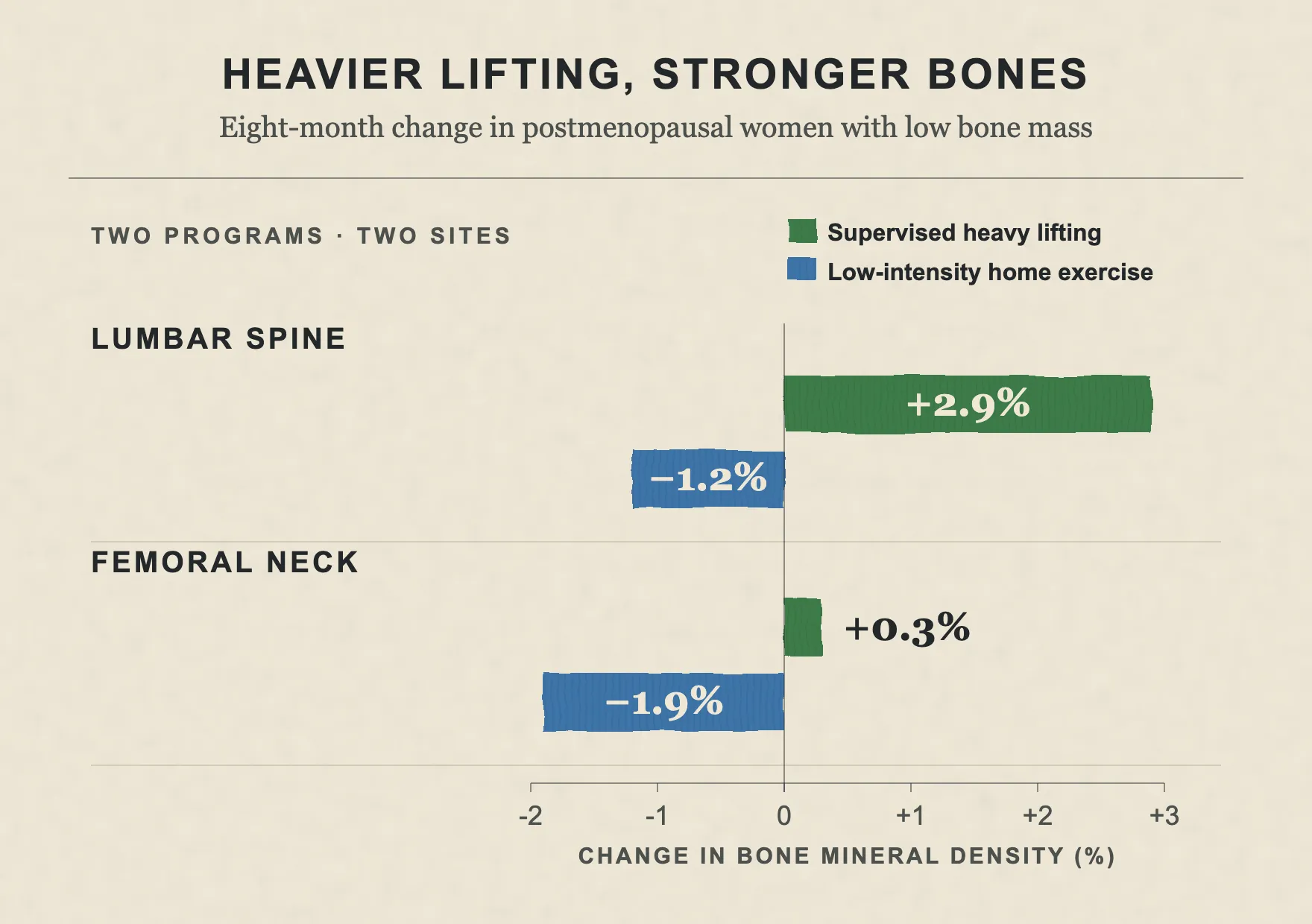
Source: Watson et al., LIFTMOR randomized trial (2018), 101 postmenopausal women with low bone mass, 8 months. Changes shown are group averages at the lumbar spine and femoral neck. High-intensity exercise was closely supervised.
If you're worried lifting something heavy will break you, the evidence points the other way. Under supervision and built up properly, it's one of the few things that can add bone back.
A review of 16 studies found that muscle-strengthening activity was tied to a 10% to 17% lower risk of dying from any cause, heart disease, or cancer, with the biggest benefit showing up somewhere around 30 to 60 minutes a week (Momma 2022). A separate meta-analysis found that any amount of resistance training lowered all-cause mortality risk by about 15%, with the largest reduction, 27%, seen at around 60 minutes a week (Shailendra 2022).
The bigger number comes from combining the two. A meta-analysis covering more than 370,000 people found resistance training alone was tied to a 21% lower risk of death, but resistance training combined with aerobic exercise was tied to a 40% lower risk (Saeidifard 2019). Cardio and lifting aren't competing for your time. Stacked together, they do more than either one alone.
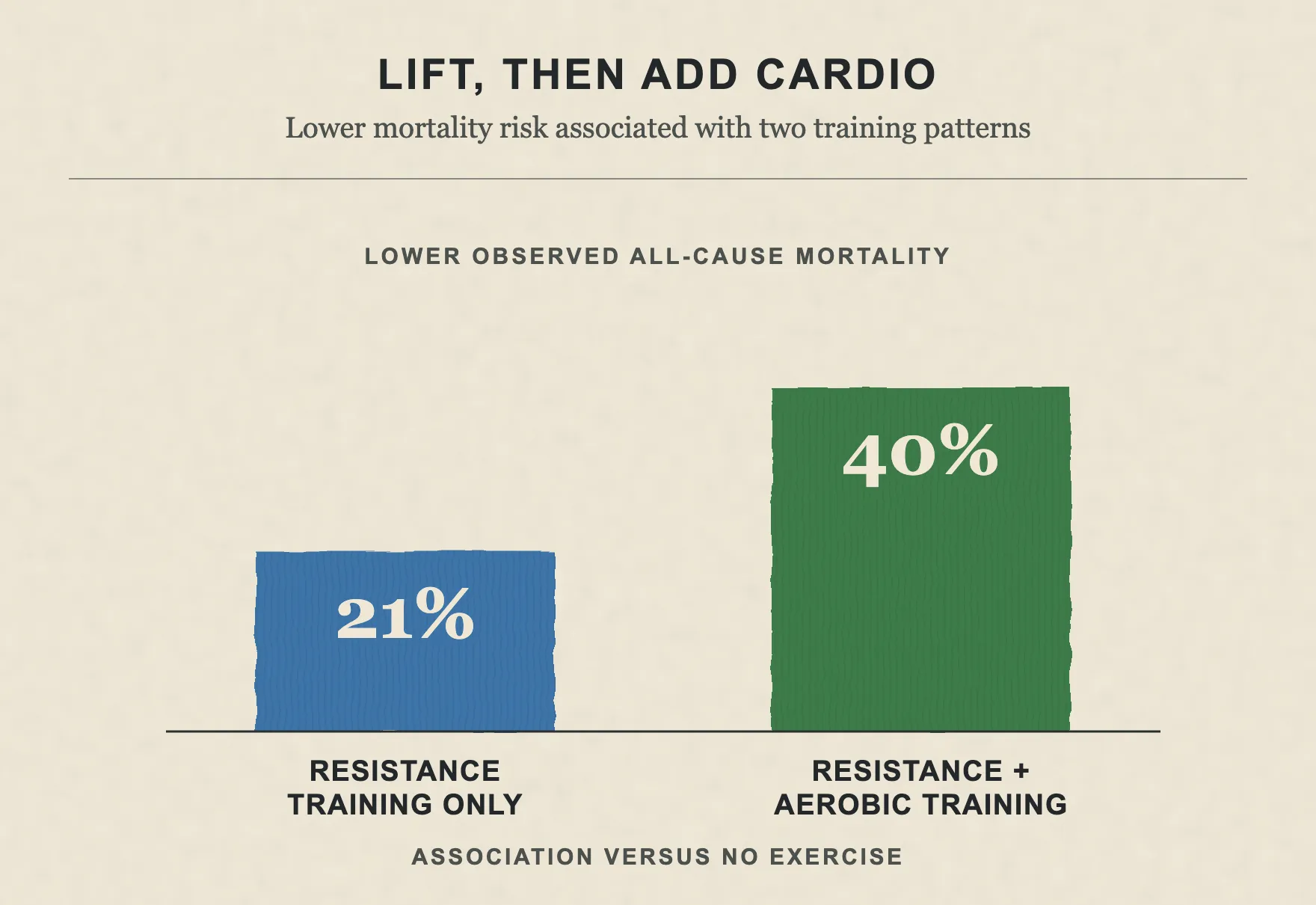
Source: Saeidifard et al. (2019), systematic review and meta-analysis of 370,256 participants. These figures are mortality associations relative to no exercise, not guaranteed causal effects or a direct randomized comparison of the two exercise patterns.
Short, hard efforts, and what I'd actually do with all this
Steady, moderate cardio is valuable, but it isn't the only tool. A Norwegian trial put heart failure patients through either moderate continuous exercise or intervals at 95% of peak heart rate, in bursts, several times a week for 12 weeks. The interval group's aerobic capacity went up 46%, more than three times the 14% gain in the moderate group. Their heart function, blood vessel function, and muscle mitochondria (the structures inside your cells that turn oxygen and fuel into energy) all improved more too (Wisløff 2007). That's the science behind the 4x4 protocol, four minutes hard, three minutes easy, repeated four times, that's become a go-to interval structure since.
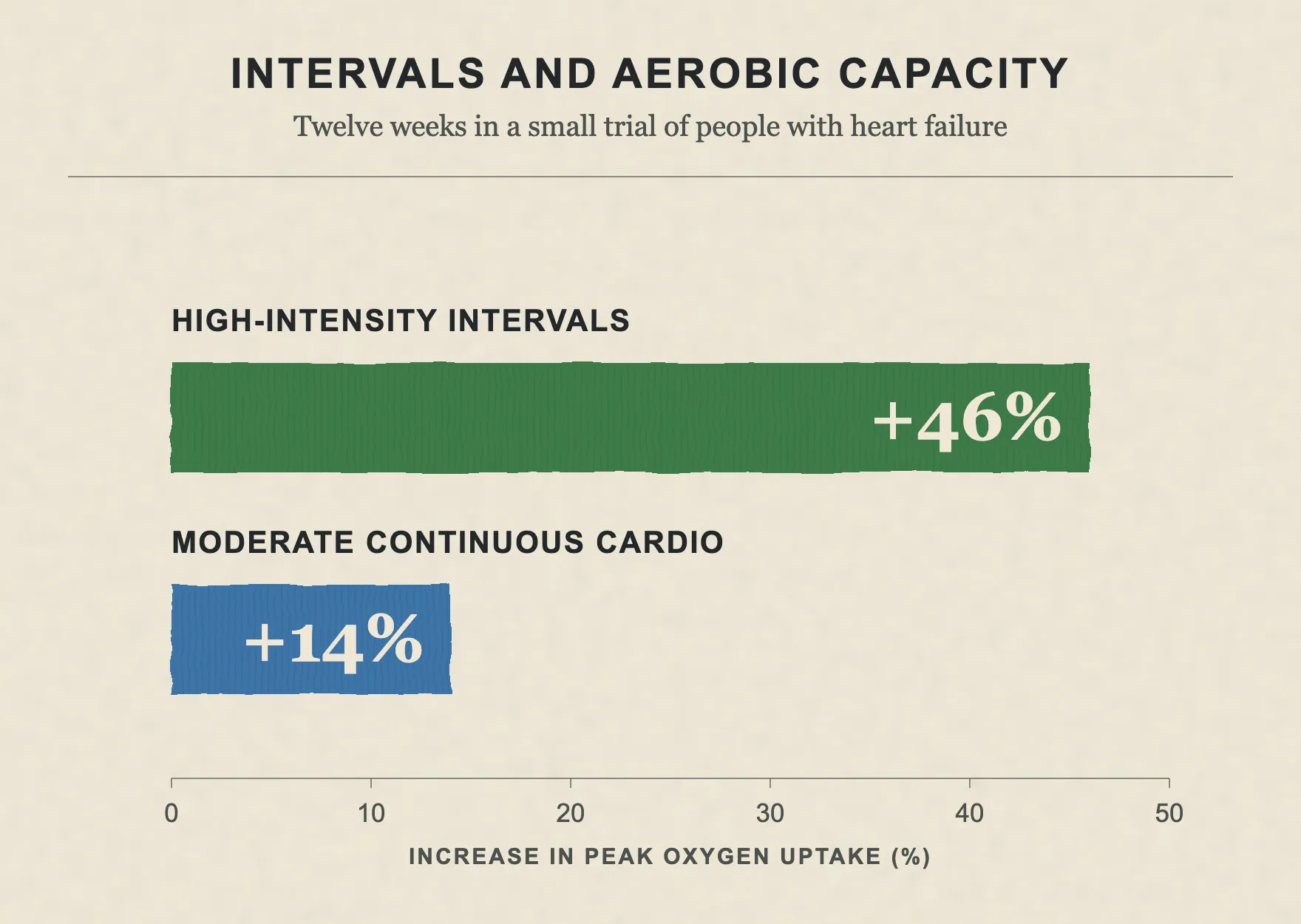
Source: Wisløff et al. (2007), 12-week randomized trial in people with heart failure. Peak oxygen uptake increased 46% with intervals versus 14% with moderate continuous training; results from this selected clinical group may not apply to everyone.
A separate study looked at what HIIT does at the cellular level in older adults. Twelve weeks of high-intensity interval training reversed many of the age-related declines in mitochondrial proteins, essentially restoring some of the cellular machinery older muscle tends to lose (Robinson 2017). Your body doesn't stop responding to hard efforts as you age.
Put together, here's where the evidence points. Something like 150 minutes a week of moderate cardio, the kind where you can talk but not without some heavy breathing, plus 20 to 30 minutes of harder intervals, plus resistance training for your whole body 2 to 3 times a week. That's not an arbitrary number. It's close to the volume where the mortality benefit in these studies tops out.
None of it works if you hate doing it. Find the version of cardio you don't dread, whether that's swimming, hiking, cycling, or even dancing. Change it up so your body and your motivation both stay fresh. And treat it as a priority, not a leftover slot at the end of an already full day. The studies above suggest it's doing more for your odds of a long life than almost anything else on your calendar.
I think about this in the context of what's coming in medicine. The pace of progress in longevity science right now is faster than anything I've seen in 40 years of practice. There are new tools for detecting disease earlier, new treatments for conditions we used to only scrape by with, and serious progress on the biology of aging itself. Life expectancy will likely see a huge leap within the next several years. But none of that matters if you’re no longer here. Move today so you’re around to reap the rewards of those breakthroughs.
If this article helped you, please share it. Your shares help keep Sage Matters free, and I only ask you to share it if you genuinely found it useful.
Ready to start restoring your health?
The membership is $300 a month, month to month. You get a written plan, teaching, and coaching. Sage does not diagnose you or give you a personal medical reading.
See the membershipReferences12
- Mandsager K, Harb S, Cremer P, Phelan D, Nissen SE, Jaber W. Association of Cardiorespiratory Fitness With Long-term Mortality Among Adults Undergoing Exercise Treadmill Testing. JAMA Netw Open. 2018;1(6):e183605.
- Kokkinos P, Faselis C, Samuel IBH, et al. Cardiorespiratory Fitness and Mortality Risk Across the Spectra of Age, Race, and Sex. J Am Coll Cardiol. 2022;80(6):598-609.
- Srikanthan P, Karlamangla AS. Muscle mass index as a predictor of longevity in older adults. Am J Med. 2014;127(6):547-553.
- Leong DP, Teo KK, Rangarajan S, et al. Prognostic value of grip strength: findings from the Prospective Urban Rural Epidemiology (PURE) study. Lancet. 2015;386(9990):266-273.
- García-Hermoso A, Cavero-Redondo I, Ramírez-Vélez R, et al. Muscular Strength as a Predictor of All-Cause Mortality in an Apparently Healthy Population: A Systematic Review and Meta-Analysis of Data From Approximately 2 Million Men and Women. Arch Phys Med Rehabil. 2018;99(10):2100-2113.
- Momma H, Kawakami R, Honda T, Sawada SS. Muscle-strengthening activities are associated with lower risk and mortality in major non-communicable diseases. Br J Sports Med. 2022;56(13):755-763.
- Shailendra P, Baldock KL, Li LSK, Bennie JA, Boyle T. Resistance Training and Mortality Risk: A Systematic Review and Meta-Analysis. Am J Prev Med. 2022;63(2):277-285.
- Saeidifard F, Medina-Inojosa JR, West CP, et al. The association of resistance training with mortality: A systematic review and meta-analysis. Eur J Prev Cardiol. 2019;26(15):1647-1665.
- Watson SL, Weeks BK, Weis LJ, Harding AT, Horan SA, Beck BR. High-Intensity Resistance and Impact Training Improves Bone Mineral Density and Physical Function in Postmenopausal Women With Osteopenia and Osteoporosis: The LIFTMOR Randomized Controlled Trial. J Bone Miner Res. 2018;33(2):211-220.
- Martyn-St James M, Carroll S. High-intensity resistance training and postmenopausal bone loss: a meta-analysis. Osteoporos Int. 2006;17(8):1225-1240.
- Wisløff U, Støylen A, Loennechen JP, et al. Superior cardiovascular effect of aerobic interval training versus moderate continuous training in heart failure patients: a randomized study. Circulation. 2007;115(24):3086-3094.
- Robinson MM, Dasari S, Konopka AR, et al. Enhanced Protein Translation Underlies Improved Metabolic and Physical Adaptations to Different Exercise Training Modes in Young and Old Humans. Cell Metab. 2017;25(3):581-592.
More from Sage Matters
A Weighted Vest Study Points to a New Reason Rucking Works
A Weighted Vest Study Points to a New Reason Rucking Works
READ ARTICLE
The Case Against Moderate Cardio
When More Time Doesn't Equal Better Results
READ ARTICLE
Muscle Mass vs Muscle Power
The Training Trade-Off That Determines Aging
READ ARTICLE
Why Movement Complexity May Matter as Much as Cardiovascular Fitness
The Olympic Athletes Data That Challenges the VO2 Max Consensus
READ ARTICLE