Introduction
Two groups of older adults with obesity followed the same six-month diet. Both lost about the same amount of weight, roughly 24 pounds. But their bodies responded to that weight loss in almost opposite ways. One group's resting metabolism dropped by 237 calories a day. The other group's metabolism barely moved, down just 16 calories a day. Two years later, the vest group had regained a little over half the weight it lost, while the diet-only group had regained all of it. The difference in weight regain between groups was not statistically significant (DeLong et al. 2025).
The only difference between the two groups was a weighted vest.
This is a study about weight loss, but I think it's really a study about rucking, the practice of walking with a loaded pack that's become one of the more popular fitness habits of the last few years. The people carrying extra weight on their walks may be triggering the same mechanism this study happened to uncover, one that has almost nothing to do with the calories burned during the activity itself.
A scale built into your bones
Weight loss research has spent decades focused on hormones. Leptin tells your brain how much fat you're carrying. Ghrelin makes you hungry before a meal. When you lose weight, both of these systems shift to try to get the weight back, which is a big part of why diets fail long term.
What's gotten far less attention is a parallel system that appears to run through your skeleton instead of your bloodstream. Bone contains cells called osteocytes, and they make up nearly all the cells in mature bone. Their known job was to sense mechanical strain and tell the bone to remodel itself, building more bone under load, breaking it down when the load disappears. That's why astronauts lose bone density in zero gravity and why weight-bearing exercise protects it.
Researchers led by John-Olov Jansson at the University of Gothenburg found something else these cells might be doing. In their rodent studies, adding weight to an animal's body, without changing what it ate, caused it to lose fat. Removing that added weight, or taking the load off an animal's limbs, caused it to gain fat back. The animals' bodies were responding to how heavy they felt to their own skeleton, not to how much food they were eating.
They call this the gravitostat. The idea is that your skeleton is constantly measuring how much weight it's carrying and reporting that number to your brain, which adjusts your appetite and resting metabolism to match. For most of human history, body weight and fat mass moved together, so this system and the hormonal system agreed with each other. Diets break that agreement. You lose fat, so leptin drops. You also lose weight, so the mechanical signal from your skeleton drops too. Both systems tell your brain to eat more and burn less.
Testing it on people
A team at Wake Forest University set out to test whether replacing that mechanical signal, artificially, could change what happens during a diet. They recruited 18 older adults with obesity and osteoarthritis, a group whose joint pain rules out the exercise that normally helps preserve metabolism during weight loss. Everyone followed the same six-month calorie-restricted diet. Half also wore a weighted vest during their normal daily activities, about six and a half hours a day, with the vest weight increased every week to replace the weight they were losing. The vest gave their skeletons the same load they'd carried before the diet started, without being a workout in itself (DeLong et al. 2025).
The results are the numbers I opened with. Equal weight loss. A very different metabolic response.
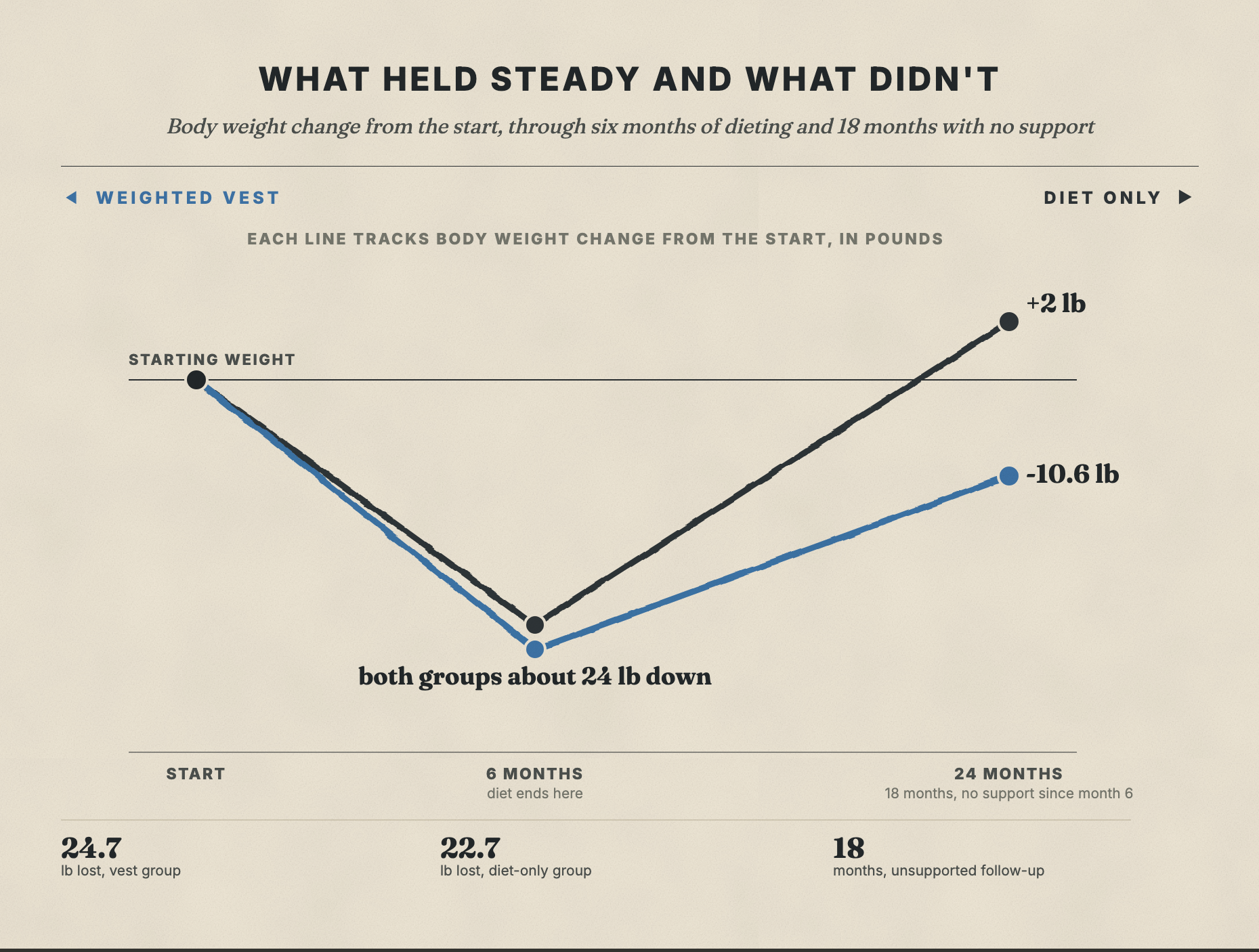
Both groups lost about 24 pounds over six months on the same diet. The two lines fall together, then split apart once the diet ends. During the 18 months after the diet ended, the vest group regained a little over half its lost weight, while the diet-only group returned to about its starting weight.
Across these 18 participants, a smaller decline in resting metabolism was associated with less weight regained afterward, although the correlation was not statistically significant (DeLong et al. 2025).
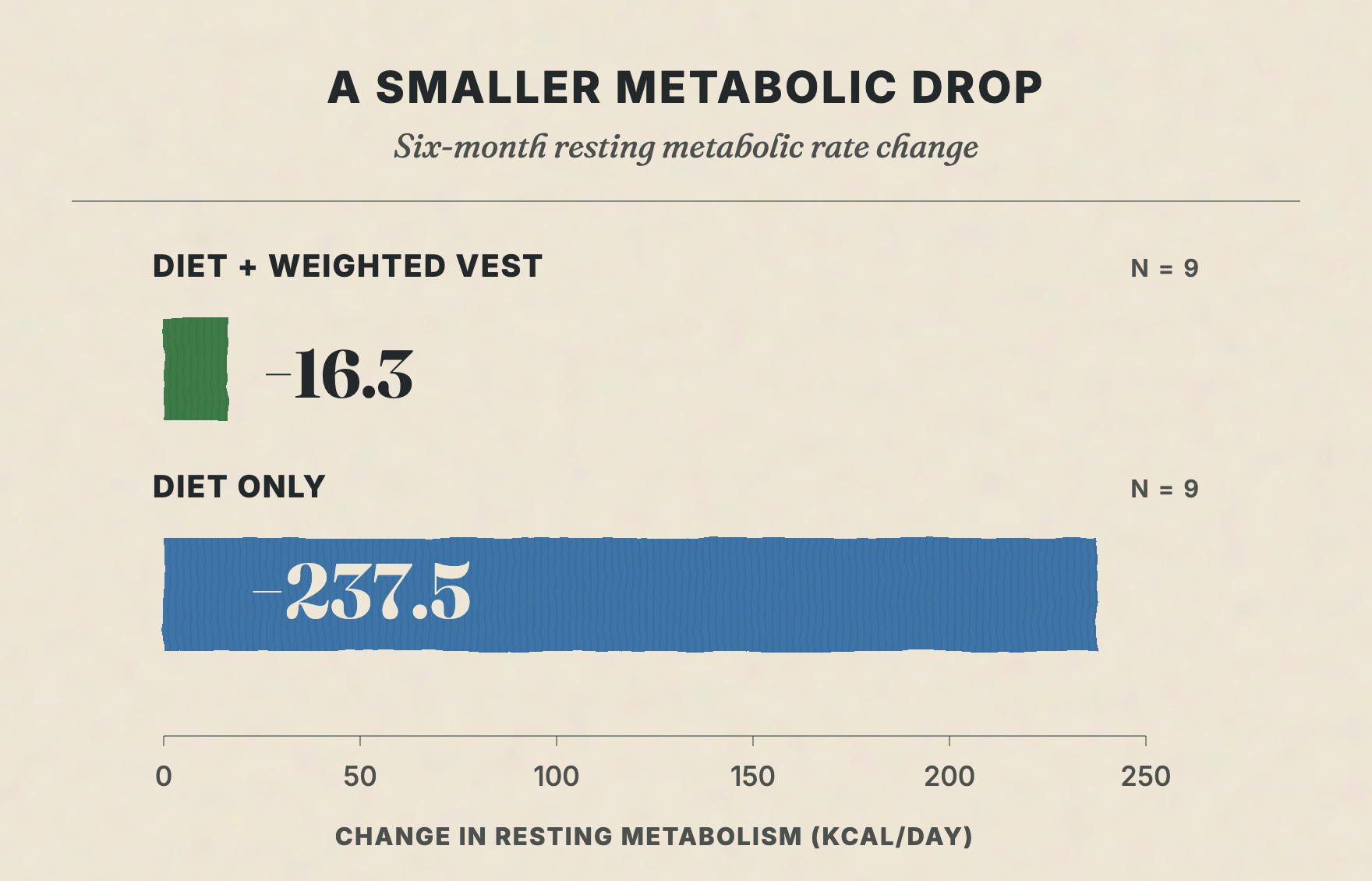
Source: DeLong et al. (2025), pilot follow-up of 18 older adults with obesity and osteoarthritis, 9 per group. Six-month mean resting metabolic rate changes were −16.3 kcal/day with the vest (95% CI −100.8 to +68.2) versus −237.5 kcal/day without (95% CI −321.9 to −153.0); between-group p < 0.01.
This is a pilot study of 18 people, and the difference in weight regain at two years didn't reach statistical significance. Studies like this are expensive to run for years, and there's no drug company or supplement brand with a reason to fund a bigger version, since a weighted vest isn't a product anyone can patent. That's a big part of why trials like this stay small, and why the field may rely on pilot-sized data like this for a while before something larger comes along.
What this means for a pack on your back
Nobody in this study went rucking. But if the gravitostat hypothesis holds up, the mechanism should apply to anyone loading their skeleton beyond its normal weight, whether that load comes from a vest worn around the house or a pack carried on a walk.
Ruckers already know the obvious benefits. Walking with 20 or 30 pounds on your back burns more calories than walking without it and raises your heart rate more. It also works your legs, hips, and back harder than an unloaded walk would. Those effects don't need a study to explain them. What the gravitostat research adds is a reason rucking might do more for weight maintenance than the calorie math alone would predict, something ruckers have reported for years without a clear mechanism to point to.
If this article helped you, please share it. Your shares help keep Sage Matters free, and I only ask you to share it if you genuinely found it useful.
The Wake Forest study tested six and a half hours a day of vest wear, not a 45-minute walk a few times a week. Whether a shorter, less continuous load produces the same signal hasn't been tested yet. But the direction of the effect, and the biology behind it, both point the same way.
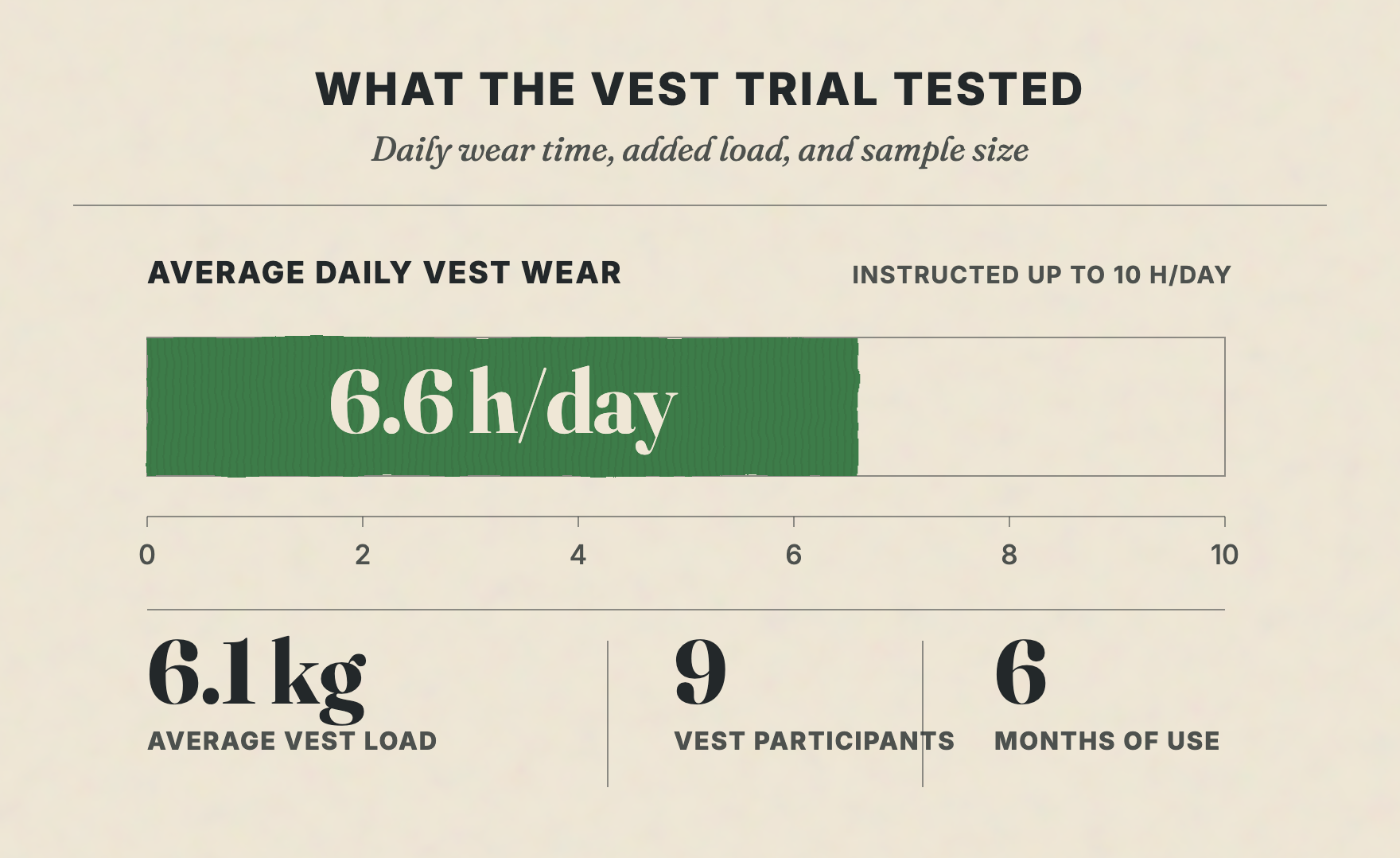
Source: DeLong et al. (2025). Vest users in the follow-up sample (n = 9) wore their vests for 6.6 ± 2.2 hours a day on average, with an average added load of 6.1 ± 2.0 kg, during the six-month intervention. They were instructed to wear the vest up to 10 hours/day. Brief rucking walks were not tested.
What a treadmill incline can and can't do
Not everyone has a place to ruck, or wants to carry a loaded pack through a neighborhood. A treadmill set to an incline is the most accessible substitute most people have, and it earns its place here on its own evidence, separate from the gravitostat story.
Grade changes the math on a walk more than most people expect. Walking cost rises steeply as the incline increases, and even a moderate grade meaningfully raises the calories burned per minute compared to flat ground (Minetti et al. 2002). A recent test of the viral "12-3-30" routine, a 12 percent incline at 3 miles an hour for 30 minutes, matched it against running for total calories burned. It took longer to burn the same number of calories, but pulled a larger share of those calories from fat than the run did (Wong et al. 2025). Incline walking also shifts more of the work toward your glutes and calves compared to flat walking, especially as you get older (Kwee-Meier et al. 2018), and lands more gently than running at a comparable pace (Whiting et al. 2020).
What an incline doesn't do is add weight to your skeleton beyond what you already carry. The gravitostat mechanism, if it's real, depends on that extra mechanical load, so a treadmill alone works through a different lever than a loaded pack does. If you want both effects on the same walk, a weighted vest on an inclined treadmill gives you the grade-driven calorie burn and the added skeletal load in one session, close to what both bodies of research actually tested, just indoors.
I do weighted walks several days a week myself, and I'd recommend it. Adding the weight is what turns an ordinary walk into a real cardiovascular workout. My Garmin regularly puts me in what it calls zone 3 during those walks, and climbing a hill with the pack on tips me into anaerobic territory some days, something a flat walk at the same pace never does.
Research on load carriage suggests the force on your knees rises in a fairly predictable way up to about 15 percent of your body weight, then climbs faster past that (Jones et al. 2023), which is a reasonable ceiling to build toward gradually rather than start at. Inside that range, the added weight gets you a harder workout on its own terms. If the gravitostat mechanism holds up the way the Wake Forest data suggests, it may also help you keep the weight off after you lose it.
If you want coaching and a written plan to go with what you read here, that's what Sage membership is. It's $300 a month, month to month. You can see how it works here: Membership
Ready to start restoring your health?
The membership is $300 a month, month to month. You get a written plan, teaching, and coaching. Sage does not diagnose you or give you a personal medical reading.
See the membershipReferences6
- DeLong, C., Nicklas, B.J., Beavers, D.P. et al. Does weighted vest use during weight loss influence long-term weight loss maintenance? A pilot study in older adults living with obesity and osteoarthritis. Int J Obes 49, 1662–1665 (2025).
- Minetti, A.E. et al. Energy cost of walking and running at extreme uphill and downhill slopes. J Appl Physiol 93, 1039-1046 (2002).
- Wong, A. et al. Metabolic and substrate responses to the "12-3-30" treadmill protocol versus self-paced running. Int J Exerc Sci (2025).
- Kwee-Meier, S.T. et al. Muscular demands of inclined walking in young versus elderly adults. Gait Posture (2018).
- Whiting, C.S. et al. Biomechanics of steep incline walking versus running. Eur J Appl Physiol (2020).
- Jones, C.M. et al. Knee joint contact forces during graded load carriage. J Appl Biomech (2023).
More from Sage Matters

Move Like Your Life Depends On It, Because It Does
A few years ago I came across a study that stuck with me.
READ ARTICLE
The Case Against Moderate Cardio
When More Time Doesn't Equal Better Results
READ ARTICLE
Muscle Mass vs Muscle Power
The Training Trade-Off That Determines Aging
READ ARTICLE
Why Movement Complexity May Matter as Much as Cardiovascular Fitness
The Olympic Athletes Data That Challenges the VO2 Max Consensus
READ ARTICLE