
Introduction
I bought a hydrogen inhalation machine last year. Wholesale, it ran $5,500. It doesn't do anything dramatic. You put on a mask and breathe hydrogen gas mixed with room air, starting with a short session and building up from there.
I was enticed not by the marketing but the research. Japan is way out ahead of the United States on this. The foundational study on hydrogen gas as a therapy came out of Nippon Medical School in Tokyo, and hospitals there already use it as part of patient care (Ohsawa et al. 2007; MHI 2026). While we’re still treating it like a biohacking curiosity they're treating it as a clinical tool.
What hydrogen actually does in the body
For years, the story on molecular hydrogen was that it acts as a "super antioxidant," mopping up free radicals wherever it finds them. The Molecular Hydrogen Institute (MHI), a nonprofit that trains physicians and researchers on this gas, now describes a more specific mechanism. Hydrogen appears to target the Rieske Iron-Sulfur Protein inside Complex III of the mitochondria, the part of the cell that produces energy. That creates a small amount of mitochondrial stress, and the cell responds by activating the Nrf2-Keap1 pathway, which increases production of glutathione, catalase, and other protective enzymes the cell makes on its own (MHI 2026).
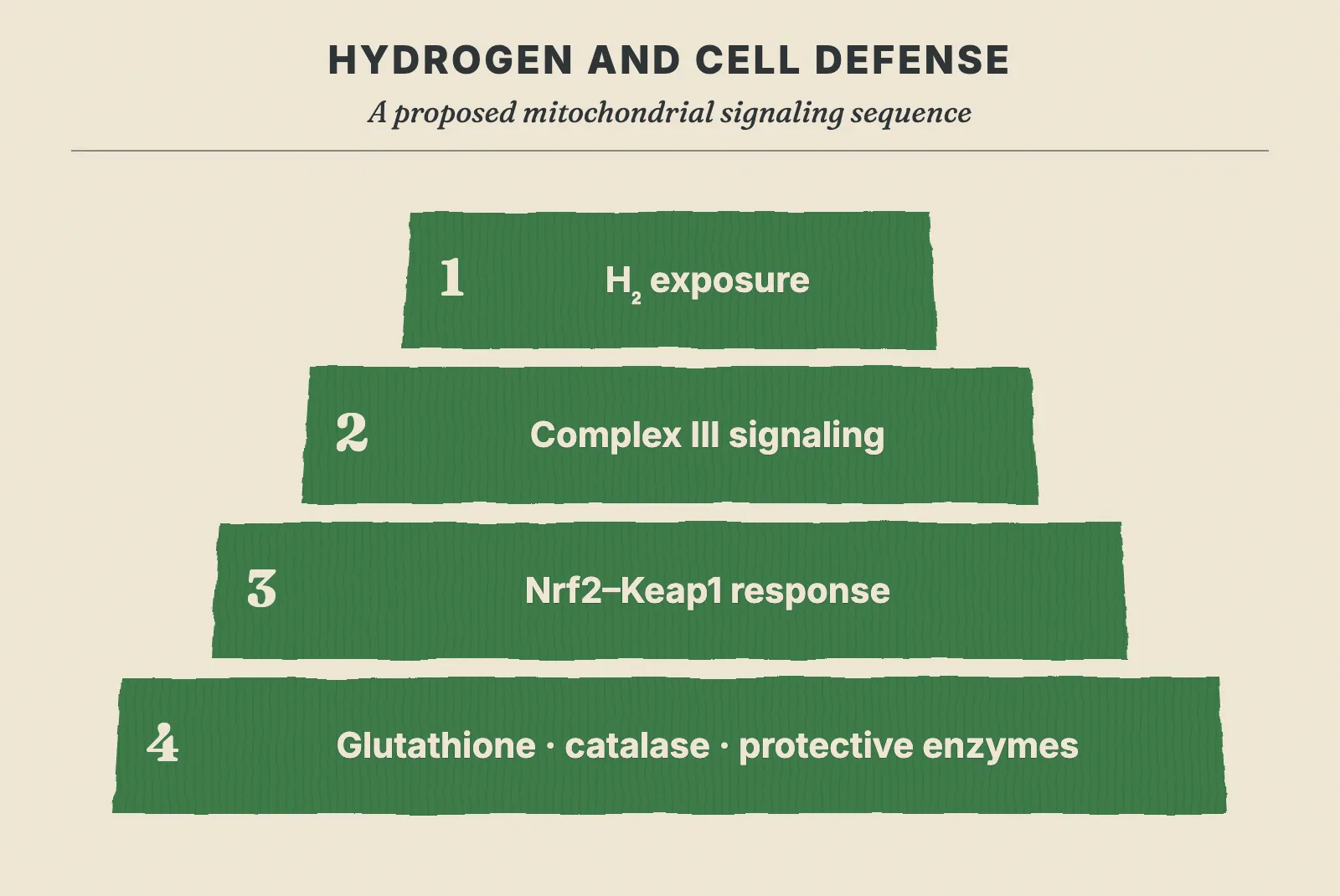
Proposed hydrogen-induced mitochondrial signaling sequence based on the Molecular Hydrogen Institute's 2026 discussion. The mechanism remains under study; this diagram does not demonstrate a clinical treatment benefit.
The practical version: hydrogen doesn't neutralize free radicals directly so much as it tells your cells to build more of their own defenses. And it's selective about it. It goes after the hydroxyl radical, the most damaging one, while leaving the reactive oxygen species your body actually needs for cell signaling alone (MHI 2026).
The study that started this whole field was published in Nature Medicine in 2007. Ikuroh Ohsawa and his team at Nippon Medical School gave rats 2% to 4% hydrogen gas after inducing a stroke, and it markedly reduced the size of the resulting brain injury (Ohsawa et al. 2007). That single paper is why hydrogen research exists today.
Most disease runs through a handful of the same pathways, inflammation, molecular signaling, and metabolic function. Fat storage is part of that metabolic picture too. Hydrogen's mechanism touches all of those pathways, which is likely why it shows up as beneficial across so many different disease models in the research rather than one narrow condition (Ohsawa et al. 2007; MHI 2026). These all point back to the mitochondria once again. Our mitochondria fail as we age, and restoring them takes real, sustained effort on our part.
How much hydrogen, and for how long
If you inhale hydrogen, the number that actually matters is FiH2, the fraction of hydrogen you're actually breathing into your lungs. It isn't the same thing as whatever concentration a machine claims to produce. MHI's guidance puts the floor for a biological effect around 1% FiH2, with most clinical protocols running 2% to 4% (MHI 2026). Go higher than that and you start running into flammability risk, which is why no responsible device does.
Tissue levels take roughly 20 to 30 minutes to approach equilibrium once you start breathing it (MHI 2026). I tell people to start there, at 15 to 20 minutes, and build up from that as they tolerate it. Some of the more striking anecdotal reports I've come across involve sessions much longer than that, hours at a stretch, and some people even sleep with the gas delivered through a nasal cannula overnight. I'm just beginning to try that myself.
There isn't a settled toxicity ceiling here. Hydrogen doesn't build up in the body over time, and it's been used at far higher concentrations than any therapeutic device produces, in deep-sea diving gas mixtures since the 1940s, with no documented chronic toxicity (MHI 2026).
I want to be straight with you here instead of selling you something. MHI counts roughly 3,000 peer-reviewed articles on molecular hydrogen and about 1,600 researchers working in the field. Only around 140 of those are human clinical trials, and most are small and preliminary (MHI 2026). It’s the same pattern we’ve discussed many a time. The mechanism is real, there’s a strong safety record, but the human trial base isn't sufficient to back a specific disease claim in people.
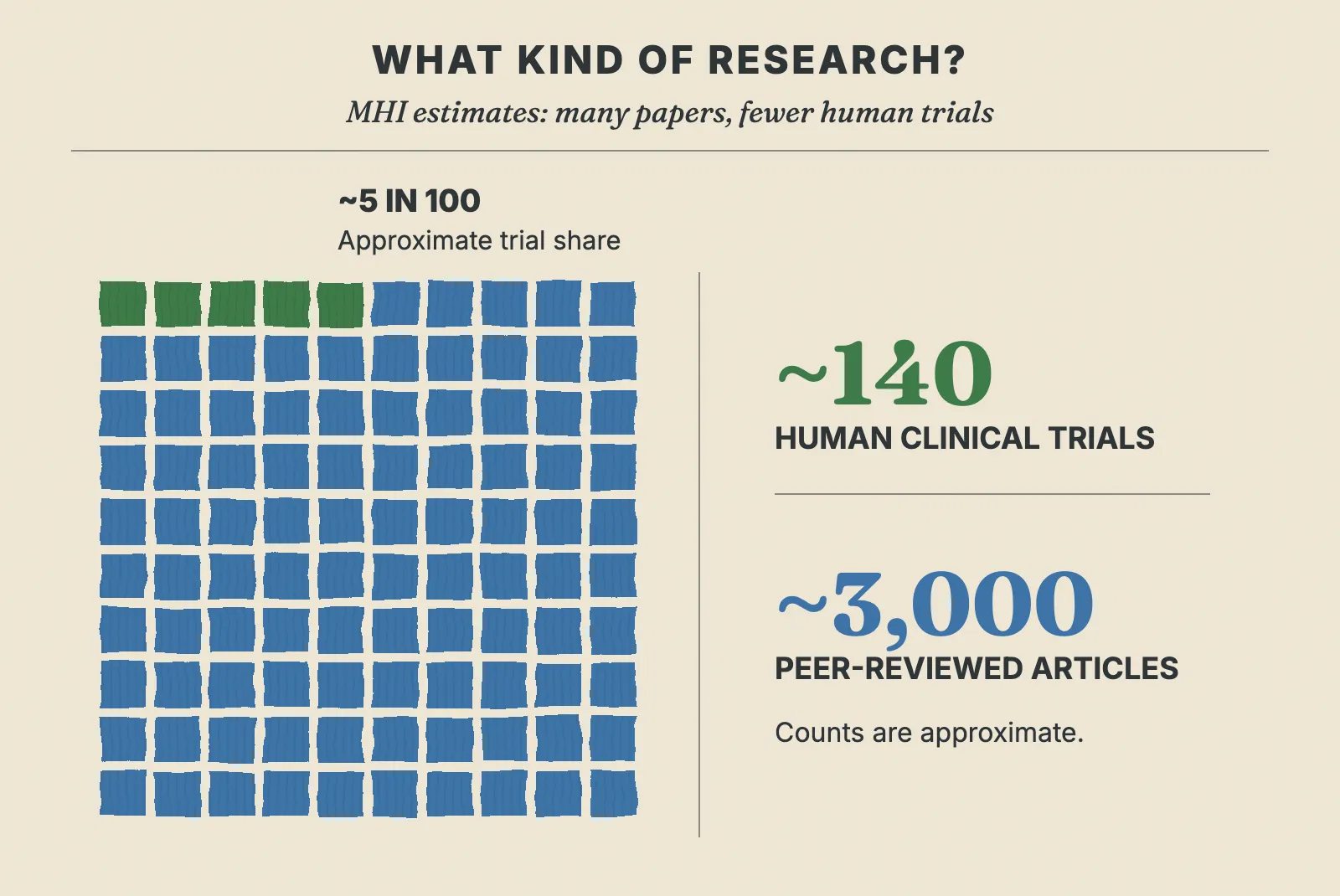
Approximate research mix from the Molecular Hydrogen Institute's reported 2026 counts: roughly 140 human trials among about 3,000 peer-reviewed articles. Five shaded squares out of 100 represent a rounded estimate; publication counts alone do not establish treatment efficacy.
Should you buy one?
Hydrogen water gets pushed hard right now, tablets you drop in a glass, bottles, countertop machines that infuse it into your drinking water. If a $5,500 inhalation unit isn't in reach, the Echo unit is a reasonable water-based option. But keep the math straight. Water only dissolves a maximum of about 1.6 ppm of hydrogen at normal pressure, no matter what the label promises (MHI 2026). Drinking that gets you a fraction of what an inhalation device delivers straight to your lungs. Hydrogen tablets dropped in a glass of water land in the same place. None of it comes close to the doses used in the Japanese inhalation studies.
If this article helped you, please share it. Your shares help keep Sage Matters free, and I only ask you to share it if you genuinely found it useful.
So to answer the question, you should probably not buy one at $5,500, and I understand that. That price puts a personal hydrogen machine out of reach for almost everyone reading this. I've said before that getting the real benefit out of the tools that actually work usually takes an investment. Not always money you have sitting around right now. Sometimes it means putting something on your wish list and waiting until you can do it right instead of doing it cheap.
One thing I have found that I didn’t expect is that my sleep scores have improved. I’ve talked about all the benefits of hydrogen. One beauty of the machine that Kash designed is that he spent more money to add an oxygen membrane. One side of the machine puts out hydrogen. The other side puts out oxygen. I have those two outputs connected and going to a nasal cannula that I sleep with. It may be the addition of the oxygen that has made my sleep better? It could be the benefits of the hydrogen. I'm happy with anything that gives me better and more restorative sleep.
The one I continue to have on my own list is a hyperbaric oxygen chamber. I decided a while back on a hard shell unit, one where I can sit up, with a large window so I can actually look out while I'm in it. Bryan Johnson has said it's the single tool he believes made the biggest difference in his longevity work. The catch is pressure. The units around $10,000 don't get you enough atmospheric pressure to do much good, and a unit that actually delivers runs upward of $50,000. I have a plan to cover that once I sell a property.
If hydrogen inhalation interests you and $5,500 isn't in the picture, that's fine. Put it on the list.
Ready to start restoring your health?
The membership is $300 a month, month to month. You get a written plan, teaching, and coaching. Sage does not diagnose you or give you a personal medical reading.
See the membershipReferences3
- Ohsawa, I., Ishikawa, M., Takahashi, K., et al. (2007). Hydrogen acts as a therapeutic antioxidant by selectively reducing cytotoxic oxygen radicals. Nature Medicine, 13(6), 688-694.
- Molecular Hydrogen Institute. (2026). Hydrogen: An Emerging Medical Gas. molecularhydrogeninstitute.org (http://molecularhydrogeninstitute.org/).
- Molecular Hydrogen Institute. (2026). The Complete Guide to Molecular Hydrogen Therapy. molecularhydrogeninstitute.org (http://molecularhydrogeninstitute.org/).
More from Sage Matters

What decades of emergency medicine already knew about carbon dioxide
What decades of emergency medicine taught me about carbon dioxide
READ ARTICLE
Can Hyperbaric Oxygen Really Reverse Aging?
READ ARTICLE
The Sauna Question
Why Heat Keeps Showing Up in Longevity Research
READ ARTICLE
Someone Is Selling You a Secret. The Real Science Lives Somewhere Else.
What the research actually says about 40 Hz gamma stimulation, BDNF, brain fog, and Alzheimer's.
READ ARTICLE