
Introduction
Dr. Boris Veysman, an emergency physician at Robert Wood Johnson University Hospital, once wrote up a resuscitation from his own shift. A pale, gray woman comes in not breathing. Her monitor shows a flat line. He calls for a tube and starts compressions, and then he reaches past the defibrillator and the adrenaline for something else, two amps of bicarbonate, pushed through a line into her jugular vein, to correct the extreme acidity in her blood before anything else stood a chance of working.
I spent several decades of my life in the emergency rooms of various hospitals, and bicarbonate was never far from the crash cart. I gave it plenty of times. I never spent much time asking why it worked the way it did.
Bicarbonate and carbon dioxide are two forms of the same chemistry in your blood. When one rises, the other tends to rise with it. A few weeks ago I wrote about Steve Scott's breathing device and the Bohr effect, the mechanism that lets your hemoglobin release the oxygen it's carrying. That piece covered a device and a breathing pattern. This one goes further, into what CO2 and bicarbonate actually do to your heart and your blood vessels once they're in your bloodstream. Some of it, it turns out, medicine has known for a very long time.

Doctors have been dialing up CO2 on purpose for decades
In critical care, there's a practice called permissive hypercapnia. When a patient is on a ventilator, doctors sometimes let their blood CO2 run higher than normal instead of correcting it down to a textbook number. The reasoning is that pushing hard to keep CO2 low usually means bigger, more forceful ventilator breaths, and those breaths can injure already-damaged lungs.
A 2007 study on rabbits shows part of why this works. Researchers raised the animals' blood CO2 in steps, from a low of about 20 mm Hg up past 250. As CO2 climbed from 20 to 80, the blood vessels in the tissue dilated, blood flow sped up, and cardiac output ticked up with it. Past 100 mm Hg, those same measurements started falling. Past 150, they were worse than where the animals started. The researchers landed on 150 mm Hg as the ceiling, the point past which raising CO2 further stops helping the peripheral circulation and starts hurting it (Critical Care Medicine, 2007).
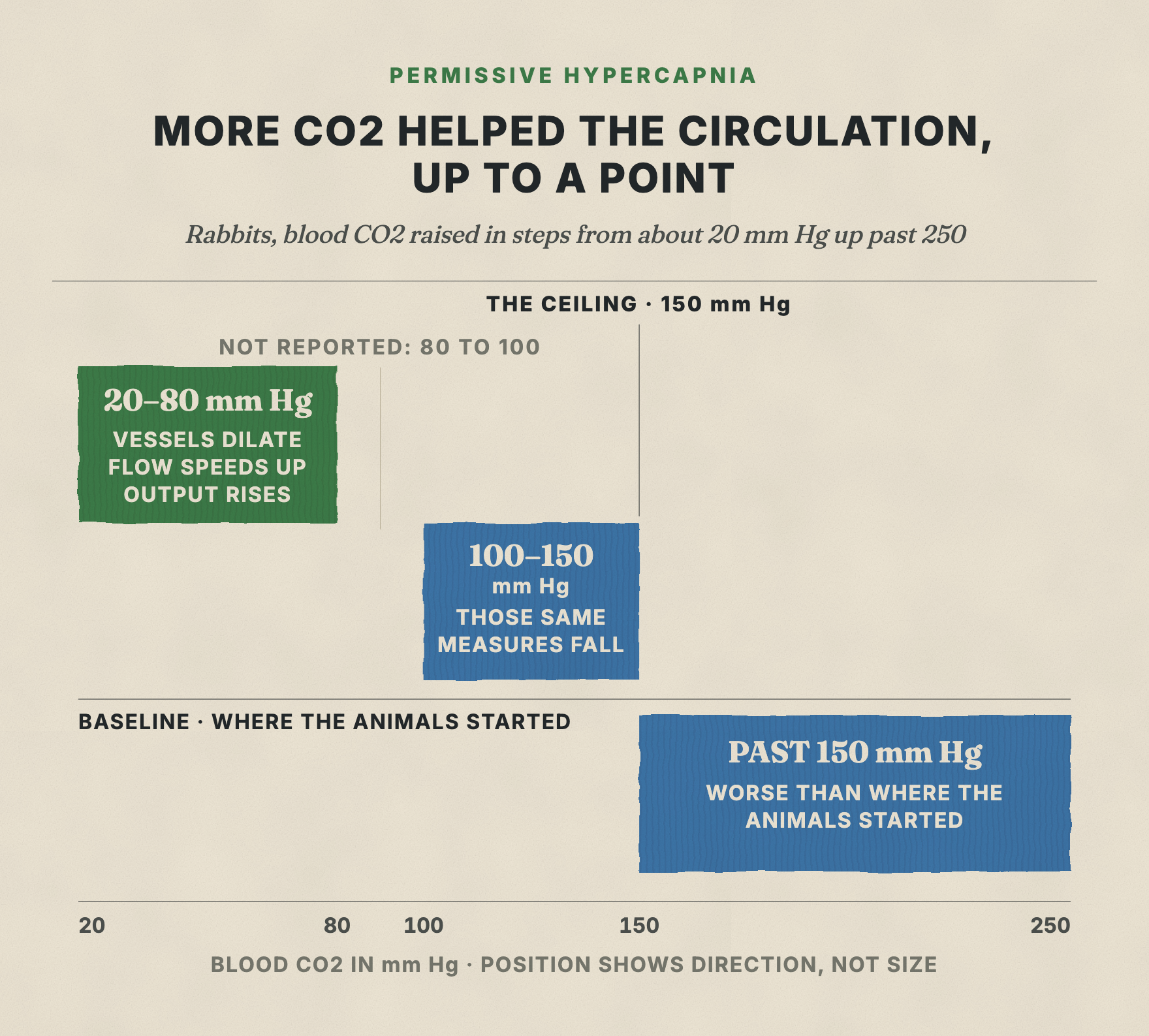
Permissive hypercapnia in rabbits. Blood CO2 raised in steps from about 20 mm Hg past 250. Critical Care Medicine, 2007. An ICU finding in animals, not a human result.
That's the detail I want you to sit with. CO2 isn't just a waste gas your lungs get rid of. Inside a range, more of it dilates blood vessels and moves more blood. Outside that range, it doesn't. Dose matters, the same as with any drug.
A century of blowing CO2 at damaged hearts
Long before ventilators, physicians were using carbon dioxide baths, called balneotherapy, to treat vascular disease. The practice goes back to the Middle Ages. CO2 dissolves easily into the water-based and fatty layers of skin, and once it's in there, it diffuses down into the small blood vessels underneath and dilates them. That's the entire mechanism behind soaking in a CO2 bath for circulation problems, and doctors were using it long before anyone could explain why in a lab.
By 1940, physiologist Y. Henderson was writing in the Encyclopedia of Medicine that carbon dioxide is "truly the breath of life." He argued that CO2 deficiency could trigger heart trouble and circulatory collapse after major surgery or long anesthesia, an idea that ran against the era's fixation on oxygen alone. Henderson's group also tried something more targeted. Patients with angina, chest pain from a heart not getting enough blood, breathed carbon dioxide for 10 to 15 minutes, 2 or 3 times a day, as an ongoing therapy rather than an emergency treatment.
Carbogen, a mix of oxygen and carbon dioxide first described by Ladislas Meduna, has its own narrower medical history. A blend of 95% oxygen and 5% carbon dioxide has been used as an emergency treatment for central retinal artery occlusion, a sudden blockage of blood flow to the eye, and it's been proposed for sudden hearing loss tied to a spasm in the artery that feeds the inner ear. In both cases the goal is the same one Henderson was chasing with angina patients: get more blood moving through a vessel that's suddenly not carrying enough.
What carbogen does to a hardening artery
The most specific finding I came across involves atherosclerosis, the plaque buildup that narrows arteries and eventually ruptures into a heart attack or stroke. Researchers already knew that advanced plaques run low on oxygen inside, a state called hypoxia, and that hypoxia tends to drive inflammation and cell death. So a research team tested what happens when mice with advanced plaques breathe carbogen instead of room air.
Carbogen raised the mice's arterial oxygen levels roughly fivefold and cut plaque hypoxia by 32% in one part of the aorta and by as much as 84% in another. The necrotic core, the dead tissue at the center of a plaque that makes it prone to rupture, shrank by 37%, and the count of dying cells inside the plaque dropped by half. Efferocytosis, the process by which immune cells clear away that dead cellular debris, went up by more than a third (Arteriosclerosis, Thrombosis, and Vascular Biology, 2014).
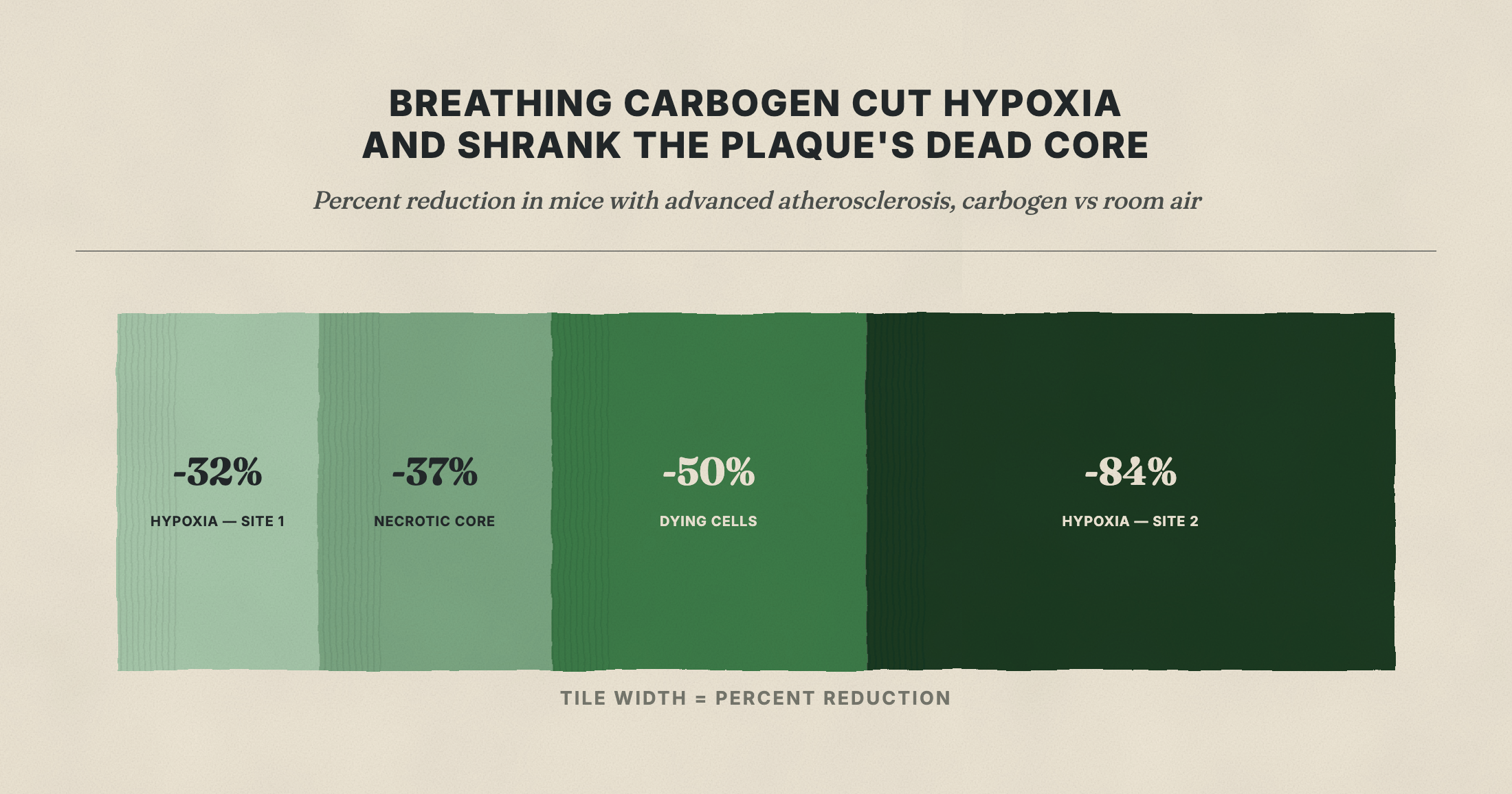
This was a mouse study, not a human trial, and I want to be straight about that. Nobody has shown yet that a person breathing carbogen for an hour a week shrinks their own plaque. But the mechanism is specific and it's measurable. Whether it holds up in people is the real question, and nobody has answered it yet.
The acid your body can't get rid of
Dr. Lynda Frassetto at the University of California, San Francisco, has described aging partly as a bicarbonate problem. Your body produces acid as a normal byproduct of metabolism, and bicarbonate is what neutralizes and clears it. When your bicarbonate reserves run low, that acid builds up as waste products, some of which show up in bloodwork as cholesterol, uric acid, sulfate, and the makings of kidney stones. Frassetto points out that 45 is roughly the average age people start showing the first signs of diabetes, hypertension, osteoporosis, and other degenerative disease, right around when that acid-clearing capacity starts to slip.
If this article helped you, please share it. Your shares help keep Sage Matters free, and I only ask you to share it if you genuinely found it useful.
I can't tell you that raising your CO2 or bicarbonate reverses that clock. Nobody has run that trial. What I can tell you is that the chemistry Veysman used to restart a dying heart and the chemistry Frassetto is describing in aging bodies are the same chemistry, just at different doses and different speeds.
One more piece, smaller and worth mentioning honestly. A brief report published in BMJ Nutrition, Prevention & Health in early 2025 proposed that the CO2 in sparkling water, once it crosses into your blood through the stomach lining, gets converted to bicarbonate inside red blood cells and may speed up glucose uptake and breakdown there. The authors called this a hypothesis built on existing physiology, not the result of a human trial. It's an interesting thread, not a finding you should act on yet (BMJ Nutrition, Prevention & Health, 2025).
Where that leaves you
None of this replaces what your cardiologist is already doing for you. Permissive hypercapnia belongs in an ICU, run by people watching a monitor, not something to try at home. Carbogen for atherosclerosis is still a mouse finding. The sparkling water study is a hypothesis, not a treatment.
What it does tell me is that carbon dioxide was never just the leftover gas we breathe out. It shows up on the crash cart, in century-old angina treatments, in a modern mouse lab studying plaque, and possibly in a can of seltzer.
I own a CO2 machine myself. I'm not telling you to buy one. For me, the downside is low, and it comes with safety precautions built in. The protocol has you start low, at just a few percent, and work up toward 5% to 8%. I breathe on mine for 5 to 10 minutes, several times a day. It's stimulating more than it is relaxing. I've always liked sparkling and carbonated water too, and now I know it may be doing something good for me as well.
References8
- Permissive range of hypercapnia for improved peripheral microcirculation and cardiac output in rabbits. Crit Care Med. 2007 Sep;35(9):2171-5.
- Percutaneous Carbon Dioxide Gas Mist Treatment Improves Cardiac Function after Myocardial Infarction in Rats via Nitric Oxide Activity. Circulation, vol. 126.
- In open heart surgery, is there a role in using carbon dioxide field flooding techniques to reduce post-operative gaseous emboli? Interactive CardioVascular and Thoracic Surgery. 2004 Dec;3(4):599-602.
- Relationship of carbon dioxide tension in arterial blood to pulmonary wedge pressure in heart failure. European Respiratory Journal. 2002;19(1):37-40.
- Reversal of Hypoxia in Murine Atherosclerosis Prevents Necrotic Core Expansion by Enhancing Efferocytosis. Arteriosclerosis, Thrombosis, and Vascular Biology. 2014;34(12):2545-2553.
- Carbogen in the management of central retinal artery occlusion (clinical literature, ophthalmology).
- BMJ Nutrition, Prevention & Health. Brief report on carbonated water, bicarbonate conversion, and glucose metabolism, published online January 2025.
- CO2 balneotherapy in cardiovascular disease: review of European studies (International Journal of Biometeorology, DOI 10.1007/s00484-010-0380-7).
More from Sage Matters

Hydrogen gas has amazing research on its benefits
Amazing hydrogen gas
READ ARTICLE
Can Hyperbaric Oxygen Really Reverse Aging?
READ ARTICLE
The Sauna Question
Why Heat Keeps Showing Up in Longevity Research
READ ARTICLE
Someone Is Selling You a Secret. The Real Science Lives Somewhere Else.
What the research actually says about 40 Hz gamma stimulation, BDNF, brain fog, and Alzheimer's.
READ ARTICLE