
Introduction
A person steps onto a platform, glides into a shallow gold-lit pool, and descends through a ring of roughly half a million underwater ultrasonic sensors. About sixty seconds later, the machine has imaged their muscle, fat, bone, and organs, running more than two petaflops of compute, a measure of how many calculations a system runs per second, with no radiation and no magnets (Butterfly Network 2026; The Verge 2026).
The company behind it built its name generating pictures from text prompts. On June 18, 2026, Midjourney announced a new health division, Midjourney Medical, and this, its first hardware product ever, a whole-body scanner it calls the Midjourney Scanner, or "Ultrasonic CT" (The Verge 2026; Forbes 2026). The licensing deal for the chip technology inside the scanner had been signed just seven months earlier (Investing.com (http://investing.com/) 2026). The lease on the building where it will live was signed four days after the announcement (The Real Deal 2026). Whatever else you make of this company, it does not sit still.

From hand tracking to picture making to body scanning
The founder's path here is worth knowing, because it explains why this exists at all.
David Holz co-founded Leap Motion in 2010, a hand-tracking and gesture-control company, and spent twelve years as its CTO before the company sold to Ultrahaptics in 2019 (Aituts; Crunchbase). Before that, he studied math and physics at UNC Chapel Hill. He also contracted for NASA's Langley Research Center and did neuroscience research at the Max Planck Institute (Aituts). After the Leap Motion years, he found a Cornell paper on diffusion models, the math behind turning noise into images, and started Midjourney as an independent research lab in San Francisco in August 2021 (Forbes 2022). The public tool launched in July 2022, and Holz told a reporter a month later that the company was already profitable (Forbes 2022).
I've built and sold companies myself. The founders worth watching are usually the ones who keep reading outside their own field long after they've made it, then act on what they find. Holz did that twice. Once with hand tracking, once with diffusion models, and now, apparently, with medical imaging.
How the scanner actually works
The hardware behind the scanner belongs to Butterfly Network, a Connecticut company trading under the ticker BFLY, that built Ultrasound-on-Chip technology, putting thousands of ultrasound transducer elements directly onto a semiconductor chip instead of the individual crystals a traditional ultrasound probe uses (Butterfly Network technology page; MedTech Dive 2026). In November 2025, Butterfly signed a licensing deal giving Midjourney access to that chip technology, worth up to $74 million to Butterfly over five years (Investing.com (http://investing.com/) 2026). The current prototype packs 40 of Butterfly's chip modules into the scanner, with later versions expected to use substantially more (Butterfly Network 2026).
CEO Holz says the imaging can rival MRI in some respects, though right now the machine produces body composition maps, meaning muscle, fat, bone, and organ volume, rather than diagnosing disease (The Verge 2026). A radiologist writing for Forbes and a reporter at The Verge both called the technology genuinely new but still an early prototype. Only about a dozen people had been scanned by the time the company announced it (Forbes 2026; The Verge 2026).

Sixty seconds is Midjourney's claim, not an independently measured result.
The regulatory workaround
This is the part that matters if you're deciding whether to trust any of this.
The Midjourney Scanner has no FDA clearance for diagnosing anything (Let's Data Science 2026). Instead of waiting years for that clearance, the company is launching under the FDA's General Wellness policy, a guidance that exempts low-risk products from full medical device regulation as long as they promote a healthy lifestyle and don't make disease-related claims (FDA guidance). That guidance was broadened in January 2026, which observers say helped clear the runway for a launch like this one (Kirk Sudheimer). By calling the output "body composition maps" instead of diagnoses, Midjourney sits in the same regulatory lane already used by consumer whole-body MRI services like Prenuvo and Ezra (David Borish, LinkedIn).
The company says it will submit results to the FDA over time and is targeting its third generation of hardware, expected around 2028, for an actual clearance push (Creeta 2026; Kirk Sudheimer). Butterfly's own press release was blunt that expanded approval "may not arrive on the anticipated timeline or at all" (Creeta 2026). The underlying chip itself isn't new to the FDA. Butterfly's core technology got its first clearance in 2017, and the current handheld device was cleared again in January 2024 (Stuart Miller, LinkedIn). What's unproven is this specific machine, doing this specific job, at this specific scale.
There are also questions the FDA doesn't touch. There's no billing code yet for elective whole-body screening of people with no symptoms, and it isn't clear whether a wellness-classified scanner counts as a HIPAA-covered entity, meaning it would have to follow federal health-privacy law, or falls under a patchwork of state privacy laws instead (Stuart Miller, LinkedIn).
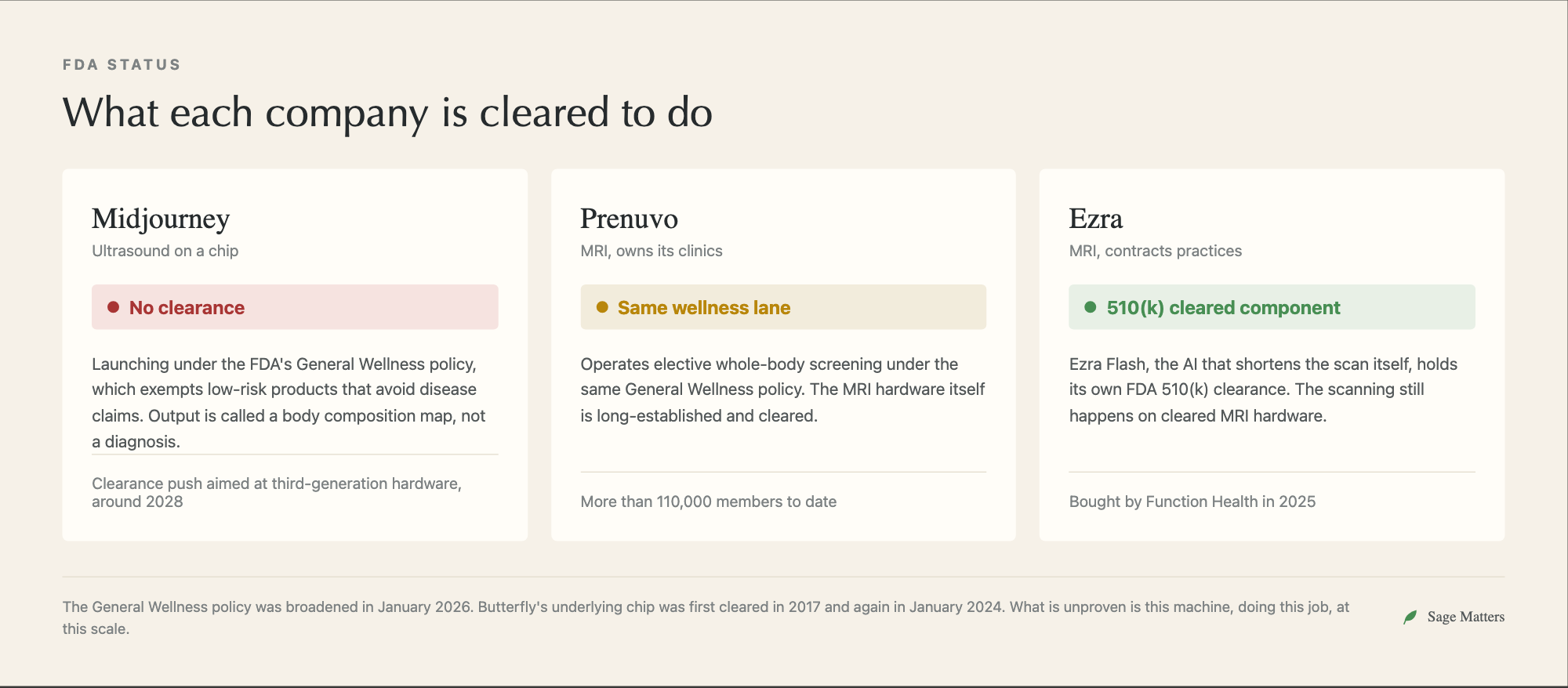
Cleared means the FDA has reviewed a device for a specific use. None of the three is cleared to diagnose disease from a whole-body scan.
How it stacks up against Prenuvo and Ezra
Midjourney isn't inventing the whole-body scan business. Two venture-backed companies already sell it, both built on MRI instead of ultrasound.
Prenuvo runs its own clinics, roughly 17 to 24 of them across North America with more opening in Europe and Australia, and charges $999 to $4,499 per scan depending on the tier (USA Today 2026; Prenuvo pricing). Ezra took a different route. It doesn't own imaging centers. It contracts with 70 to 100 existing radiology practices and prices scans from $499 to $999, cheaper because an FDA-cleared AI tool called Ezra Flash speeds up the MRI itself (Ezra 2025; PR Newswire 2025). Function Health bought Ezra in 2025 and has since raised $298 million at a $2.5 billion valuation (a16z 2025).
If this article helped you, please share it. Your shares help keep Sage Matters free, and I only ask you to share it if you genuinely found it useful.
Midjourney's ultrasound approach, if it holds up, could eventually undercut both on cost. No shielded room, no cryogenics, a sixty-second claimed scan time against twenty to seventy-five minutes for the MRI-based competitors (Prenuvo pricing; Ezra pricing). But it's starting years behind on the two things that actually matter for a medical product, regulatory clearance and a track record. Prenuvo has more than 110,000 members and roughly $100 million in revenue. Ezra's parent company reports over 300,000 members. Midjourney had scanned about a dozen people as of its announcement (Healthy Guru; Sacra; Forbes 2026).
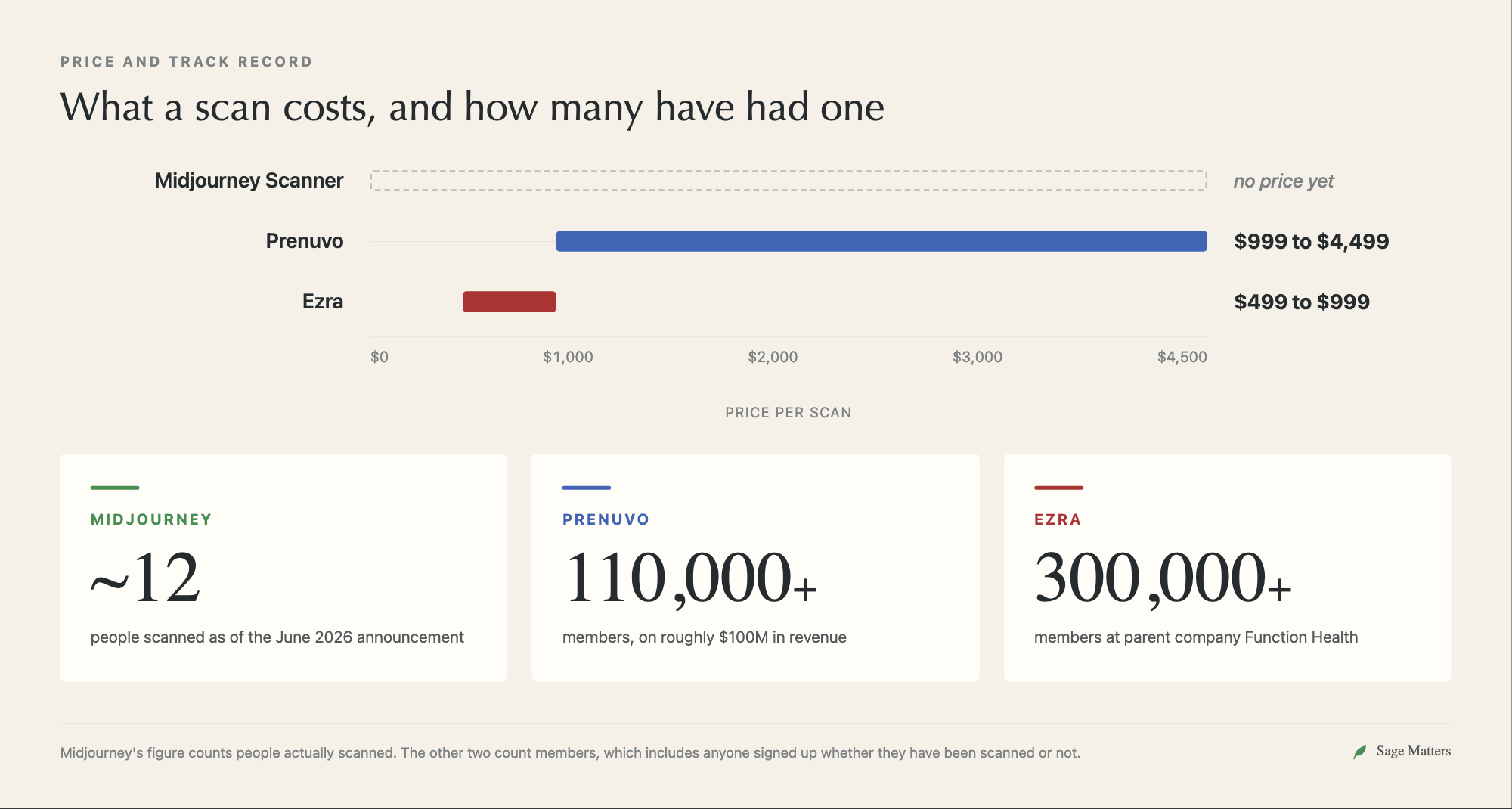
Midjourney has not announced a price. Its count is people scanned; the other two are members, which includes anyone signed up.
Where this is headed
Midjourney's rollout plan for these scanners is a spa. The company leased roughly 23,000 square feet across four floors at 300 Grant Avenue in San Francisco, describing a gold-colored bathhouse with saunas, cold plunges, and ten scanning rooms with hot tubs, targeting an end-of-2027 opening (The Real Deal 2026; New Atlas 2026). It says it wants 50,000 scanners deployed globally eventually, and it's paying for all of this itself out of more than $200 million a year in image-generation subscription revenue, no outside investors (The Hustle 2026).
That's an unusual way to fund a medical device company, and an unusual way to launch one.
There's also a practical reason to pay attention to this one. Prenuvo and Ezra both put you inside a machine wrapped in a magnetic field strong enough to require a shielded room and constant cryogenic cooling, which rules out anyone with certain pacemakers, aneurysm clips, or other metal implants, and leaves some people simply uneasy about that kind of exposure. Midjourney's scanner uses sound waves in a pool of water instead, no magnet, no shielding, no coil. That alone makes it worth following even before this machine has a diagnostic track record.
Whether an unproven ultrasound scanner wrapped in a spa experience is worth your attention before it has FDA clearance, or worth waiting on until it does, isn't something I can decide for you. Prenuvo and Ezra already have the clinical track record. Midjourney is betting it can build the technology and the trust at the same time. You decide which bet you'd rather watch play out first.
References28
- The Verge. "Midjourney Medical announcement." 2026. https://www.theverge.com/ai-artificial-intelligence/952011/midjourney-medical-ai-ultrasound-scan
- The Verge. "Behind-the-scenes follow-up." 2026. https://www.theverge.com/ai-artificial-intelligence/961265/midjourney-medical-ultrasound-scanner-behind-the-scenes-video
- Butterfly Network. Press release on the Midjourney partnership. 2026. https://www.butterflynetwork.com/press-releases/midjourney-scanner-ultrasound-chip
- Butterfly Network. Ultrasound-on-Chip technology page. https://www.butterflynetwork.com/technology
- MedTech Dive. "With ultrasound-on-a-chip, Butterfly Network aims for global reach." 2026. https://www.medtechdive.com/news/with-ultrasound-on-a-chip-butterfly-network-aims-for-global-reach/818119/
- Investing.com (http://investing.com/). "Butterfly Network enters licensing agreement with Midjourney." 2026. https://www.investing.com/news/sec-filings/butterfly-network-enters-licensing-agreement-with-midjourney-for-ultrasound-technology-93CH-4364619
- Forbes. "Midjourney's move into medicine is a bet on data, not doctors." 2026. https://www.forbes.com/sites/gabrielalinzainescu/2026/06/19/midjourneys-move-into-medicine-is-a-bet-on-data-not-doctors/
- Forbes. "Midjourney's whole-body ultrasound system, a radiologist's thoughts." 2026. https://www.forbes.com/sites/paulhsieh/2026/06/30/midjourneys-whole-body-ultrasound-system-a-radiologists-thoughts/
- The Real Deal. "Midjourney health-scanning startup leases at Union Square." 2026. https://therealdeal.com/san-francisco/2026/06/22/midjourney-health-scanning-startup-leases-at-union-square/
- New Atlas. "Midjourney full-body scan spa." 2026. https://newatlas.com/medical-ai/midjourney-full-body-scan-spa-ai/
- The Hustle. "Take a dip at the Midjourney spa." 2026. https://thehustle.co/news/take-a-dip-at-the-midjourney-spa
- FDA. General Wellness: Policy for Low Risk Devices. https://www.fda.gov/regulatory-information/search-fda-guidance-documents/general-wellness-policy-low-risk-devices
- Let's Data Science. "Midjourney unveils full-body ultrasonic scan spa." 2026. https://letsdatascience.com/news/midjourney-unveils-full-body-ultrasonic-scan-spa-cd947611
- Creeta. "Midjourney Medical USCT body scanner." 2026. https://news.creeta.com/en/midjourney-medical-usct-body-scanner-2026/
- Kirk Sudheimer. "The regulatory strategy is the GTM." Substack. https://commcat.substack.com/p/the-regulatory-strategy-is-the-gtm
- David Borish. "Midjourney's pivot to medicine." LinkedIn. https://www.linkedin.com/pulse/midjourneys-pivot-medicine-most-surprising-ai-year-david-borish-lj7nc
- Stuart Miller. "Midjourney AI image-generation company just announced." LinkedIn. https://www.linkedin.com/pulse/midjourney-ai-image-generation-company-just-announced-stuart-miller-e2ujc
- USA Today. "Prenuvo expands full-body MRI and bloodwork labs." 2026. https://www.usatoday.com/story/life/health-wellness/2026/03/23/prenuvo-expands-full-body-mri-bloodwork-labs/89042666007/
- Prenuvo pricing page. https://www.prenuvo.com/pricing
- Ezra pricing page. https://ezra.com/pricing
- Ezra. "Ezra obtains new FDA 510(k) clearance for Ezra Flash AI." 2025. https://ezra.com/en-gb/blog/ezra-obtains-new-fda-510-k-clearance-for-ezra-flash-ai-making-full-body-mris-more-accessible
- PR Newswire. "Function Health acquires Ezra, introduces $499 full-body MRI scan." 2025. https://www.prnewswire.com/news-releases/function-health-acquires-ezra-introduces-499-full-body-mri-scan-302446016.html
- a16z. "Function Health Series B announcement." 2025. https://a16z.com/announcement/function-health-series-b/
- Healthy Guru. "Prenuvo MRI review." https://healthyguru.com/prenuvo-mri-review/
- Sacra. "Function Health revenue, valuation and funding." https://sacra.com/c/function-health/
- Aituts. "David Holz, biography, Midjourney founder and CEO." https://aituts.com/david-holz/
- Crunchbase. David Holz person profile. https://www.crunchbase.com/person/david-holz
- Forbes. "Midjourney founder David Holz on the impact of AI on art, imagination and the creative economy." September 2022. https://www.forbes.com/sites/robsalkowitz/2022/09/16/midjourney-founder-david-holz-on-the-impact-of-ai-on-art-imagination-and-the-creative-economy/
More from Sage Matters

The tragedy of one germ, one disease, one drug
In 1876 the German scientist Robert Koch showed that a specific bacterium, Bacillus anthracis, causes anthrax (Koch 1876).
READ ARTICLE
Need to be seen
Why access to care has become a strategy game
READ ARTICLE
Think Twice - Second Opinion
Why you should ask for a second opinion
READ ARTICLE
Are medical terms deliberately misleading?
Recent vaccine policy changes show how confusing medical language can be
READ ARTICLE