
Introduction
In 1876 the German scientist Robert Koch showed that a specific bacterium, Bacillus anthracis, causes anthrax (Koch 1876). Conventional medicine remains rooted in germ theory, whose postulates grew out of that research. It became a rigid principle of one germ, one disease, one drug, and I think it still dominates clinical practice.
I believe the modern medical literature has been heavily funded and steered by pharmaceutical companies that develop drugs for isolated disease states. That approach looks for a single cause and a single drug, and it overlooks how many things drive chronic illness at once.
Many of the best approaches are changes in lifestyle. When a disease shows up, we need to work on every strand of the web, and we need the choir to sing in harmony. The mind affects our health, and I believe the spirit directs and drives us.
The web in functional medicine
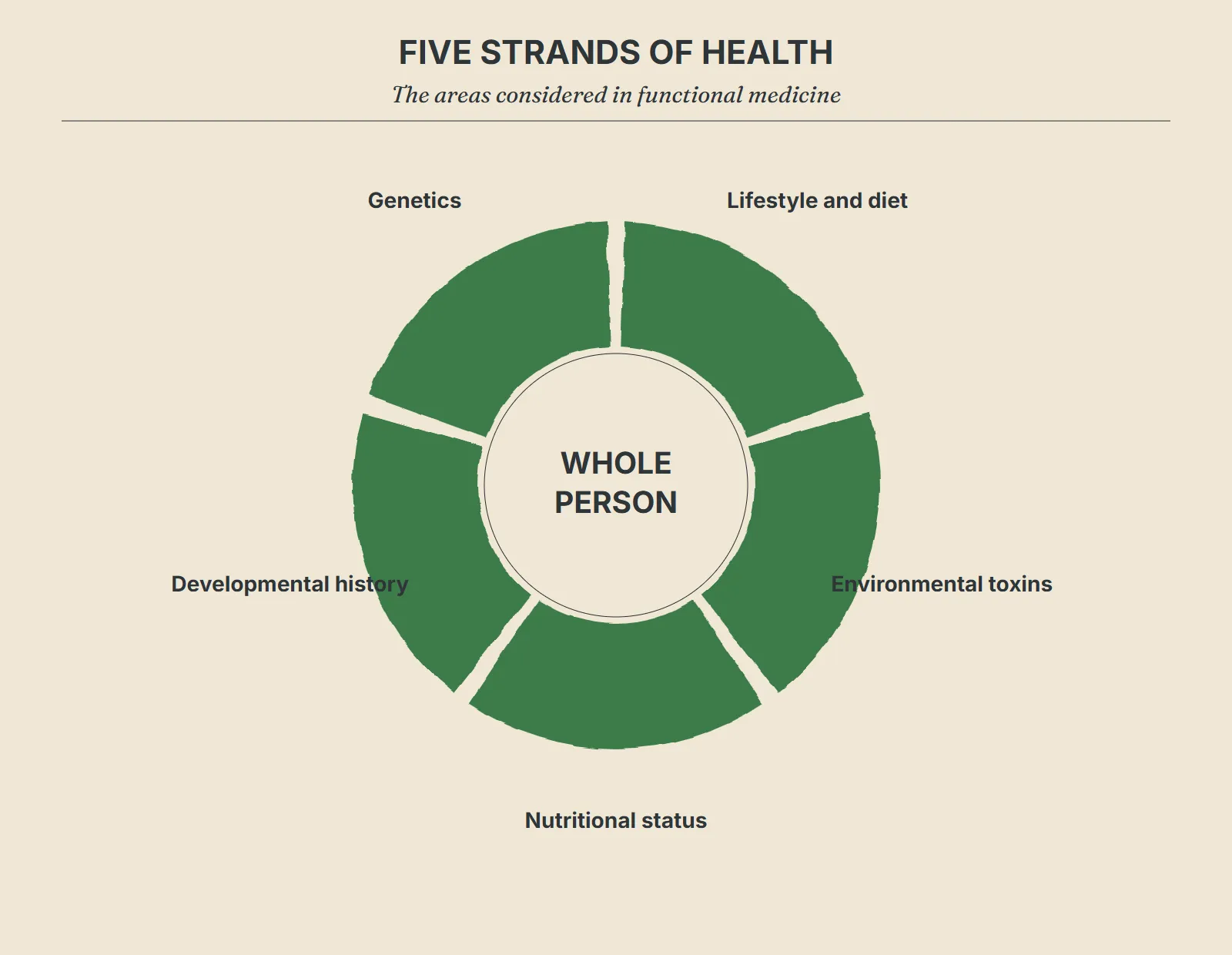
Five strands described in the functional medicine approach. This is a conceptual map, not a measurement of their relative influence.
As many of you know, I trained and certified as a functional medicine practitioner through the Institute of Functional Medicine (IFM). The training focused on taking a detailed history, doing an exam, and ordering laboratory evaluation. One of our tools was the web. Health works as an interconnected web, and pulling on a single strand affects the whole system. This is what the IFM training taught us to examine.
Genetics. A person's baseline blueprint comes from both parents, a mix of dominant and recessive genes that sets physical traits and disease risk. High-penetrance genes readily show up in the body's physical traits. Low-penetrance genes depend heavily on epigenetic influences (outside factors that change how a gene is expressed) and on the environment.
Lifestyle and diet. Diet quality and daily habits can switch low-penetrance genes on or off, so lifestyle and clinical care can strengthen helpful traits and suppress harmful ones.
Environmental toxins. Toxic substances can damage gene expression, detoxification, and other pathways.
Nutritional and mineral status. Minerals regulate the body's physiological pathways, and deficiencies keep those pathways from working at their best.
Developmental history. We evaluate the mother's pregnancy term, prenatal nutrition, early toxic exposures, and physiological insults.
Richard Horowitz and the 16-point MSIDS map
I want to introduce you to Richard Horowitz, MD, author of Ending Chronic Illness (Horowitz 2026a). I think he has put together the most promising model for approaching chronic illness and disease. The book is a text so detailed that I believe it will become a manual for those working in functional medicine.
Horowitz trained as an internal medicine physician. He opened his practice in a remote, rural part of upstate New York because he wanted to live close to nature. The area turned out to be one of the highest endemic areas for Lyme disease, a tick-borne infection, so he saw many patients with it. He began by referring them to infectious disease specialists and others. Over time he realized those patients weren't getting answers that made any difference to their symptoms, and he had to dive in and understand Lyme disease himself. Over many years he developed effective ways to treat Lyme disease.
He came to understand that the functional medicine model works best for these patients. In recent years he discovered that many chronic illnesses carry the same markers of inflammation he saw in Lyme, and that chronic disease shows up and responds to treatment through what he identified as six rivers of inflammation with ten downstream effects. He has applied this to Alzheimer's, ADHD, autism, and cancer, and more conditions remain to be worked out (Horowitz 2026a). For Alzheimer's he has a published case report on one patient with chronic Lyme disease, which describes improvement in inflammation markers and in phosphorylated tau, a protein linked to Alzheimer's (Horowitz 2026b). He has also published the model itself, with a symptom survey and a chart review of 200 patients (Horowitz and Freeman 2018), and a questionnaire built on it that was validated for suspected Lyme disease (Citera, Freeman, and Horowitz 2017).
His 16-point MSIDS map (multiple systemic infectious disease syndrome) has six principal causes, which he calls rivers of inflammation.
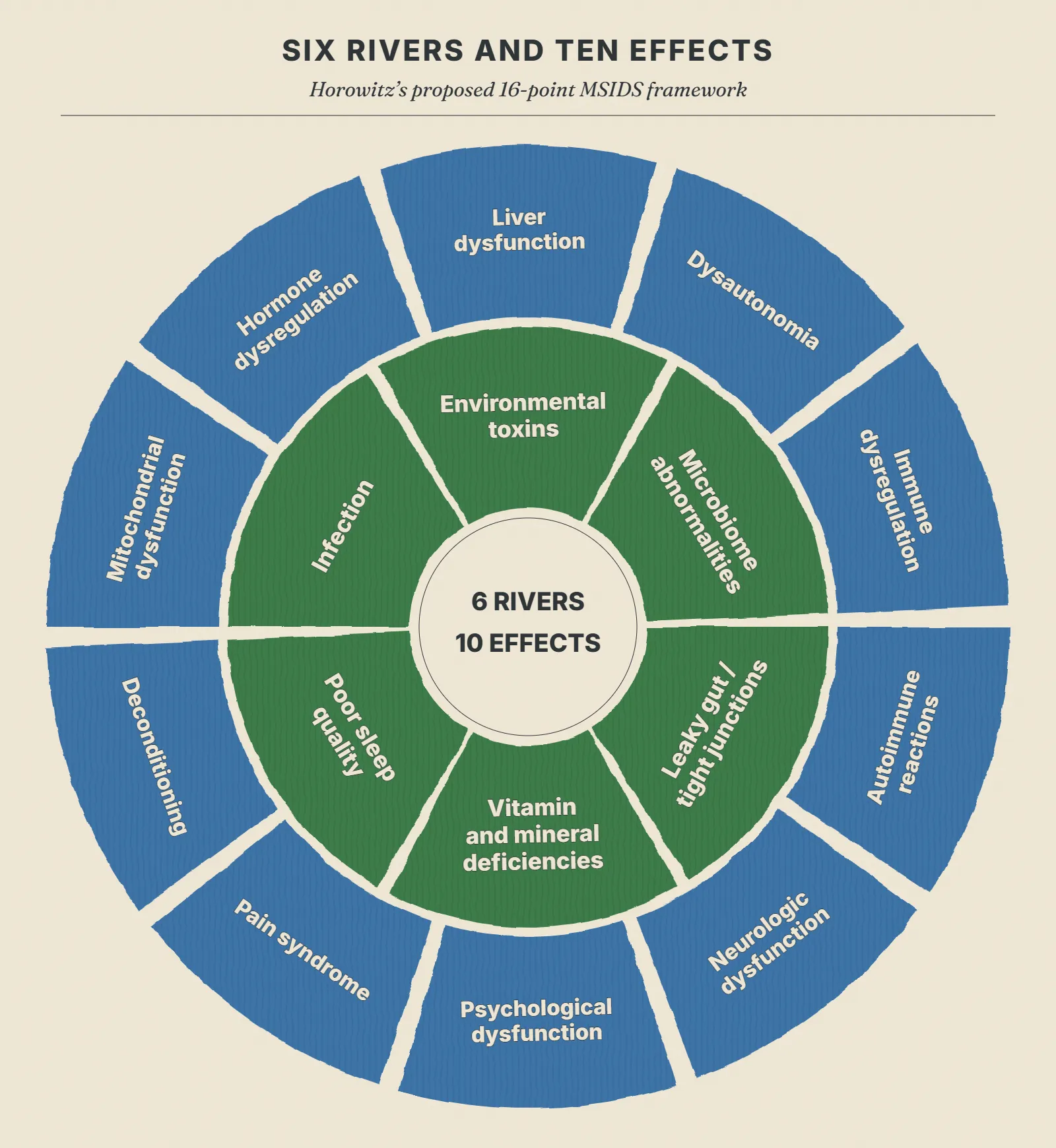
Horowitz's 16-point MSIDS framework, showing six proposed contributors and ten downstream effects. Conceptual categories from Horowitz and Freeman (2018), not measured effect sizes or proof of causation.
Infection
Environmental toxins
Microbiome abnormalities
Leaky gut or loss of tight junction (this leads to food sensitivities)
Vitamin and mineral deficiencies
Poor sleep quality (sleep disorders)
If this article helped you, please share it. Your shares help keep Sage Matters free, and I only ask you to share it if you genuinely found it useful.
The microbiome is the community of bacteria that lives in the gut. Tight junctions are the seals between the cells that line the gut.
From those rivers he developed ten downstream, or secondary, effects.
Mitochondrial dysfunction
Hormone dysregulation
Liver dysfunction with impaired detoxification
Dysautonomia, which may manifest as POTS (Postural Orthostatic Tachycardia Syndrome)
Immune dysregulation (an example of that is mast cell activation syndrome)
Autoimmune reactions, and some of those are associated with genetic expression
Neurologic dysfunction
Psychological dysfunction
Pain syndrome
Deconditioning
Mitochondria are the parts of our cells that make energy. Dysautonomia is a malfunction of the nervous system that controls automatic functions such as heart rate. In mast cell activation syndrome, immune cells release their chemicals when they shouldn't.
The common thread is inflammation. In the posts ahead I'll look at the specific triggers of that inflammation and the changes that can calm it, with the whole person in view.
Ready to start restoring your health?
The membership is $300 a month, month to month. You get a written plan, teaching, and coaching. Sage does not diagnose you or give you a personal medical reading.
See the membershipReferences5
- Citera M, Freeman PR, Horowitz RI. Validation of the Horowitz Multiple Systemic Infectious Disease Syndrome Questionnaire for Suspected Lyme Disease. Int J Gen Med. 2017;10:249-273.
- Horowitz RI. Ending Chronic Illness. Avid Reader Press/Simon & Schuster; 2026a.
- Horowitz RI. Improving Biomarkers of Inflammation Including Phosphorylated tau (p-tau) in a Patient with Chronic Lyme Disease/PTLDS Using Dapsone Combination Therapy. J Alzheimers Dis Rep. 2026b. doi:10.1177/25424823261445434
- Horowitz RI, Freeman PR. Precision Medicine: The Role of the MSIDS Model in Defining, Diagnosing, and Treating Chronic Lyme Disease/Post Treatment Lyme Disease Syndrome and Other Chronic Illness: Part 2. Healthcare (Basel). 2018;6(4):129.
- Koch R. Die Aetiologie der Milzbrand-Krankheit, begründet auf die Entwicklungsgeschichte des Bacillus anthracis. Beitr Biol Pflanz. 1876;2(2):277-310.
More from Sage Matters

Midjourney doesn't sit still. Its newest product is a body scanner.
A person steps onto a platform, glides into a shallow gold-lit pool, and descends through a ring of roughly half a million underwater ultrasonic sensors
READ ARTICLE
Need to be seen
Why access to care has become a strategy game
READ ARTICLE
Think Twice - Second Opinion
Why you should ask for a second opinion
READ ARTICLE
Are medical terms deliberately misleading?
Recent vaccine policy changes show how confusing medical language can be
READ ARTICLE