Introduction
A twenty-year study out of the Italian Alps tracked the diets of 829 people and found something, something interesting that is. The people who ate the most spermidine, a compound found in wheat germ, soybeans, and aged cheese, died at less than half the rate of the people who ate the least, 15.1 deaths per 1,000 person-years versus 40.5 (Rzeski & Rzeska 2026). That's the Bruneck Study, and it's good evidence that some of the most promising anti-aging compounds aren't found in a lab. They're in your pantry.
I supplement with several of these compounds myself, and I recommend them to people who ask. But after going through the research on four of the best-studied ones, spermidine, fisetin, berberine, and urolithin A, I want to teach you where the food will take you and where it will not.
Spermidine: wheat germ and fermented foods
Spermidine works by triggering autophagy, your cells' own cleanup process for clearing out damaged proteins and worn-out cell parts. As we age, this process slows down. Spermidine restarts it (Rzeski & Rzeska 2026).

Wheat germ is the richest common source of spermidine, at up to 337 mg per kilogram of dry weight. Soybeans, mushrooms, lentils, peas, broccoli, and cauliflower carry meaningful amounts too. So do fermented foods: aged cheddar, brie, natto, and fermented sausage all build up spermidine through microbial activity during fermentation (Rzeski & Rzeska 2026).
In mice, spermidine protects the heart and the brain. It reduces cardiac hypertrophy, preserves heart function, and in Alzheimer's models it cuts down on the tau tangles and amyloid buildup associated with the disease (Rzeski & Rzeska 2026). The human trials on cognition are smaller and more mixed. A trial giving older adults 0.9 mg a day for a year didn't move the needle on memory tests or inflammation markers, though the dose was well below the 8 to 12 mg a day that people eating a typical Western diet already take in (Rzeski & Rzeska 2026). That’s a noteworthy gap. It's part of the reason I think food is doing real work here that low-dose supplements haven't been shown to replace.
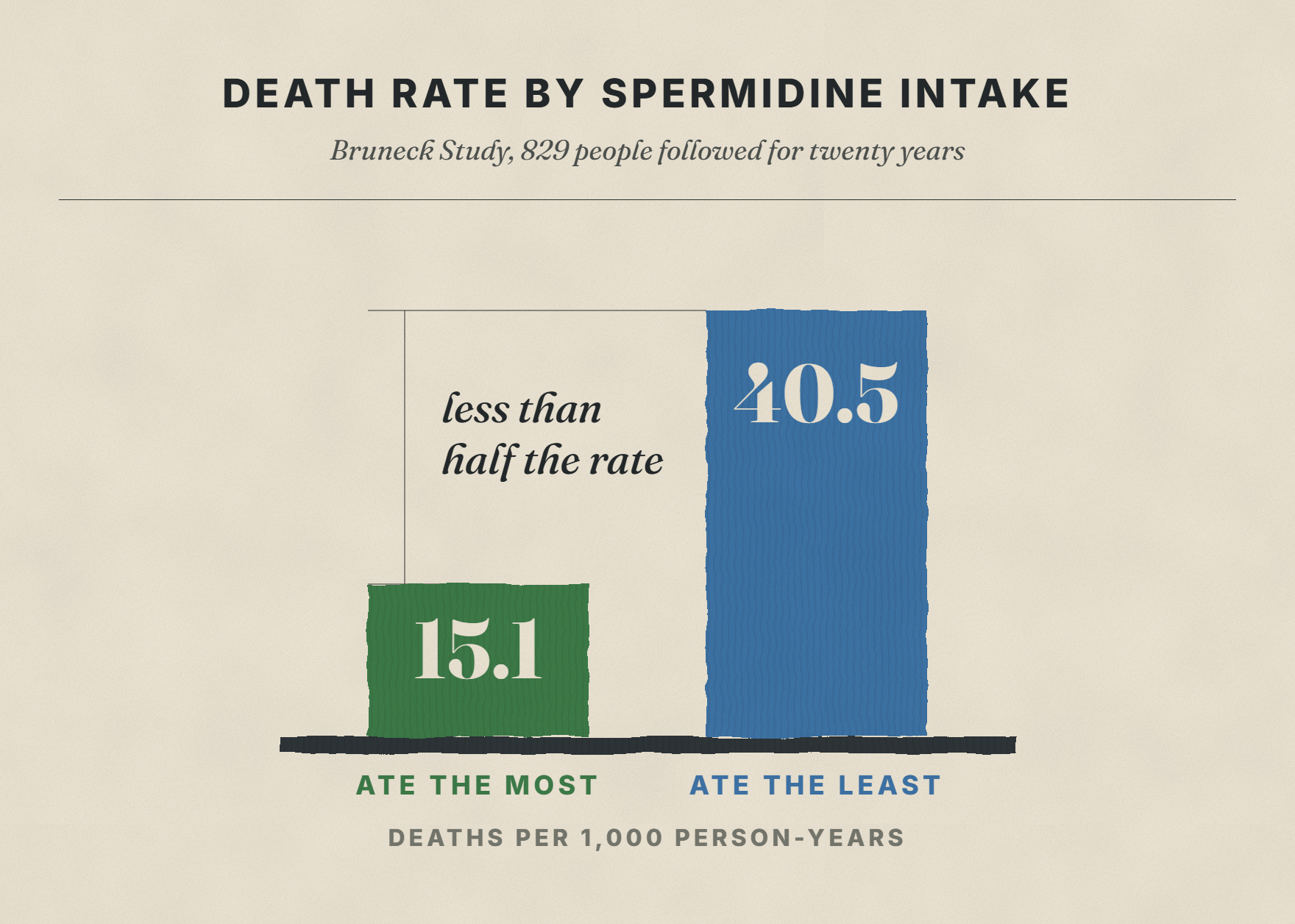
Bruneck Study, 829 people followed for twenty years: highest versus lowest dietary spermidine intake, in deaths per 1,000 person-years. This is observational data, so people who eat more spermidine may differ in other ways too (Rzeski & Rzeska 2026, Nutrients 18(15):2511).
Fisetin: strawberries, and a bioavailability problem
Fisetin is the compound behind the "senolytic" idea you may have heard about, meaning it selectively kills off senescent cells. These are the cells that stop dividing but don't die, and instead sit around leaking inflammatory signals that damage the tissue around them. In lab studies, fisetin was the most potent senolytic out of ten flavonoids tested, clearing out roughly a quarter to half of senescent cells in senescent tissue (Rzeski & Rzeska 2026).
Strawberries are the best dietary source by a wide margin, at roughly 160 mg per kilogram fresh weight. Apples, persimmons, grapes, kiwi, and onions carry smaller amounts (Rzeski & Rzeska 2026).
Here's the catch. Fisetin from food barely gets absorbed. It's poorly soluble in water, and your gut and liver break most of it down before it reaches your bloodstream in any meaningful concentration. The blood levels after eating fisetin-rich food land in the low nanomolar range, far under the micromolar concentrations shown to clear senescent cells in the lab (Rzeski & Rzeska 2026). Eating strawberries is worthwhile for a dozen other reasons, but it isn't going to get you a senolytic dose. The human trials use 100 to 1,000 mg doses, taken intermittently rather than daily, which is only realistic through a supplement (Rzeski & Rzeska 2026).
Berberine: not really a food, but the most-studied of the four
Berberine is different from the other three. It comes from the roots and bark of plants like barberry and goldenseal, and it isn't part of any food most of us eat. Its use goes back centuries in Chinese and Ayurvedic medicine, and today it's sold as a standardized extract (Rzeski & Rzeska 2026).
It also has, by far, the strongest clinical record of the group. Berberine activates AMPK, an enzyme that shifts your cells from storing energy to burning it, similar to what happens during exercise or calorie restriction. A 2008 trial gave newly diagnosed type 2 diabetics either berberine or metformin, 500 mg three times a day, for three months. Blood sugar and triglyceride improvements were comparable between the two groups (Yin 2008). A later meta-analysis pooling 46 randomized trials confirmed it: berberine cut HbA1c, fasting glucose, LDL cholesterol, and inflammatory markers like CRP and IL-6 across thousands of patients with type 2 diabetes (Guo 2021).
Berberine also reshapes your gut bacteria, and this may be doing as much work as its direct cellular effects. Only 1 to 5% of an oral dose gets absorbed into your bloodstream. The rest sits in your gut, where it increases beneficial bacteria like Akkermansia muciniphila and reduces species linked to metabolic inflammation (Rzeski & Rzeska 2026). This is a compound worth knowing about, but there's no dietary version of it. If you want the benefit, then you my friend will have to take a supplement.
One caution: berberine interacts with several medications, including statins, warfarin, and certain antidiabetic drugs, because it inhibits the liver enzymes that clear them. Talk to whoever manages your prescriptions before adding it (Rzeski & Rzeska 2026).
Urolithin A: pomegranates, walnuts, and uncooperative guts
Urolithin A doesn't exist in food at all. It's made inside your gut, when specific bacteria convert compounds called ellagitannins, found in pomegranates, walnuts, pecans, and berries, into the active molecule (Rzeski & Rzeska 2026).
That conversion step is where things get complicated. Studies have sorted people into three groups based on how well they make urolithin A from food: roughly a quarter to half of people convert it efficiently, another slice converts a related but less active form, and the rest, in some populations up to half, don't produce meaningful amounts no matter how much pomegranate juice they drink (Rzeski & Rzeska 2026). You can even add a bowl of walnuts to your bottle of pomegranate juice, but if you don’t have the right gut bacteria it’s all for nothing.
That's not a small caveat. It's the reason direct urolithin A supplementation exists at all, and the clinical results behind it are real. In a trial of 88 middle-aged adults given 500 or 1,000 mg a day for four months, hamstring strength rose by about 12% at the lower dose, along with improvements in aerobic endurance and a drop in CRP (Singh 2022). A separate trial in older adults found improved muscle endurance in both hand and leg muscles after four months of supplementation (Liu 2022). The first human safety trial, back in 2019, confirmed the compound gets into skeletal muscle and changes gene expression there in ways consistent with better mitochondrial function (Andreux 2019). Mitochondria are the structures inside your cells that produce energy, and keeping them working well is one of the clearer threads running through healthy aging research.
Where I land
Eat the wheat germ. Eat the strawberries. Eat the walnuts and the pomegranate and the aged cheese, because they're doing real things in your body beyond whatever role these four compounds play. And for spermidine specifically, the dietary intake levels in the Bruneck Study outperformed the low-dose supplement trials.
If you want to try any of this yourself, the doses used in the trials above are a reasonable starting point: 100 to 1,000 mg of fisetin taken intermittently, 900 to 1,500 mg of berberine in divided doses, and 500 to 1,000 mg of urolithin A daily (Rzeski & Rzeska 2026).
But I don't stop there, and I don't think you should either. Fisetin from food doesn't clear the bar needed for its senolytic effect. Berberine was never in your food supply to begin with. And urolithin A depends on gut bacteria that a large share of people simply don't have, no matter what they eat. For those three, I take supplements, at the doses studied in the trials above, because the food alone can't reliably get you there.
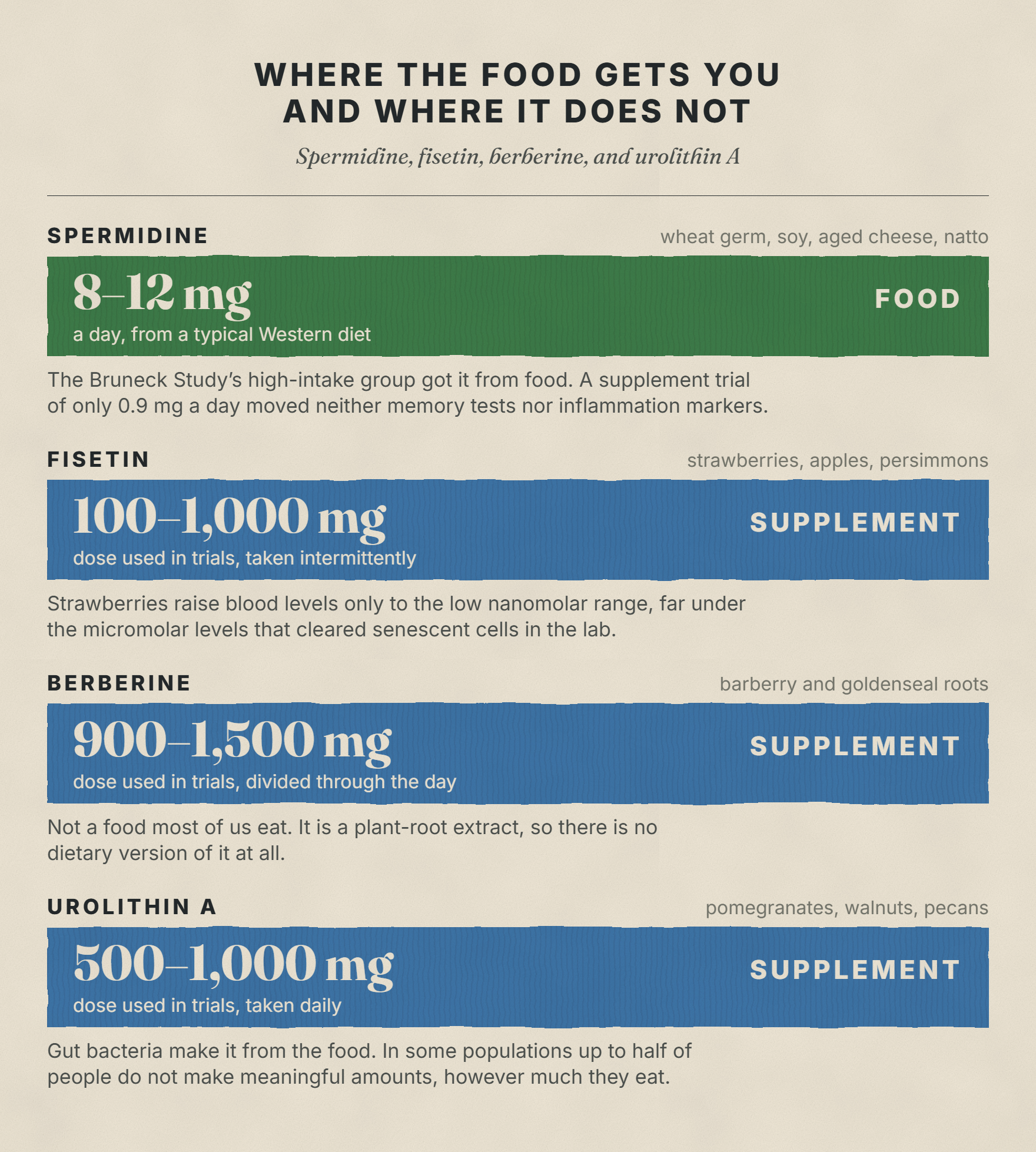
Spermidine shows typical dietary intake; the other three show the doses used in human trials. Food sources and dose ranges from Rzeski & Rzeska (2026), Nutrients 18(15):2511.
Food sources and dose ranges are drawn from Rzeski & Rzeska (2026), Nutrients 18(15):2511. "Food alone" reflects whether typical dietary intake reaches the concentrations used in the human trials cited above, not whether the food has other value.
References
Rzeski W, Rzeska W. Natural Bioactive Compounds Targeting Key Hallmarks of Aging: Functional Food Potential of Spermidine, Fisetin, Berberine, and Urolithin A. Nutrients. 2026;18(15):2511.
Yin J et al. Head-to-head comparison of berberine and metformin in newly diagnosed type 2 diabetes. 2008 (cited in Rzeski & Rzeska 2026).
Guo Y et al. Meta-analysis of 46 randomized controlled trials of berberine in type 2 diabetes. 2021 (cited in Rzeski & Rzeska 2026).
Yousefzadeh MJ et al. Screening of ten flavonoids identifies fisetin as the most potent senolytic. 2018 (cited in Rzeski & Rzeska 2026).
Andreux PA et al. First-in-human phase I trial of urolithin A. Nature Metabolism. 2019 (cited in Rzeski & Rzeska 2026).
Singh A et al. ATLAS trial: urolithin A and muscle strength in middle-aged adults. Cell Reports Medicine. 2022 (cited in Rzeski & Rzeska 2026).
Liu S et al. Urolithin A and skeletal muscle endurance in older adults. JAMA Network Open. 2022 (cited in Rzeski & Rzeska 2026).
Ready to start restoring your health?
The membership is $300 a month, month to month. You get a written plan, teaching, and coaching. Sage does not diagnose you or give you a personal medical reading.
See the membershipMore from Sage Matters
Your sugar substitute might be changing your grandchildren's genes
I've had patients tell me, almost proudly, that they switched from soda to a diet version.
READ ARTICLE
Why sardines are one of the best anti-aging foods you can eat
A team in Barcelona ran a year-long trial on 152 adults over the age of 65, all with prediabetes. Half of them added about 200 grams of sardines a week to
READ ARTICLE
Resistant starch improves visceral fat
Why visceral fat matters, what drives it, and how resistant starch may help reduce it.
READ ARTICLE
The 'Normal' Problem
When Your Labs Look Fine But Your Body Knows Better
READ ARTICLE