Introduction
I've had patients tell me, almost proudly, that they switched from soda to a diet version. Or from sugar to a "natural" sweetener. They think the problem is solved.
This year I learned something new. For some of these products, this creates a problem that not only affects them, but also affects their kids and grandkids. Kids and grandkids who never touch the stuff at all.
Aspartame and sucralose are the two I already tell patients to avoid. The newer research only makes that advice stronger. What's changed for me is realizing the "safe" swaps people reach for instead, stevia especially, aren't automatically safe either. Coming from a plant doesn't guarantee anything about what happens two generations down the line.
Aspartame and sucralose
I already tell people not to use aspartame or sucralose. This year's research just gives me more reasons why.
A team at Florida State University, led by Pradeep Bhide, ran two studies on aspartame. In the first, mice got aspartame every day, at doses below 15% of the FDA's maximum allowed amount. They developed anxiety-like behavior. Their brain chemistry changed too, in the part of the brain that controls fear. Those changes showed up in their children and grandchildren, mice that never had a drop of aspartame themselves (Jones et al. 2022).
Another researcher, Charles Vorhees, published a critique of that study. He raised concerns about how it was designed and how the data was analyzed (Vorhees 2023). Vorhees is an advisor to the Calorie Control Council, and that's worth knowing. That's the trade group for companies that make low-calorie sweeteners. While that doesn’t make his critique wrong, it’s useful to know his potential incentives for going after the study. Bhide's team ran more analysis in response. They said their original findings held up (Jones et al. 2023 reply).
A second paper from Bhide's lab, a year later, used the same dose range but looked at learning and memory instead. Those doses, roughly equivalent to what's in two to four small diet sodas a day, caused learning and memory problems in the mice consuming aspartame. Those problems passed down through the father's line only, to both male and female offspring. They were carried through changes in sperm (Jones et al. 2023). This effect faded after one generation. It didn't reach the grandchildren the way the anxiety effect did. Bhide reads that as a sign the change is epigenetic, meaning it's a change in how genes get switched on and off, not a change to the DNA itself. Epigenetic changes tend to fade faster across generations than damage to the DNA.
Sucralose tells a similar story. A 2026 study out of the University of Chile tracked mice across three generations. Only the first generation actually drank sucralose or stevia. Their children and grandchildren never touched either sweetener. They still showed measurable changes (Concha Celume et al. 2026). In the sucralose group, two inflammation genes, called Tlr4 and Tnf, became overactive in the intestine. A metabolism gene called Srebp1 became underactive in the liver. That pattern stuck around in the descendants. Their gut bacteria shifted toward more harmful types and fewer helpful ones, worse than in the stevia group. Short-chain fatty acids dropped too, and stayed lower across generations. These are helpful substances your gut bacteria make, and they can affect gene activity in a way that passes from parent to child. Male offspring developed poor glucose control. By the second generation, male descendants ran higher fasting blood sugar.
Jules Griffin, a researcher at the University of Aberdeen who wasn't part of the study, called it an in-depth look at effects across generations. He also cautioned that how much of this applies to humans is still unclear (Science Media Centre 2026).
The part about stevia that surprised me
In that same Chilean study, stevia caused a milder version of the same pattern. Inflammation and metabolism genes shifted. Short-chain fatty acids dropped. But the effect stopped after one generation, unlike sucralose's, which carried on to the second (Concha Celume et al. 2026). Still, in that first generation, female descendants of stevia-exposed mice ran higher fasting blood sugar. The researchers don't have a clean answer for why stevia's effect showed up in females and sucralose's showed up in males. Both sweetener groups also ended up with more types of gut bacteria overall, but less of the helpful short-chain fatty acids. More variety in the gut isn't automatically a healthier gut.
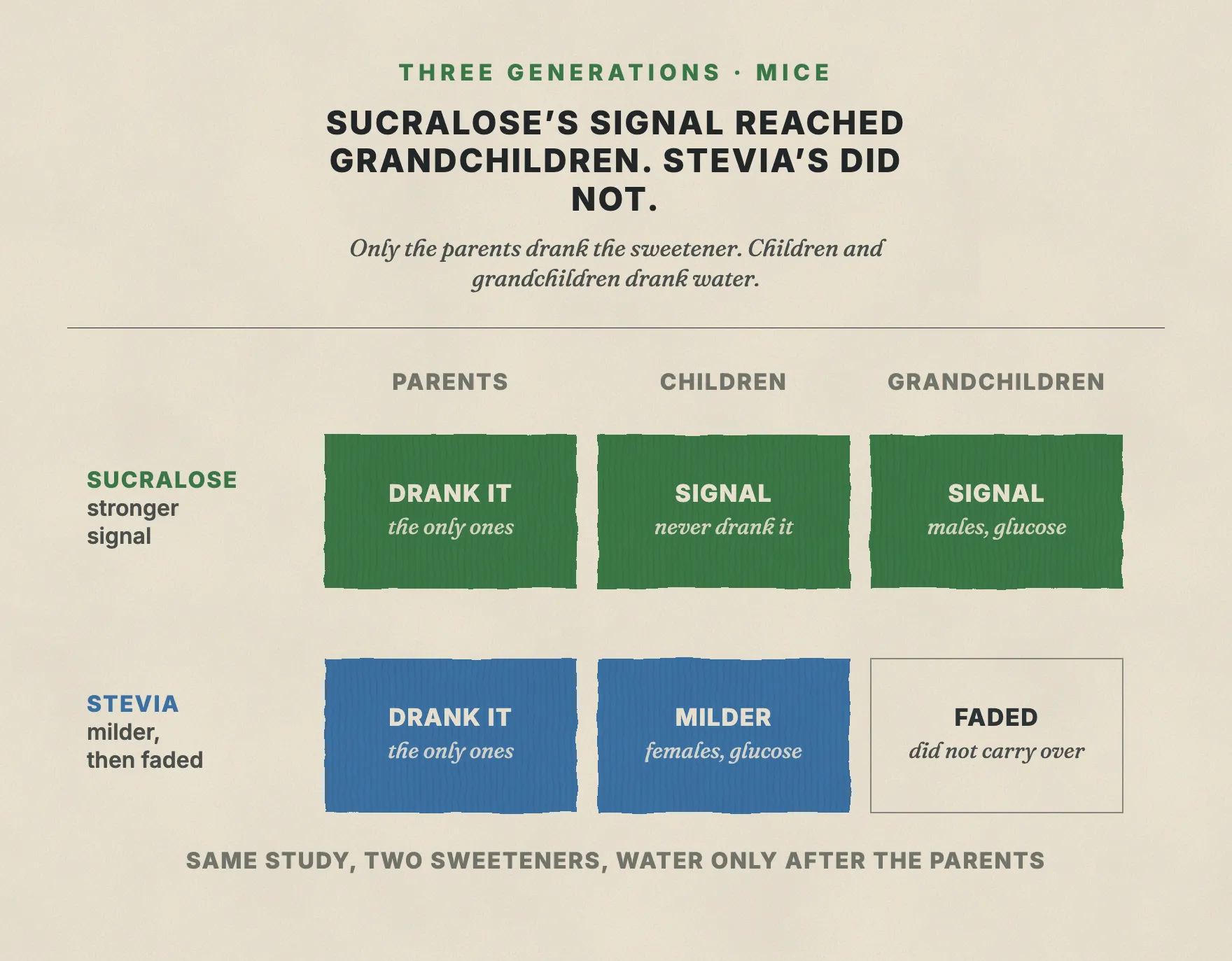
Concha Celume et al., Frontiers in Nutrition, 2026. Only the first generation drank sucralose or stevia. Mice. Sucralose’s gene, gut, and glucose changes reached the second generation, including higher fasting blood sugar in males. Stevia’s pattern was milder and stopped after one generation.
I bring this up because stevia comes from a plant. Many people treat "comes from a plant" as a reason to stop worrying. This mouse data says that reasoning doesn't hold up, at least not yet. A separate study, outside this one, fed stevia to pregnant mice. Their offspring's gut bacteria changed in ways that lasted into adulthood. That points to pregnancy as a more sensitive time than everyday adult use (Kasti et al. 2022).
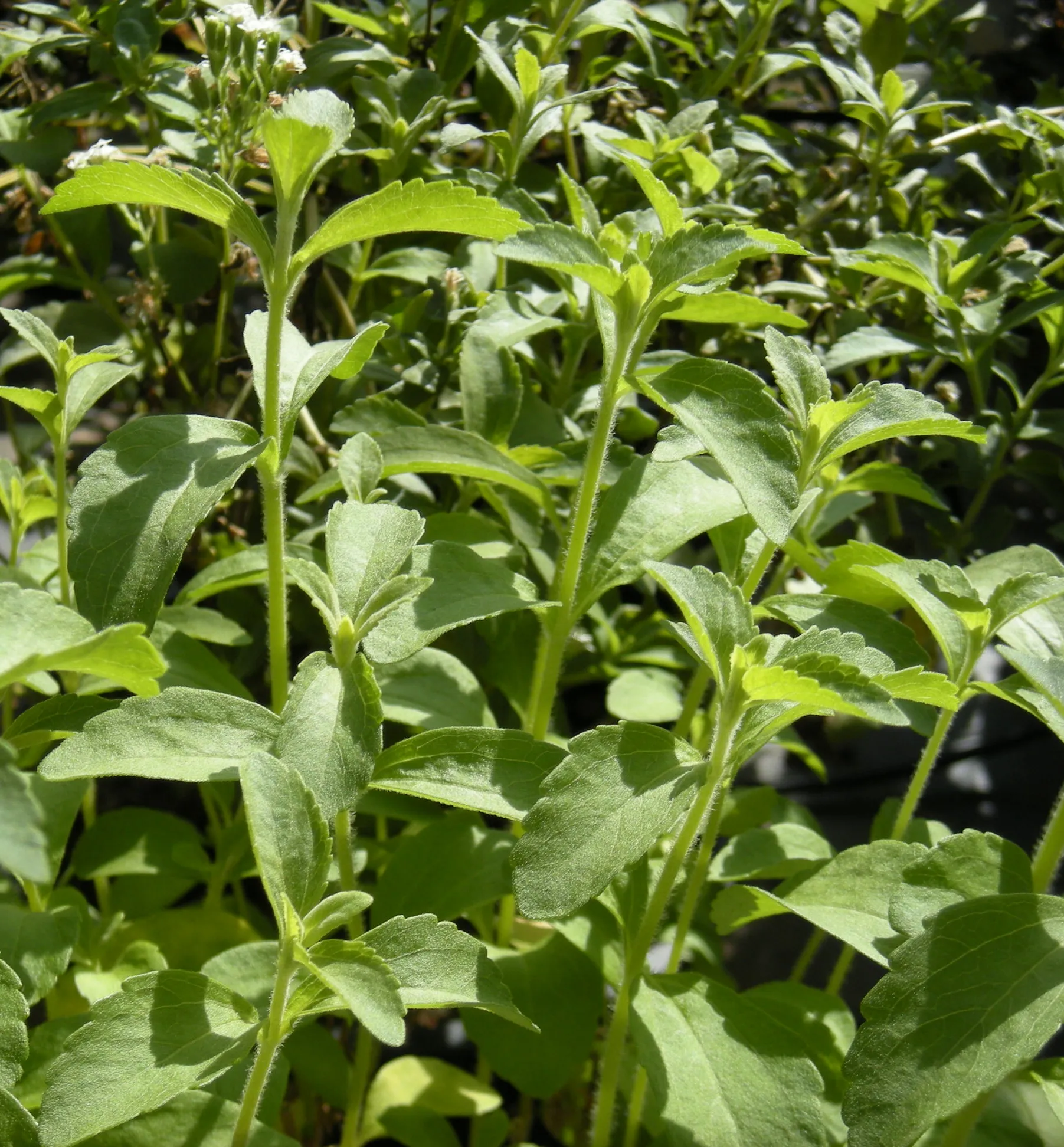
Stevia rebaudiana foliage. Photo by Ethel Aardvark, CC BY 3.0, via Wikimedia Commons.
The human data on stevia is more reassuring, as far as it goes. A 12-week trial with 14 stevia users and 13 people who didn't use it found no real change in overall gut bacteria (Singh et al. 2024). But a computer model could still tell the two groups apart with 75% accuracy. That means something in the gut was shifting, even without a change in the big picture. A separate review found that the sweet compounds in stevia, called steviol glycosides, get broken down by gut bacteria. In animal and lab studies, they showed anti-inflammatory effects, including lower levels of inflammation markers (Kasti et al. 2022).
The human data can't answer one big question. No human trial has followed a second generation to see whether stevia's gene effects pass down the way they do in mice. You can't ethically run that experiment in people. My honest summary for stevia is a milder signal than sucralose, one that fades faster in mice, reassuring but incomplete in humans, and a real open question during pregnancy.
Sugar alcohols carry a different kind of risk
Xylitol and erythritol haven't been tested with the same multi-generation, gene-expression study design as sucralose and stevia. But they've picked up their own warning signs, in different places.
At the European Society of Cardiology's 2026 meeting, a team led by Marco Witkowski, at Charité University Hospital in Berlin, studied almost 18,000 people. The data came from two large groups, the Canadian Longitudinal Study on Aging and EPIC-Norfolk. Over six years, the people with the highest blood xylitol levels had a 57% greater risk of a major heart or blood vessel event than the people with the lowest levels (ESC Congress 2026). That's a link found in observational data, not proof from a controlled trial. It doesn't prove xylitol caused those events on its own. It builds on a 2024 study, from the same researcher, that found xylitol promotes blood clotting (Witkowski et al. 2024). Separately, a mouse study cited in a 2024 review linked xylitol to anxiety-like behavior (Balcón-Pacheco et al. 2024).
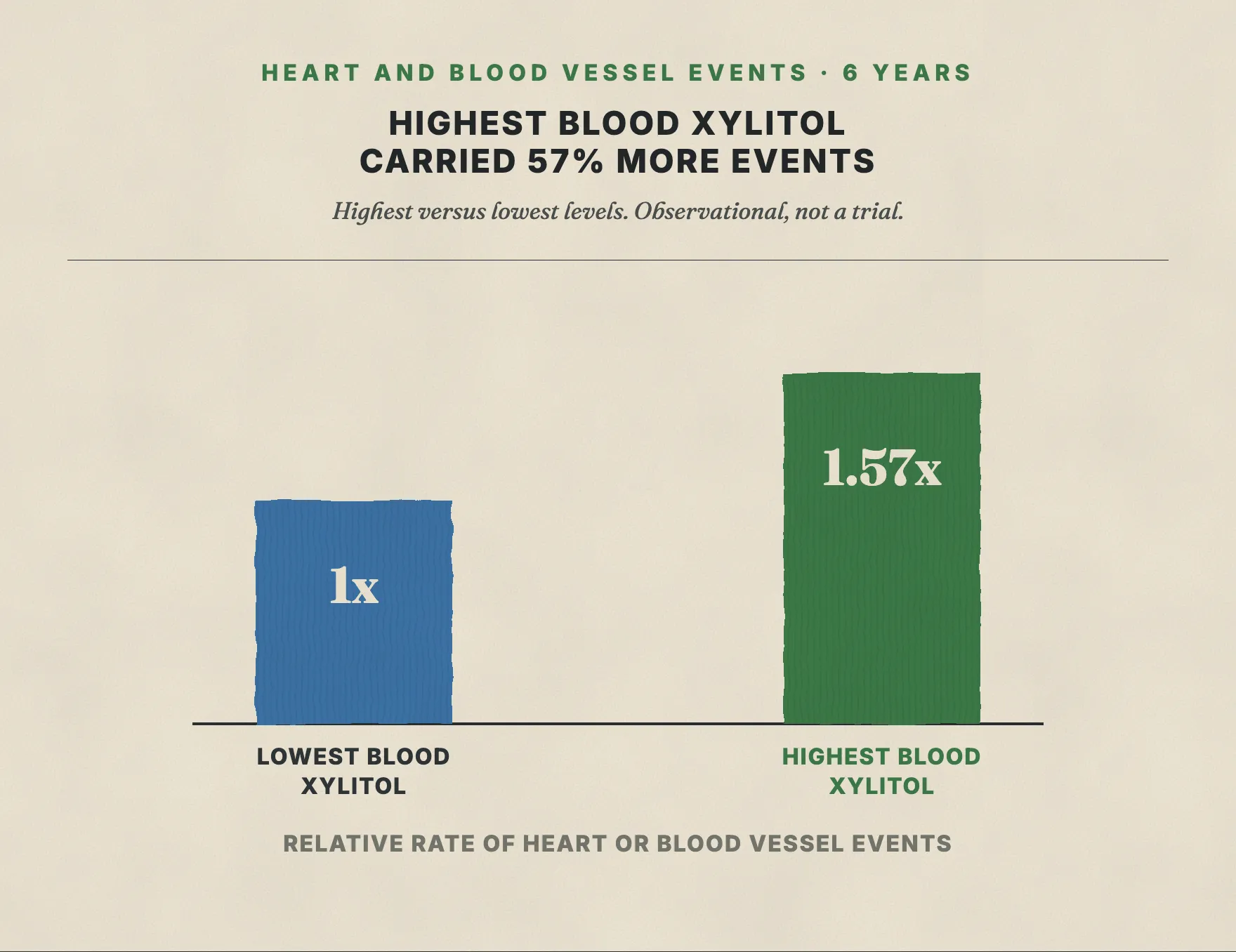
ESC Congress 2026; Witkowski et al. Almost 18,000 people from the Canadian Longitudinal Study on Aging and EPIC-Norfolk, followed for six years. Highest versus lowest blood xylitol. Observational, not a trial.
Erythritol shows up in that same heart-risk data. The picture there gets complext fast, because your body makes 5 to 15 grams of xylitol on its own every day. It makes erythritol too. So blood levels reflect more than just what you eat.
What concerns me more is a 2026 study that gave erythritol to pregnant rats, then tracked the effect into their granddaughters. It lowered a hormone called AMH, which reflects how many eggs a female has left, and it suppressed the genes that manage cellular cleanup. It also disrupted a signaling pathway called PI3K, which the ovary's follicles need to survive. The researchers found these changes were still present in the second generation, in rats that never received erythritol themselves, at any point (Frontiers in Endocrinology 2026). Body weight and litter size weren't affected, so the damage stayed narrow. It targeted the ovary specifically, and it reached all the way to the granddaughters. A separate zebrafish study found erythritol disrupted signals involved in brain development, at levels the FDA considers standard (ScienceDirect 2025).
I use some sugar alcohols myself. Reading this research hasn't made me stop. But it has made me pay closer attention to which one, and how much. Especially with xylitol, given that cardiovascular signal. Right now, that's the strongest and most consistent finding in this whole body of research.
If this article helped you, please share it. Your shares help keep Sage Matters free, and I only ask you to share it if you genuinely found it useful.
Monk fruit and allulose are the least studied of the group
Monk fruit and allulose are newer to the market. What data exists on them leans reassuring. Monk fruit's sweet compounds, called mogrosides, survive digestion mostly intact. Gut bacteria then ferment them into short-chain fatty acids, the opposite direction from what sucralose does.
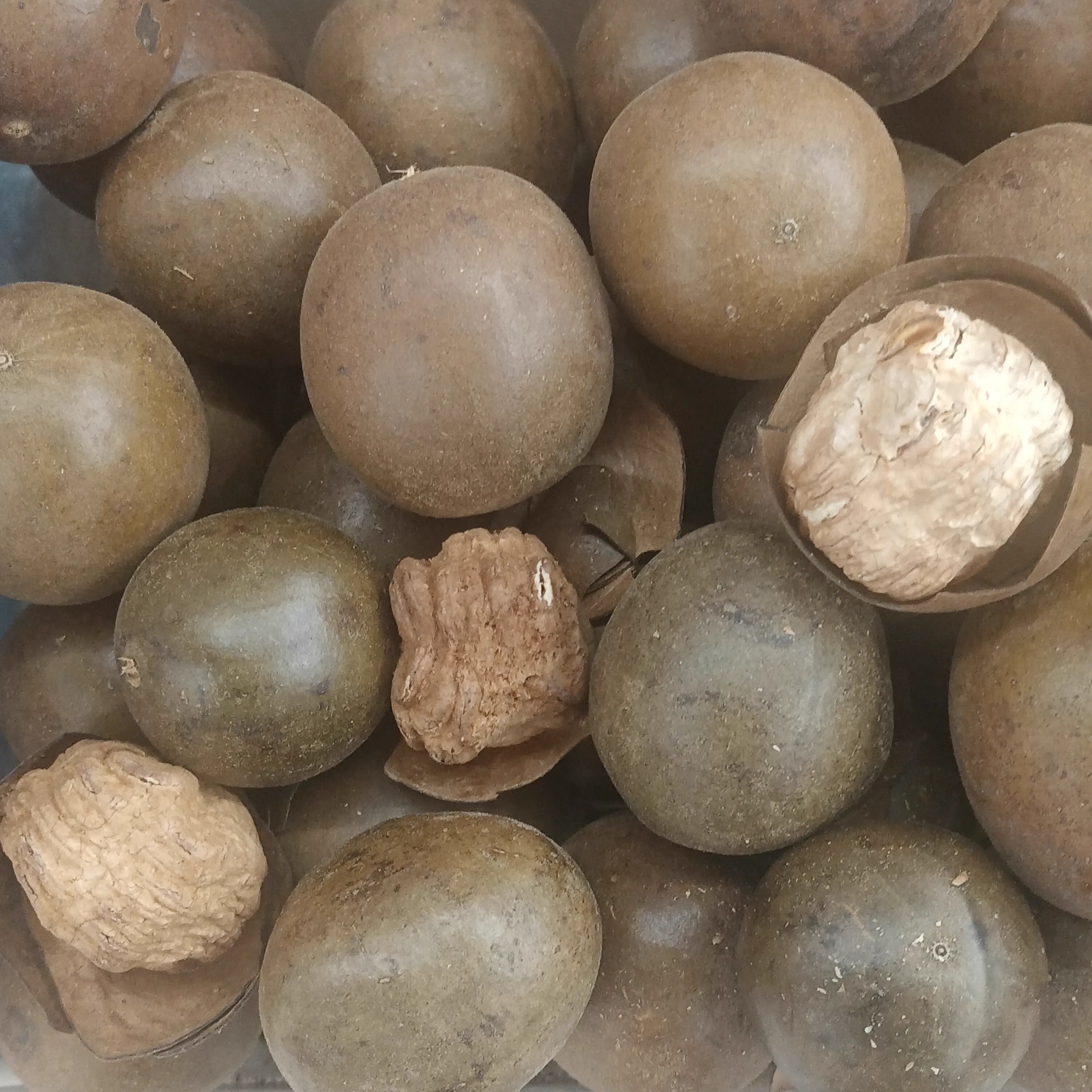
Dried monk fruit (Siraitia grosvenorii). Photo by François Nguyen, CC BY 2.0, via Wikimedia Commons.
Allulose has reduced weight gain and inflammation in obese mice. Part of how it did that was by turning down an inflammation-linked gene across several tissues (Han et al. 2020). In rat studies that followed standard safety-testing rules, allulose caused no birth defects, even at high doses. It had no effect on fertility, pregnancy, or litter size in a one-generation reproductive study (Sa et al. 2022). A 30-day human safety study found allulose was generally well tolerated. One high-dose group of people 35 and older showed a small drop in bone density scores. The researchers called that drop within normal clinical range.
But neither monk fruit nor allulose has gone through the two-generation, gene-expression testing that flagged the sucralose and stevia findings. Allulose's reproductive testing used an older, one-generation design, not the newer gene-expression approach used for sucralose and stevia. The reassuring data on both of these sweeteners may simply mean they haven't been studied closely yet.
Where this leaves you
Everything here happened in mice, rats, and zebrafish, not people. Every researcher involved says plainly that these findings don't automatically apply to humans. No one has run a multi-generation study in people, because you can't ethically do it. That's a real limit on how far any of this can be pushed.
What I take from it is narrower than "avoid all sweeteners." I already told you to avoid aspartame and sucralose. That hasn't changed. Beyond that, coming from a plant, by itself, doesn't tell you whether something is safe across generations. Stevia's mouse data on fasting blood sugar and insulin resistance in offspring is the clearest example of that. Xylitol's heart-risk signal is a different kind of problem, one that has nothing to do with genetics, and right now it's the strongest finding in this whole area. Monk fruit and allulose look better so far. But looking better and being well studied are two different things.
Whether any of that changes what's in your kitchen isn't a call I can make for you. What I'd ask is that you make it on purpose. Know which of these sweeteners has actually been tested for the question you're worried about, and which one just hasn't been looked at yet.
Ready to start restoring your health?
The membership is $300 a month, month to month. You get a written plan, teaching, and coaching. Sage does not diagnose you or give you a personal medical reading.
See the membershipReferences15
- Concha Celume, F., Pérez-Bravo, F., Magne, F., Olivares, R., Gotteland, M. "Artificial and natural non-nutritive sweeteners drive divergent gut and genetic responses across generations." Frontiers in Nutrition, Jan 30, 2026. DOI: 10.3389/fnut.2026.1694149
- Jones, S.K. et al. "Transgenerational transmission of aspartame-induced anxiety and changes in glutamate-GABA signaling and gene expression in the amygdala." PNAS, 119(43), e2213120119, 2022.
- Jones, S.K., McCarthy, D.M., Stanwood, G.D., Schatschneider, C., Bhide, P.G. "Learning and memory deficits produced by aspartame are heritable via the paternal lineage." Scientific Reports, 13, 14326, 2023.
- Vorhees, C.V. "Concern over differences between experimental design and data analyses in Jones et al." PNAS, 120, e2302944120, 2023.
- Jones, S.K. et al. "Reply to Charles V. Vorhees: Aspartame and anxiety-like behavior." PNAS, 120, e2304679120, 2023.
- Singh, G. et al. "Consumption of the Non-Nutritive Sweetener Stevia for 12 Weeks Does Not Alter the Composition of the Human Gut Microbiota." Nutrients, 16(2), 296, 2024.
- Kasti, A.N. et al. "The Effects of Stevia Consumption on Gut Bacteria: Friend or Foe?" Microorganisms, 10(4), 744, 2022.
- Han, Y. et al. "Tracing the Anti-Inflammatory Mechanism/Triggers of D-Allulose: A Profile Study of Microbiome Composition and mRNA Expression in Diet-Induced Obese Mice." Molecular Nutrition & Food Research, 2020.
- Sa, S. et al. "Teratogenicity of D-Allulose." Toxicology Reports, 9, 821-824, 2022.
- Frontiers in Endocrinology (2026). "Gestational Exposure to the Artificial Sweetener Erythritol Reprograms Ovarian Function Through AMH Suppression and Oxidative Stress-Mediated Disruption of Autophagy and PI3K Signaling." DOI: 10.3389/fendo.2026.1829421
- ScienceDirect (2025). "Erythritol disrupts neurodevelopmental signaling and behavior in zebrafish via shh/nodal and notch pathways."
- European Society of Cardiology. "Xylitol may increase the risk of cardiovascular events." Press release, ESC Congress 2026, Munich, Aug 28-31, 2026.
- Witkowski, M. et al. "Xylitol is prothrombotic and associated with cardiovascular risk." European Heart Journal, 45, 2439-2452, 2024.
- Science Media Centre (UK). Expert reaction to Concha Celume et al. study, April 10, 2026.
- Balcón-Pacheco, C. et al. 2024 (cited study on xylitol and anxiety-like behavior in mouse models).
More from Sage Matters

Eat the food. Take the supplement. Here's why I do both.
A twenty-year study out of the Italian Alps tracked the diets of 829 people and found something, something interesting that is. The people who ate the
READ ARTICLE
Why sardines are one of the best anti-aging foods you can eat
A team in Barcelona ran a year-long trial on 152 adults over the age of 65, all with prediabetes. Half of them added about 200 grams of sardines a week to
READ ARTICLE
Resistant starch improves visceral fat
Why visceral fat matters, what drives it, and how resistant starch may help reduce it.
READ ARTICLE
The 'Normal' Problem
When Your Labs Look Fine But Your Body Knows Better
READ ARTICLE