Introduction
A team in Barcelona ran a year-long trial on 152 adults over the age of 65, all with prediabetes. Half of them added about 200 grams of sardines a week to their diet, roughly two standard servings. The other half changed nothing. By the end, the sardine group had lower insulin resistance, higher HDL cholesterol, lower triglycerides, and lower blood pressure than the control group, and fewer of them tested as high risk for developing type 2 diabetes (Díaz-Rizzolo et al. 2021).
Those four markers, insulin resistance, HDL, triglycerides, and blood pressure, are the ones that track how well your metabolism holds up as you get older. When they move in the right direction, your risk of the diseases that actually shorten life goes down with them. That's the case for sardines as an anti-aging food.
I bring this up because sardines get dismissed. People think of them as a backup food, something you eat when there's nothing else in the house. I'd argue the reputation is backwards. Pound for pound, a can of sardines does more for your body than most things marketed as superfoods, and it costs just a few bucks.
Aging is partly about inflammation and structure
Most of what we call aging comes down to two things breaking down at once: chronic low-grade inflammation, and physical structure, especially bone. EPA and DHA, the long-chain omega-3 fats in sardines, reduce inflammatory markers and support cardiovascular function, which is part of why the American Heart Association recommends regular fish intake for heart health (Rimm et al. 2018).
Bone tells a similar story. In a canned sardine, you're usually eating the bones without noticing, and that gets you around 380 milligrams of calcium per 100 grams. A salmon fillet gives you about 15 milligrams. Once you're past 50 and you’re ruminating about your bone density and fall risk, this suddenly becomes a little more important to you. A hip-shattering fall at 75 changes the rest of someone's life. Calcium from food is one of the best, easiest tools you have to fight a bad outcome.
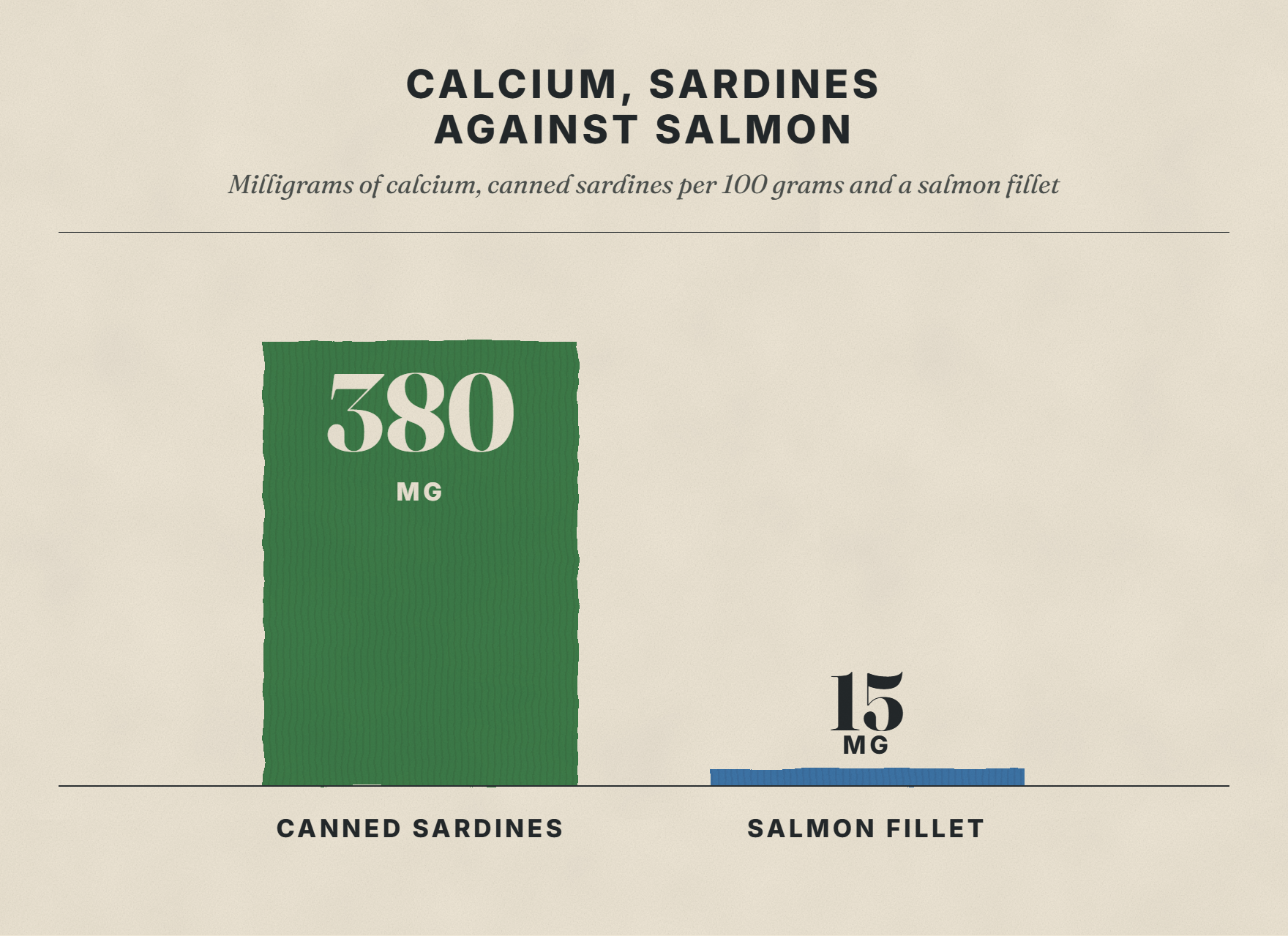
Calcium in canned sardines per 100 grams, against about 15 milligrams in a salmon fillet. Source: USDA FoodData Central.
A 100-gram serving of sardines packed in oil, drained, has about 25 grams of protein, close to a chicken breast, in a food you can keep in a drawer for years without refrigeration. Sardines also carry more B12 per serving than salmon, along with a solid dose of vitamin D and selenium, which works as a cofactor for antioxidant enzymes in the body and fits the same anti-inflammatory picture.
Now there is something I want to address that I've seen stated wrongly elsewhere. Sardines are often sold as the top source of omega-3 fats. Salmon actually beats them on that measure, with roughly twice the EPA and DHA per serving and more than double the vitamin D. If omega-3 density were the only thing that mattered, salmon would win that comparison outright.
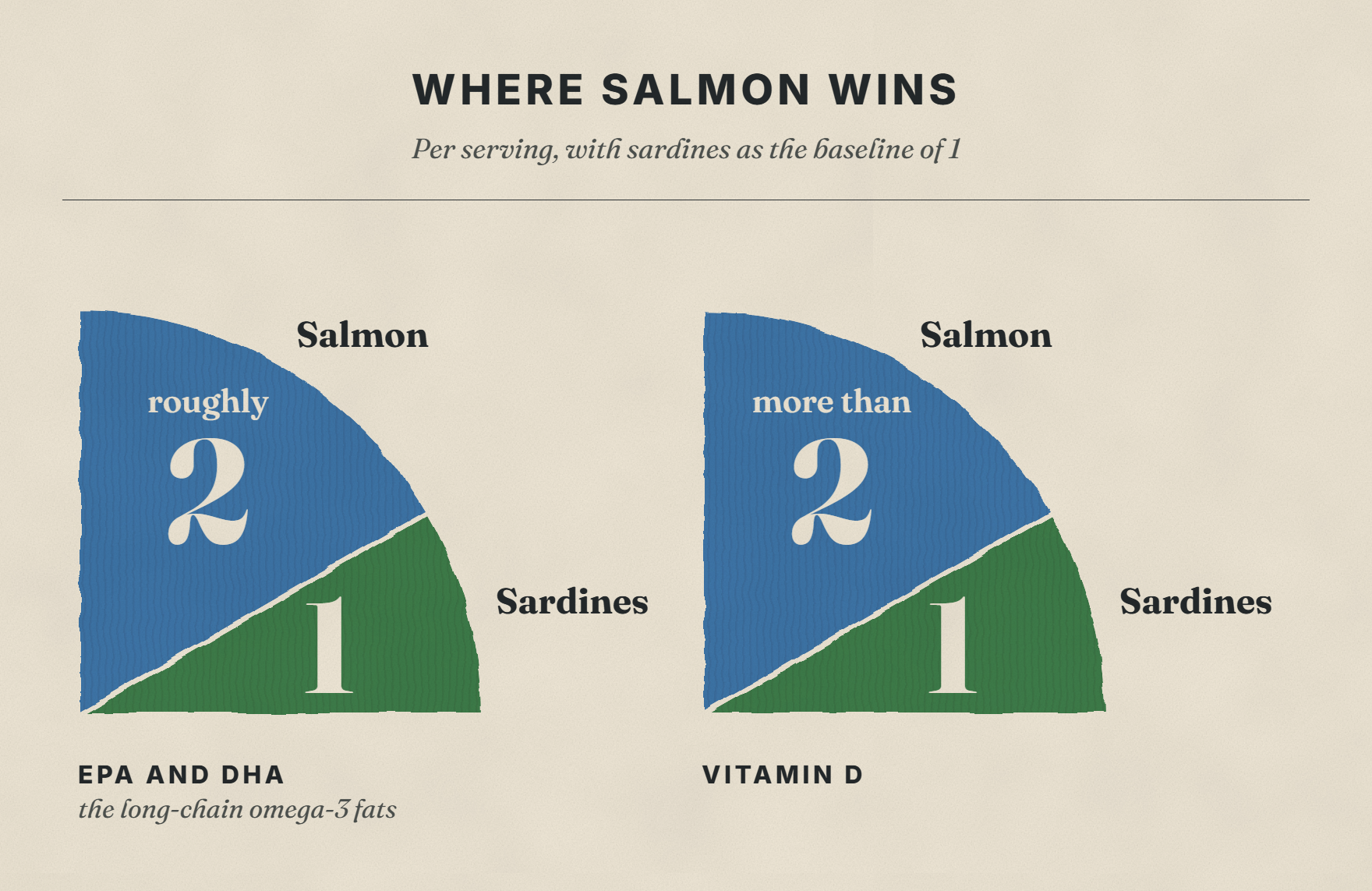
Relative amounts per serving, with sardines set at 1. Salmon has roughly twice the EPA and DHA and more than double the vitamin D. Source: USDA FoodData Central.
Price and shelf life, not the omega-3 numbers alone, are why I recommend sardines as often as I do.
A pantry staple that never goes bad
A canned sardine doesn't need a refrigerator, a freezer, or a working stove. It sits in a cabinet for years and comes out exactly as useful as the day it went in.
People should give that some more credit. Every emergency preparedness list, whether it's for a hurricane, a winter storm, or just a stretch without power, comes back to the same requirement: food that doesn't spoil and gives you real protein without cooking. Open a can, and you get 20-something grams of protein plus the calcium and B12 you'd get from any other serving, without power or a working stove.
I'd rather see a family keep a case of sardines in the pantry than count on a freezer full of food that spoils the moment the power goes out.
Editor’s note: These are, however, best eaten outside, far away from others. Ideally you place the used containers in a grocery bag or something to contain the smell, and then throw them away in an outside dumpster just to be safe. And you will need a breath mint before reentering society.
How to actually eat them
Buy sardines packed in olive oil, I’d choose those over ones packed in water or tomato sauce. The oil holds onto the omega-3s better during processing, and the fat helps your body absorb the vitamin D. Tomato-packed versions often carry added sugar, and smoked sardines go through a process I wouldn't want as a regular habit. Water-packed works fine if that's what's available. Just add your own olive oil when you eat it.
Skip frying them. High heat breaks down the same fats you're trying to get from the fish in the first place. A squeeze of lemon or a splash of vinegar helps preserve those fats and makes the calcium easier for your body to use.
Two or three servings a week is a reasonable target. If you already eat a burger or a steak that often, swapping one of those meals for a tin of sardines is an easy way to get there.
This is roughly how I eat myself. I stay fasted through the morning aside from what I drink: ketones, ginger tea, then freshly ground coffee with C8 oil and Ceylon cinnamon. About 45 minutes to an hour after that comes a low-carb protein smoothie with several other powders mixed in, which is also when I take most of the many supplements I add every day. A can of sardines, or another lean protein, is usually my first real food of the day, and it holds me comfortably for the next couple of hours until dinner, when I add complex carbs and protein with some color on the plate.
References
Díaz-Rizzolo DA, et al. Clinical Nutrition. 2021. PMID 33932804.
Rimm EB, et al. Circulation (American Heart Association Science Advisory). 2018. PMID 29773586.
USDA FoodData Central. Nutrient data for canned sardines and salmon (FDC IDs 175139, 175168, 171998).
More from Sage Matters
Your sugar substitute might be changing your grandchildren's genes
I've had patients tell me, almost proudly, that they switched from soda to a diet version.
READ ARTICLE
Eat the food. Take the supplement. Here's why I do both.
A twenty-year study out of the Italian Alps tracked the diets of 829 people and found something, something interesting that is. The people who ate the
READ ARTICLE
Resistant starch improves visceral fat
Why visceral fat matters, what drives it, and how resistant starch may help reduce it.
READ ARTICLE
The 'Normal' Problem
When Your Labs Look Fine But Your Body Knows Better
READ ARTICLE