Introduction
GHK-Cu usually gets introduced as a cosmetic peptide. That's accurate, and it undersells the molecule by a lot.
This is a copper-binding tripeptide, three amino acids long, and it shows up in collagen remodeling, antioxidant defense, mitochondrial energy production, wound healing, inflammation control, and gene regulation. That's an unusually wide résumé for something this small. Some of that résumé is backed by solid human data. Some of it is cell studies, animal work, or gene-expression databases that tell you what's plausible, not what's proven. I'll show you both, and tell you honestly which is which.
What GHK-Cu actually is
GHK is short for glycyl-L-histidyl-L-lysine, a three-amino-acid peptide that binds copper tightly enough to form a stable complex, written as GHK-Cu. It occurs naturally in your blood plasma.
Here's the interesting part. Published research shows plasma GHK levels around 200 ng/mL at age 20, dropping to roughly 80 ng/mL by age 60 (Pickart 2018). That decline lines up with the same decades where wound healing slows down, skin gets thinner, and tissue repair generally gets less efficient. That's a correlation, not proof that replacing GHK reverses any of it, and correlations need testing before they become treatments. But it's the kind of correlation that's worth taking seriously, not dismissing.
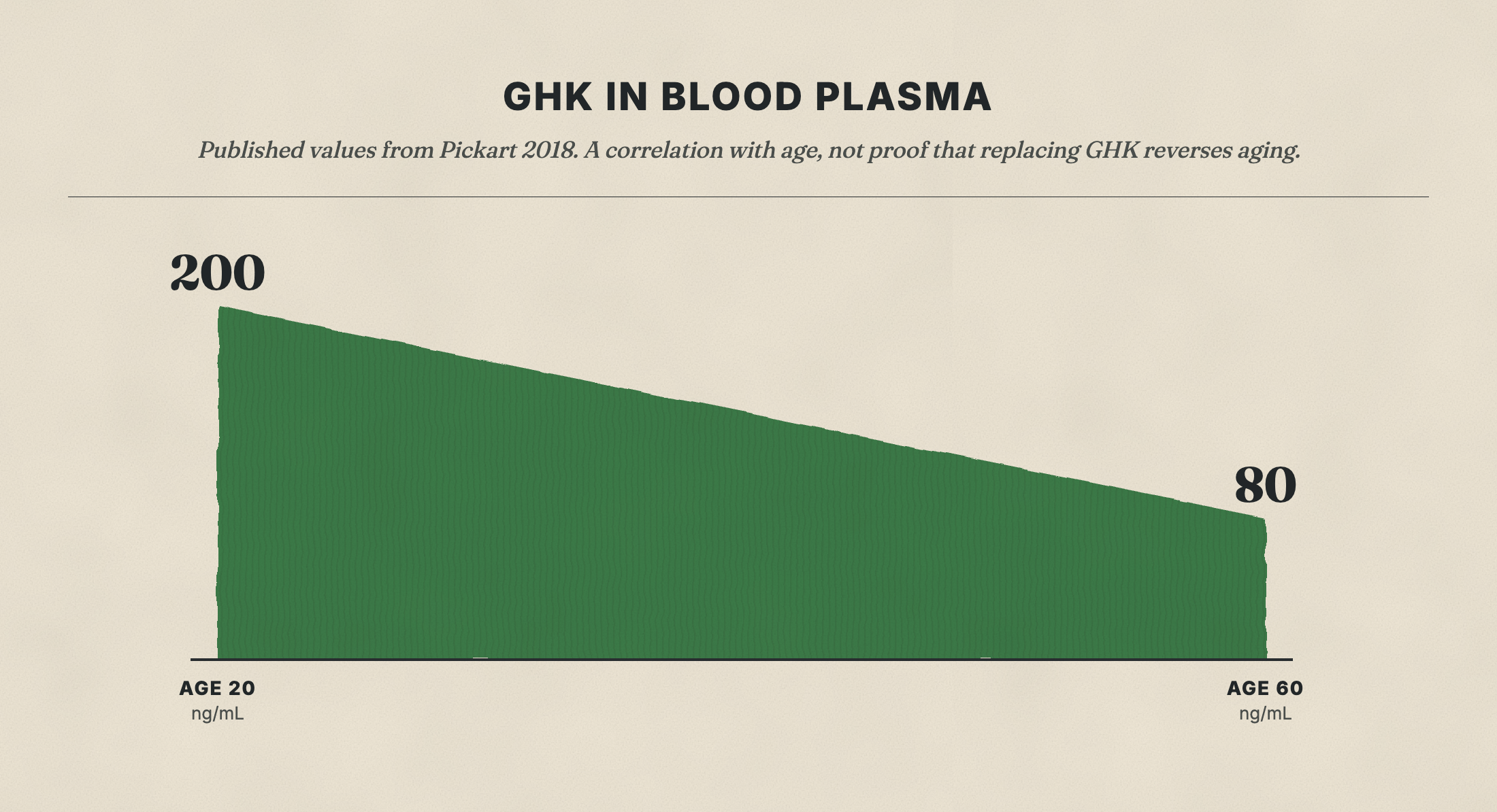
Pickart and Margolina, Int J Mol Sci, 2018. Tapering wedge. Plasma GHK around 200 ng/mL at age 20, about 80 ng/mL at age 60. A correlation with age, not proof that replacing GHK reverses aging.
Copper needs an escort
Copper is essential. It's the working part of several enzymes your body can't do without, including lysyl oxidase, which cross-links collagen and elastin, copper-zinc superoxide dismutase, a major antioxidant enzyme, and cytochrome c oxidase, also called Complex IV, the last step in the mitochondrial chain that makes ATP.
Copper is also dangerous when it's loose. Free copper drives oxidative reactions that damage DNA, proteins, and cell membranes. That's why your body normally moves copper around using dedicated carrier proteins instead of letting it float free.
GHK appears to work inside that same system. The interesting idea is that GHK-Cu might deliver copper the way your body already prefers, in a coordinated, escorted form that hands it off to the enzymes that need it instead of dumping it into tissue. That's the difference between copper delivery and copper supplementation, and it's why researchers keep circling back to this molecule instead of just saying "take more copper."
What's actually proven, skin and wounds
If you want the strongest human evidence for GHK-Cu, it's topical. The most cited study here followed 71 women with photoaged skin for 12 weeks using a GHK-Cu facial cream, and found real gains in skin density and thickness along with a big drop in wrinkle depth, measured by ultrasound and skin profilometry (Leyden 2002). Worth knowing, that data was presented at a dermatology conference by researchers tied to the company selling the cream, not published as an independent peer-reviewed paper. That doesn't make it false, it just means I'd weight it as solid industry data rather than gold-standard independent evidence.
A more recent trial ran a similar experiment differently. In 2023, a California biotech company put a stabilized GHK-Cu gel through a 3-month trial in 21 women, using high-resolution ultrasound to track collagen density directly. The average increase was 28 percent, and the top responders saw 51 percent (Carey 2023). Same caveat applies here, more so. This was a company-funded study of the company's own product, announced through a press release rather than a peer-reviewed journal, with a small sample. The investigator was a real academic dermatologist at McGill, which counts for something. I'd call this promising, with a small, company-funded sample.
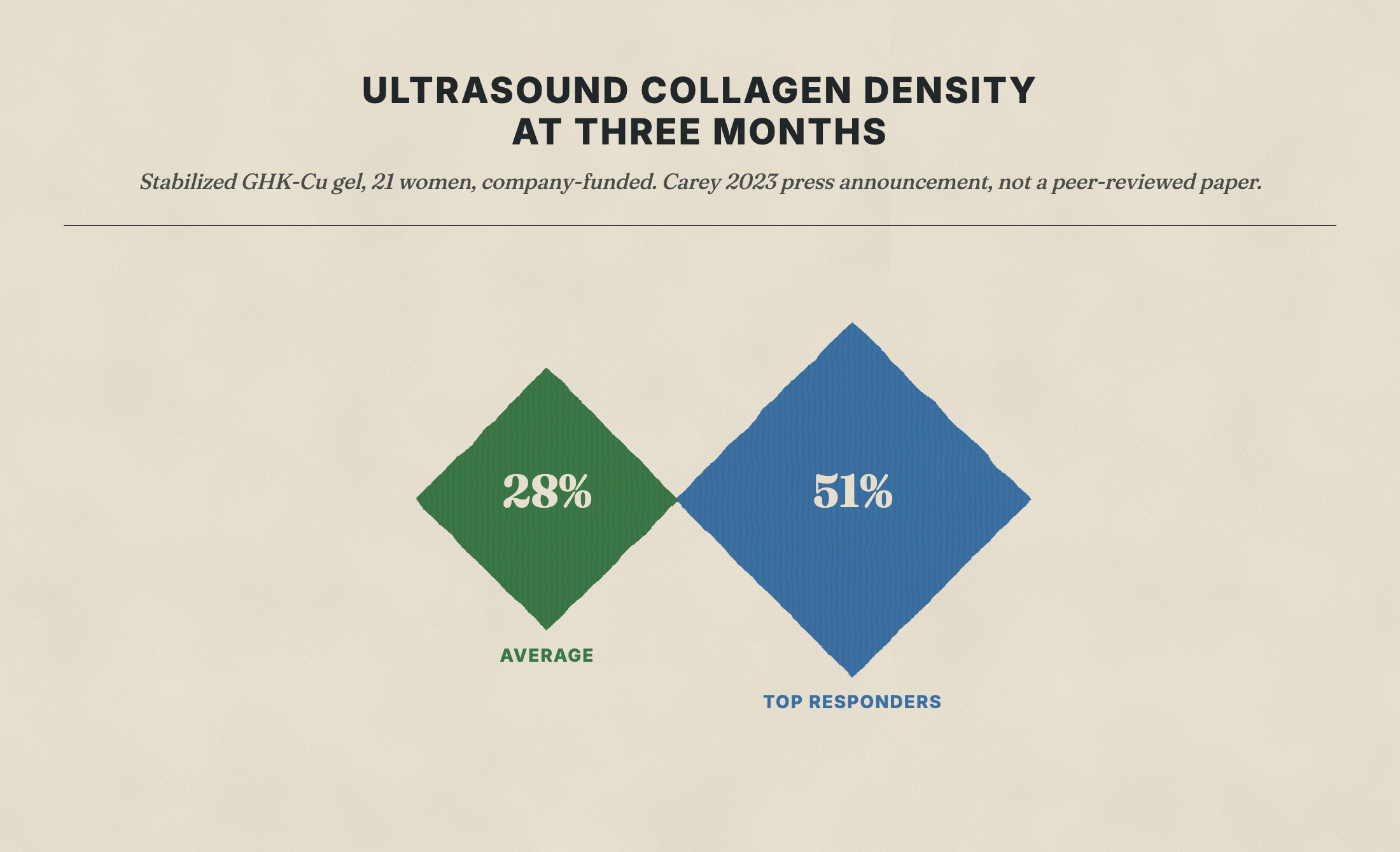
Carey, Yuvan Research press announcement via EurekAlert, 2023. Overlapping diamonds: area scaled to the raw percent increase. Company-funded trial of a proprietary GHK-Cu gel in 21 women, 3 months. Not a peer-reviewed paper.
Wound healing has real weight behind it too. A randomized trial in diabetic foot ulcers reported faster closure and fewer infections with a copper-peptide gel compared to the vehicle alone. Animal studies back that up with better closure, blood vessel growth, and tissue organization (Wang 2017). If those human numbers hold up under a closer read, and I plan to check, this tells you GHK-Cu can influence real tissue repair, along with how skin looks.
Why does this make biological sense? Healthy repair isn't just "make more collagen." GHK-Cu has been linked to collagen and elastin synthesis, to lysyl oxidase stabilizing new fibers, and to the enzymes that clear out damaged matrix so new tissue can actually organize instead of just piling up. That's a more complete picture of regeneration than "more collagen," and it's why the skin data doesn't feel like a fluke.
Here's one practical note if you're using a topical product. Strong acids, like ascorbic acid or glycolic acid, layered directly on top of a copper-peptide product, may mess with the copper binding. Using them at different times of day is a reasonable habit until we have better formulation-specific data.
The wider promise, and why none of it is proof yet
Beyond skin, the mechanistic case for GHK-Cu keeps showing up in places you wouldn't expect. A 2012 study used a gene-expression database to find compounds that might reverse the gene signature of emphysema, and GHK came up. When researchers exposed human lung fibroblasts to it, gene expression shifted in ways tied to tissue repair (Campbell 2012). A 2025 study found similar repair signals in a mouse model of colitis, including better gut barrier function and more mucus-producing cells (Frontiers Pharmacol 2025). In aging mice, intranasal GHK-Cu improved memory measures and lowered markers of brain inflammation (Cognitive Decline Study 2023).
That's mechanism and animal data. It's the kind of finding that gets oversold on the internet. A gene-expression database analysis is also where the claim that GHK influences 31.2 percent of the human genome comes from. That's a real number from a real analysis, using a defined threshold for changed gene expression. That doesn't mean an injection resets a third of your genes, it means GHK looks like something that nudges a whole repair-and-remodeling program. That's genuinely interesting. It's also exactly the kind of finding that's easy to overstate, so I'm not going to.
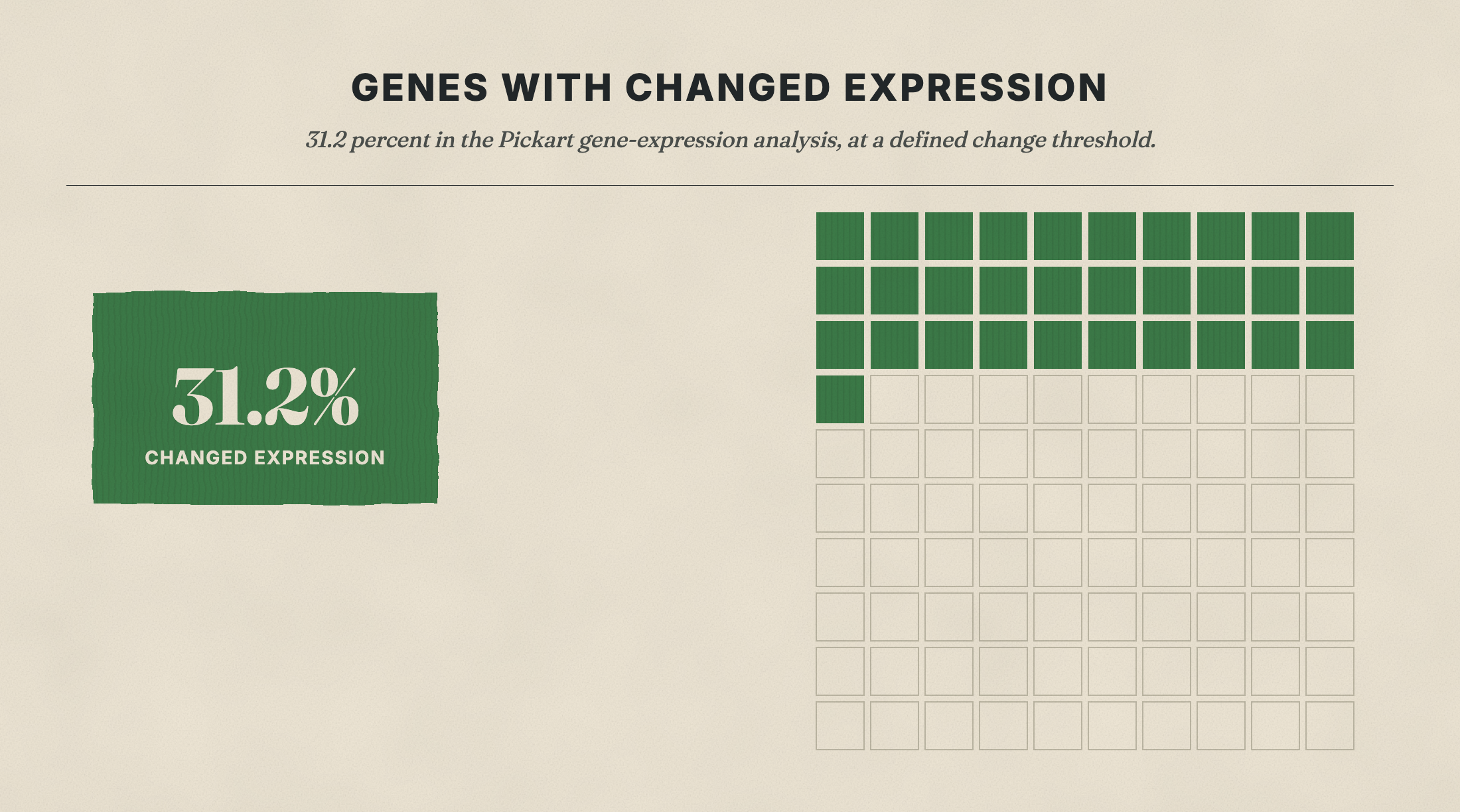
Pickart 2018 gene-expression analysis. 31.2 percent of genes crossed a defined change threshold. That is not the same as an injection resetting a third of the genome. The grid shows 31 of 100 squares as a rounded count.
Hair is a similar story. The mechanism, better blood flow to the follicle, less local inflammation, is plausible. The clinical evidence isn't strong enough yet to call GHK-Cu a replacement for minoxidil, whatever the marketing around it says.
The real obstacle, and a new fix worth watching
Here's a problem that follows GHK-Cu everywhere it's used. It doesn't last long once it's in the body. It's a small, charged molecule, and it breaks down fast, especially outside a narrow pH range. That's the real reason absorption has been such a headache, whether that's a cream barely getting past the skin barrier or an oral dose getting torn apart by digestive enzymes before it does anything.
If this article helped you, please share it. Your shares help keep Sage Matters free, and I only ask you to share it if you genuinely found it useful.
Here's something worth watching on exactly that front. Two 2025 papers out of Italy describe chemically linking GHK to a sugar backbone, either trehalose, a simple two-sugar molecule, or hyaluronan, the same large sugar polymer your joints and skin already use to hold water. In cell culture, the sugar-linked versions held onto copper just as well as plain GHK, and the sugar itself appeared to boost the peptide's antioxidant activity rather than get in the way of it (Naletova 2025). The hyaluronan-linked version also triggered release of proteins tied to bone and blood vessel growth (Greco 2025).
I want to be straight about what this is. It's lab bench work in cell culture, and it doesn't prove anything yet about oral or systemic absorption in people. But it's a real, mechanistic answer aimed at GHK-Cu's actual weak point, and it tells me serious researchers are trying to fix the stability problem instead of just injecting more of an unstable peptide and hoping for the best. That's the kind of development I want to keep an eye on for you.
What I'd tell you if you're already using it
A lot of people are already using GHK-Cu, topically, orally, or by injection, and plenty of them report real results. I'm not here to tell you to stop, and I'm not the FDA. My job is to make sure you know what you're actually looking at.
Topical use is the best-supported route, and my own read is that the downside risk there is low. Same with oral use, where absorption is limited but the safety margin is wide. Injectable use is a different conversation, not because the peptide itself looks dangerous, but because you're relying on an unregulated product for purity, sterility, and actual concentration, without the dose-ranging studies that would normally back up a specific protocol.
If you're curious what people are actually doing, community reports describe subcutaneous doses around 1 to 2.5 mg a day, often cycled over a few weeks. Blends marketed as "glow" stacks, which combine GHK-Cu with BPC-157 and thymosin beta variants, tend to run higher, 5 to 7.5 mg total. None of that is an evidence-based dose, it's just what's circulating, and there's no validated human dosing standard for systemic use yet, whatever the goal.
A few practical things matter more than the peptide itself. Zinc competes with copper, so loading up on zinc while using a copper peptide can work against you. Vitamin C and adequate protein support the same collagen-building work GHK-Cu is trying to do, so it helps to have those covered. And a label that says "copper peptide" tells you nothing about purity, concentration, or whether the specific formulation has any data behind it at all. That part matters more than most people think.
If you're already injecting it and want to be careful, checking serum copper, ceruloplasmin, and basic liver and kidney function isn't unreasonable. There's no universal protocol telling you exactly what to check or how often, so use judgment.
Where I land
GHK-Cu is a real molecule with real biology behind it. Copper transport, collagen organization, antioxidant defense, mitochondrial function, wound repair, it touches all of it, and the topical and wound-healing evidence is solid enough to take seriously. The rest, the mitochondrial story, the gene-expression breadth, the lung and gut and brain findings, is promising and worth watching, not proof of anything yet.
I'd rather tell you honestly where the evidence stands than sell you certainty I don't have. Plenty of people are getting real results with this peptide. That's worth knowing too. I want you deciding with your eyes open.
Ready to start restoring your health?
The membership is $300 a month, month to month. You get a written plan, teaching, and coaching. Sage does not diagnose you or give you a personal medical reading.
See the membershipReferences9
- Pickart L, Margolina A. Regenerative and Protective Actions of the GHK-Cu Peptide in the Light of the New Gene Data. Int J Mol Sci. 2018;19(7):1987.
- Campbell JD, et al. A gene expression signature of emphysema-related lung destruction and its reversal by the tripeptide GHK. Genome Medicine. 2012;4:67.
- Wang X, et al. GHK-Cu-liposomes accelerate scald wound healing in mice by promoting cell proliferation and angiogenesis. Wound Repair Regen. 2017;25(2):270-278.
- Exploring the beneficial effects of GHK-Cu on an experimental model of colitis and the underlying mechanisms. Frontiers in Pharmacology. 2025;16:1551843.
- Intranasal GHK peptide enhances resilience to cognitive decline in aging mice. 2023. PMID:38014118.
- Naletova I, Rizzarelli E. Protective Functions of β-Alanyl-L-Histidine and Glycyl-L-Histidyl-L-Lysine Glycoconjugates and Copper in Concert. Antioxidants. 2025;14(12):1512.
- Greco V, Lanza V, Tomasello B, Naletova I, Cairns WRL, Sciuto S, Rizzarelli E. Copper Complexes with New Glycyl-l-histidyl-l-lysine-Hyaluronan Conjugates Show Antioxidant Properties and Osteogenic and Angiogenic Synergistic Effects. Bioconjugate Chemistry. 2025;36(4):662-675.
- Leyden JJ, Stephens TJ, Finkey MB, Appa Y, Barkovic S. Skin care benefits of copper peptide containing facial cream. Presented at the American Academy of Dermatology 60th Annual Meeting, New Orleans, LA. 2002. (Conference-presented data, not an independent peer-reviewed publication.)
- Carey W. Epigenetic mechanisms activated by GHK-Cu increase skin collagen density in clinical trial. Yuvan Research Inc. news release via EurekAlert. 2023. (Company-sponsored trial of the company's own proprietary product, released via press announcement, not peer-reviewed.)
More from Sage Matters
I read the FDA's own review of seven peptides. Their scientists said no to all of them.
I read the FDA's own review of seven peptides. Their scientists said no to all of them.
READ ARTICLE
The GLP-1 story keeps growing- Part 3
The addiction data got real
READ ARTICLE
GLP-1s might be the best longevity medicine we have-Part 2
GLP-1s might be the best longevity medicine we have
READ ARTICLE
Why I don't chase the scale with GLP peptides- Part 1
Why I don't chase the scale with GLP-1s
READ ARTICLE