Introduction
Patients ask me about BPC-157 and Semax more than almost any other compound these days. So when the FDA's Pharmacy Compounding Advisory Committee spent two days this past July deciding whether pharmacies can legally compound seven of the most talked-about peptides, I didn't wait for a headline to tell me what happened. I pulled the FDA's own briefing documents, all eight of them, and read what their scientists actually wrote before the vote.
I should say where I stand before I show you what I found. I've been interested in peptides since I studied Vladimir Khavinson's bioregulator research years ago, the same researcher behind epitalon, one of the seven compounds in this review. I've watched patients get real, sometimes striking results from peptide therapy. That's anecdote, and I'll use that word on purpose, because that's exactly what it is, however impressive it's been to watch. What I found in the FDA's own documents is the gap between what I've watched happen and what anyone can actually prove.
What FDA's own scientists actually said
FDA reviews a substance for compounding against four things: how well it's chemically characterized, how long it's actually been used in compounding, what evidence exists that it works, and what evidence exists that it's safe (FDA PCAC Introduction Briefing 2026). Because FDA treats a peptide's free-base form and its acetate salt as two separate substances, each of the seven peptides got two recommendations, fourteen in total. FDA staff wrote the same conclusion fourteen times: do not add this to the compounding list.
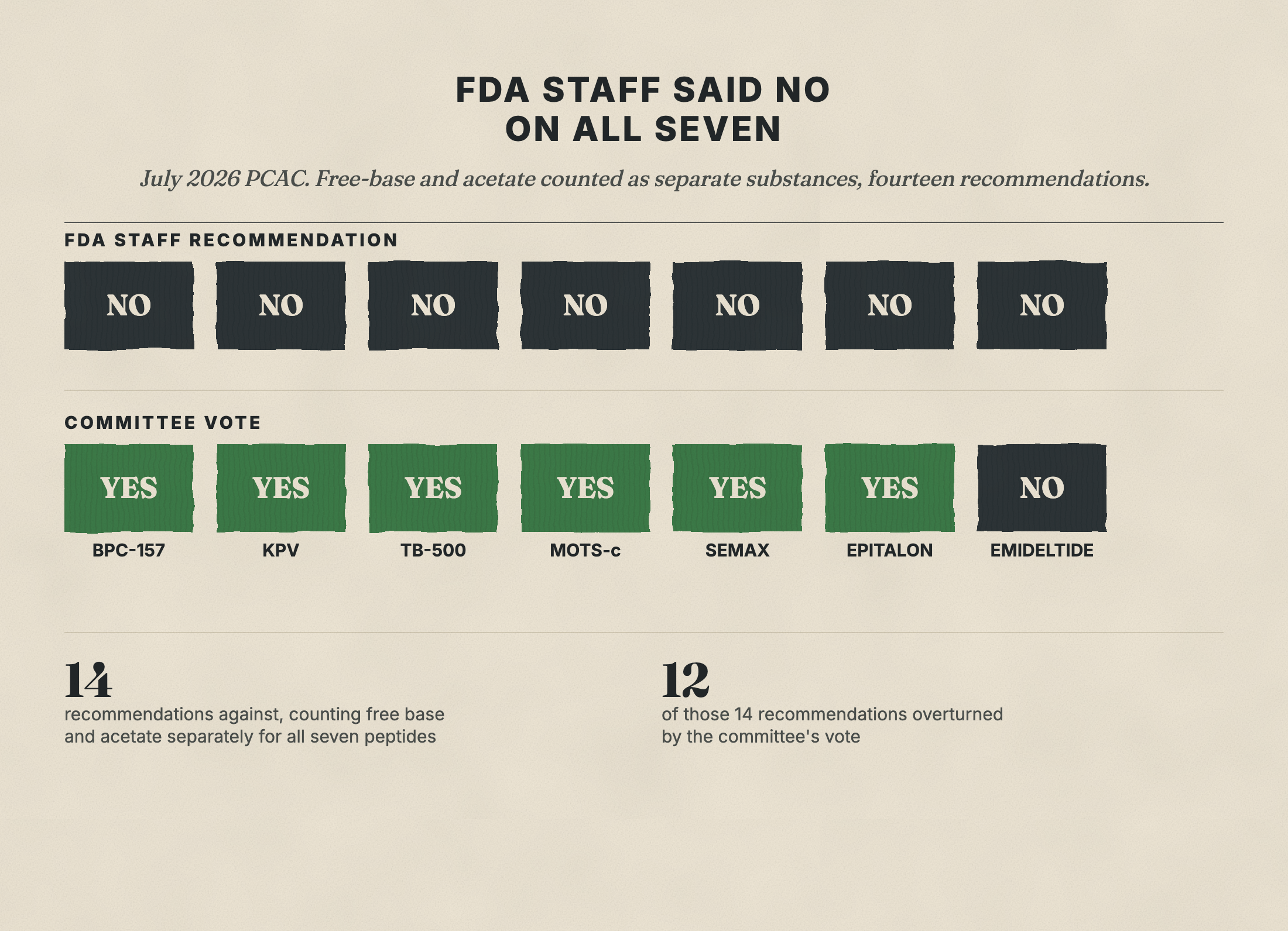
FDA PCAC briefing documents, July 23-24, 2026. Staff recommended against all seven peptides. Free-base and acetate counted separately, fourteen recommendations. Committee approved six of seven.
Two of the seven, KPV and TB-500, have no human data behind them at all. FDA's reviewers wrote plainly that they could not find a single published study of either compound given to a human being, for any reason (FDA KPV Briefing 2026, FDA TB-500 Briefing 2026). MOTS-c is the same story (FDA MOTS-c Briefing 2026). BPC-157 has exactly five human studies behind it, and the one trial for its proposed use, ulcerative colitis, was presented at a 2005 gastroenterology conference and never published as a full paper (Ruenzi et al., Gastroenterology 2005, abstract A584, cited in FDA BPC-157 Briefing 2026). Semax has two usable human references, and one of them found the drug didn't actually relieve pain for most of the migraine and trigeminal neuralgia patients who took it (FDA Semax Briefing 2026).
Two of seven have zero human data at all. The rest have almost none.
The safety signals that did turn up
Where FDA's reviewers did find something, it wasn't reassuring.
A 28-day toxicology study in rats and dogs found BPC-157 altered blood clotting time and raised liver markers including ALT, glucose, and triglycerides. FDA's own reviewers called these "clinically relevant safety signals" (FDA BPC-157 Briefing 2026). Three adverse event reports turned up in FDA's database, including a 28-year-old man who ended up in the emergency room with shortness of breath after an injection, and a woman whose skin darkened and stayed darkened after using a combination BPC-157/TB-500 product, a reaction that came back when she tried the product again (FDA BPC-157 Briefing 2026).
Semax's animal data showed it can affect blood clotting too, raising bleeding risk. In mice, it also increased the same dopamine response in the brain that amphetamine and cocaine produce. FDA's reviewers flagged that finding directly, because that response is the pathway behind drug reinforcement and addiction, and no one has studied whether Semax carries that same risk in people (FDA Semax Briefing 2026). FDA's adverse event database turned up one report: a patient hospitalized for eye pain and burning after using a Semax nasal spray bought online (FDA Semax Briefing 2026).
Epitalon is the one that stopped me, and it's personal for me. Khavinson's group developed epitalon and has published on it for decades, and I take that body of work seriously. That's exactly why FDA's finding here bothers me more than the others. Epitalon is marketed for anti-aging on the strength of one mechanism: it activates telomerase and lengthens telomeres. FDA's own reviewers point to that same mechanism as the risk. Longer telomeres are generally linked to a higher cancer risk (FDA Epitalon Briefing 2026). Taking Khavinson's research seriously means taking that finding seriously too, not just the parts that sound promising.
The one peptide with real data got voted down
Of the seven peptides reviewed, emideltide, also called DSIP, had by far the most human data behind it: 209 subjects across studies going back to the 1980s (FDA Emideltide Briefing 2026). It's the one substance in this review that actually has a real evidence base. It's also the only one the committee voted down.
Here's the catch. Every one of those 209 subjects got the drug intravenously, and the compounding proposal on the table was for a shot under the skin. Zero data exists for that route. Emideltide also has real recorded side effects, including a case of dangerously low blood pressure. FDA's reviewers pointed out that its mechanism looks a lot like how addictive drugs work. One of its proposed uses is treating opioid withdrawal itself (FDA Emideltide Briefing 2026).
So the peptide with the most actual human evidence, and real documented risks to weigh against it, is the one that got rejected. The six with almost no human evidence at all got approved.
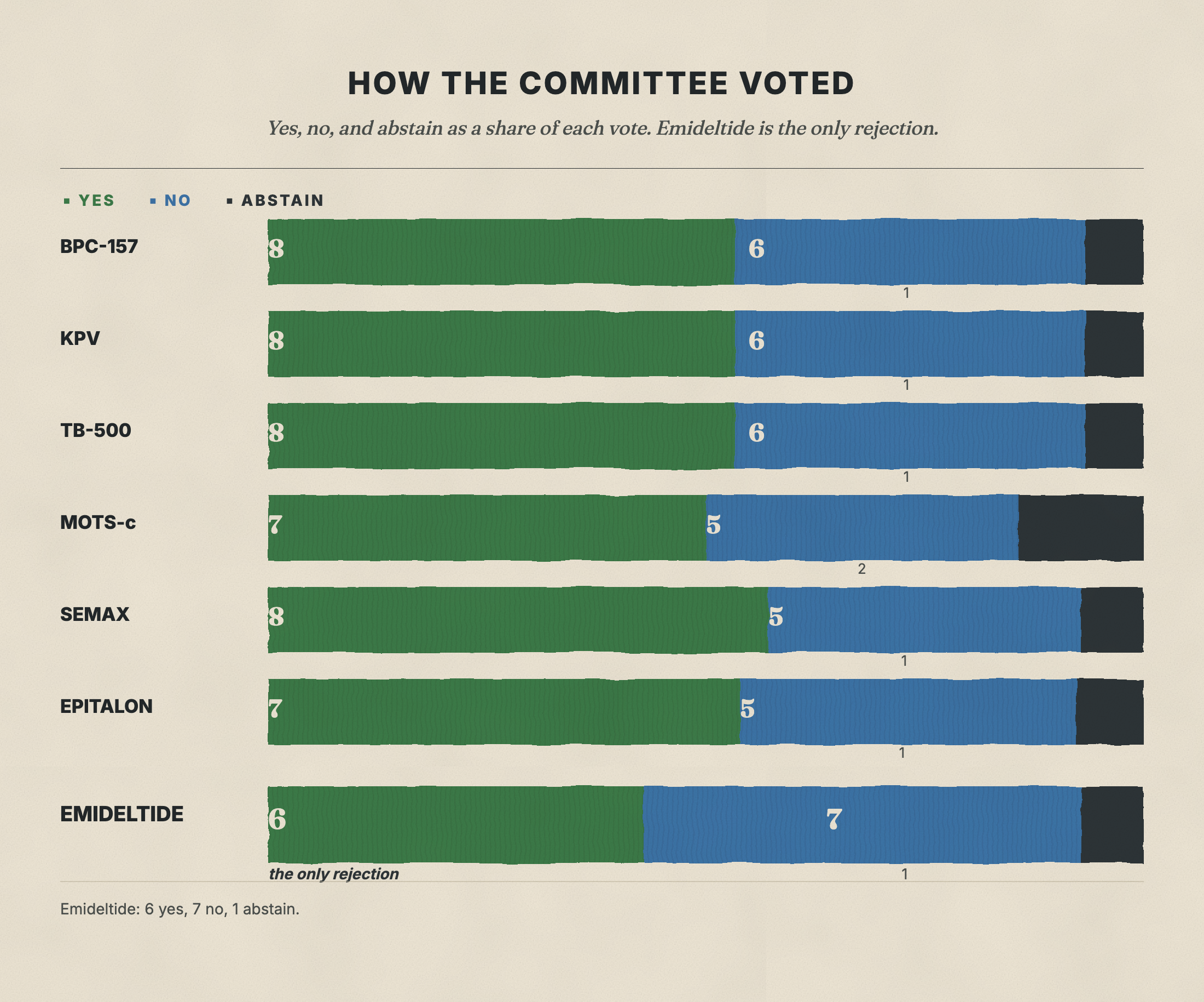
FDA PCAC vote, July 2026. Yes, no, and abstain as a share of each vote. Emideltide: 6 yes, 7 no, 1 abstain.
Two arguments, both real
I pulled FDA's own roster for this committee. Eight of its twelve standing members had been appointed only two to three months before the vote, seated in April and May of 2026 (FDA PCAC Roster 2026). Six of those eight run clinics that sell peptide therapy to patients right now, for the same compounds they were voting on. I checked each clinic myself.
All eight of the new appointees voted yes on BPC-157, KPV, and TB-500. Seven of eight voted yes on MOTS-c.
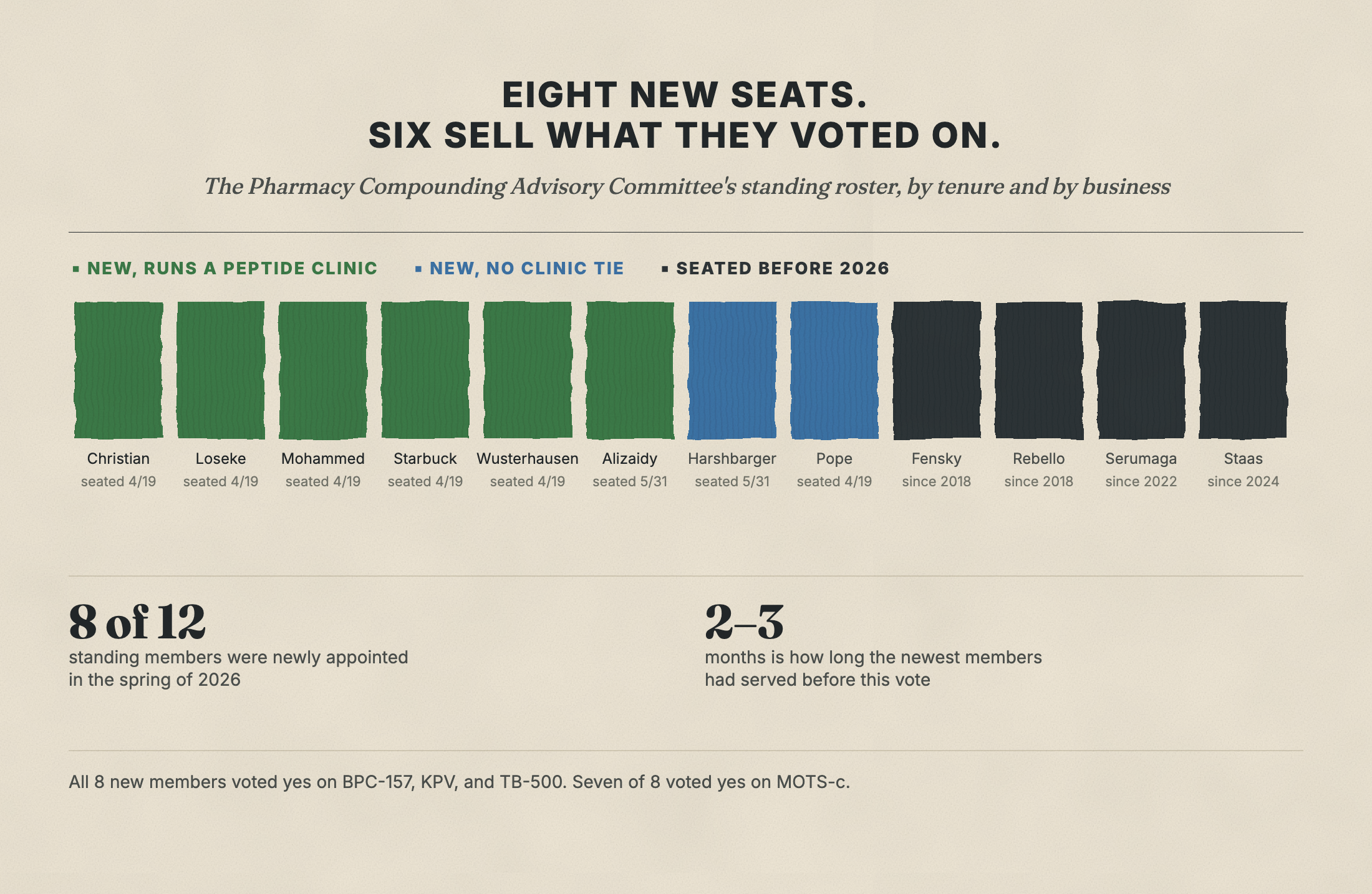
FDA PCAC standing roster, 2026. Eight of twelve standing members were appointed in April and May 2026. Six of those eight run peptide clinics. All eight new members voted yes on BPC-157, KPV, and TB-500. Seven of eight voted yes on MOTS-c.
I'm not going to pretend the access argument some of those same members made is wrong just because they had something to gain by making it. Dr. Haleem Mohammed, chief medical officer at Gameday Men's Health, a chain that sells BPC-157 directly, put it about as honestly as anyone did that week. Asked about the risk of pushing patients toward the gray market by voting no, he said he had to weigh "am I doing greater harm" (Lovelace and Miller, NBC News 2026). Patients really are buying these compounds from unlabeled vials shipped from strangers, and a licensed pharmacy is a genuine improvement over that, whatever else is true about the evidence.
Dr. Elizabeth Rebello, an anesthesiologist at MD Anderson with no peptide clinic and nothing to gain either way, made the opposite case just as plainly. She said she was concerned the committee was "responding to a market-induced demand rather than a decision based on solid science" (Lovelace and Miller, NBC News 2026). A federal listing reads to the public like an endorsement, evidence or not, and most of these compounds have never been tested in a real trial.
Mohammed sells the product he voted to approve. Six of the eight new members who voted yes do the same. Read both before you decide how much weight to put on this vote.
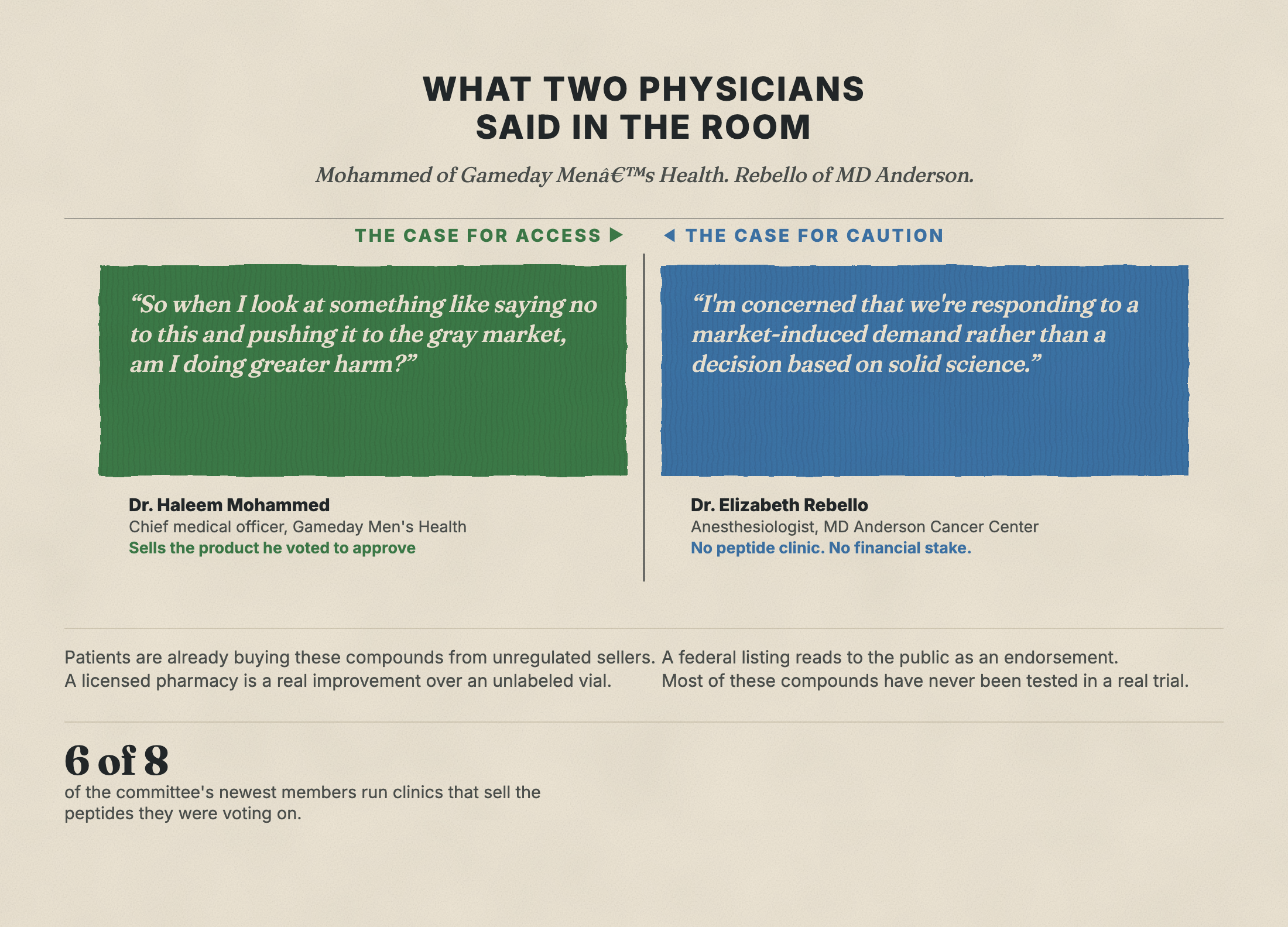
Quotes from Lovelace and Miller, NBC News, July 23, 2026. Mohammed is chief medical officer at Gameday Men's Health. Rebello is an anesthesiologist at MD Anderson with no peptide clinic.
This committee has said no before
This committee has ruled against the evidence before, in both directions.
If this article helped you, please share it. Your shares help keep Sage Matters free, and I only ask you to share it if you genuinely found it useful.
In June 2022, the same Pharmacy Compounding Advisory Committee reviewed enclomiphene citrate, a testosterone-related drug that arrived with a completed Phase 3 trial program. The committee voted against adding it to the compounding list. Compare that to July 2026, when the same body approved MOTS-c and KPV with no completed human trials of any kind. The 2022 committee rejected a drug that had trials. The 2026 committee approved compounds that don't.
There's precedent running the other way too. In a 2019 final rule, FDA overrode this same committee's own recommendation to add tranilast to the compounding list, even with the topical-only restriction the committee had proposed, because FDA's safety reviewers weren't satisfied. A committee "yes" has been reversed by the agency before. It can happen again here.
One more fact belongs in this section. FDA's BPC-157 review cites a Kentucky pharmacy, Tailor Made Compounding, as evidence that BPC-157 has a history of use in compounded products. What that review doesn't mention: that same pharmacy pleaded guilty in federal court in October 2020 to unlawfully distributing BPC-157 and several other unapproved peptides, including DSIP and epitalon, and forfeited $1,788,906.82 in sales (U.S. Attorney's Office, Eastern District of Kentucky, October 2020). "Historical use" is the category the vote used. The same pharmacy had a history of getting caught. Those are different facts.
Where I actually come down
I lean closer to the access argument than the caution argument. The evidence is not there yet, for most of these. I've watched peptides work in ways the formal trials haven't caught up to explaining, and I don't think that makes the anecdotes worthless, just unproven.
What I'd like to see is standardization: pharmacies compounding the actual molecule the label says, real side-effect reporting instead of a database nobody's required to use, and enough of that data accumulating that someone besides a wellness clinic can eventually say what these compounds actually do.
The honest problem underneath all of this is money. Most of these molecules can't be patented the way a new drug can, and a real randomized trial runs upward of $500 million. No company is going to spend that to prove a compound works when a generic version, if it existed, could be made by a compounding pharmacy the following Wednesday. I've followed Khavinson's peptide research since it was a much smaller field than it is today, and I think there's real science underneath a lot of this. GLP-1 drugs are the proof of what happens when a compound like this gets the investment and the trials it deserves. I'd like to see more of these substances get that same chance instead of sitting in the gray market forever.
Where this leaves you
None of that changes what's true today. A committee vote is a recommendation. FDA still has to issue a final rule, and it hasn't yet. What actually happened in that room over two days still isn't fully public either. FDA hasn't posted a transcript, only the raw video and the briefing documents I just walked you through.
If you're considering one of these peptides, ask your physician what the actual human data says for the specific form and route you'd be taking, and whether a committee voted yes. And go read FDA's own documents yourself if you want the source instead of my summary of it.
You should be the one in the driver's seat for your own path to health, Everything in life is a cost-benefit analysis. You weigh what you might gain against what you might lose, and then you choose. My job is to tell you honestly what's actually known right now, not to make that choice for you. This field moves fast enough that you can find someone credentialed to support almost any position you want to hear. So ask the two questions that actually matter here: what's the risk, and what's the benefit. To your health and well-being.
Ready to start restoring your health?
The membership is $300 a month, month to month. You get a written plan, teaching, and coaching. Sage does not diagnose you or give you a personal medical reading.
See the membershipReferences7
- FDA. "Pharmacy Compounding Advisory Committee Meeting, July 23-24, 2026." Introduction, BPC-157, KPV, TB-500, MOTS-c, Semax, Epitalon, and Emideltide Briefing Documents.
- FDA. "Pharmacy Compounding Advisory Committee Roster."
- Lovelace, Berkeley Jr., and Sara G. Miller. "FDA panel, with ties to the peptide industry, recommends easing restrictions on four of the compounds." NBC News, July 23, 2026.
- Ruenzi, M., et al. "A Multicenter, Randomized, Double Blind, Placebo-Controlled Phase II Study of PL 14736 Enema in the Treatment of Mild to Moderately Active Ulcerative Colitis." Gastroenterology, vol. 128, 2005, abstract A584.
- FDA. "June 8, 2022: Meeting of the Pharmacy Compounding Advisory Committee." Enclomiphene Citrate review materials.
- FDA. "List of Bulk Drug Substances That Can Be Used To Compound Drug Products in Accordance With Section 503A." Final rule, February 19, 2019.
- U.S. Attorney's Office, Eastern District of Kentucky. "Nicholasville Compounding Pharmacy and Its Owner Plead Guilty to Unlawful Distribution," October 2020.
More from Sage Matters
GHK-Cu: A Small Copper Peptide With Large Biological Ambitions
GHK-Cu: A Small Copper Peptide With Large Biological Ambitions
READ ARTICLE
The GLP-1 story keeps growing- Part 3
The addiction data got real
READ ARTICLE
GLP-1s might be the best longevity medicine we have-Part 2
GLP-1s might be the best longevity medicine we have
READ ARTICLE
Why I don't chase the scale with GLP peptides- Part 1
Why I don't chase the scale with GLP-1s
READ ARTICLE