Introduction
A randomized trial published in JAMA Psychiatry in 2025 gave weekly semaglutide to adults with alcohol use disorder (Hendershot 2025). By weeks 5 through 8, the drug group showed a large drop in heavy drinking days compared to placebo, and weekly cravings fell too. That's a controlled trial testing the claim head on, not an association study or a patient forum post.
The reason isn't a mystery once you know where GLP-1 receptors sit. They show up in the brain's reward circuitry, the same territory that lights up with nicotine, alcohol, and gambling. The VA has now launched its own trial for alcohol use disorder specifically, which tells you this moved from an interesting observation to funded research fast.
A cancer signal, with one exception
A 2025 study in JAMA Oncology matched 86,632 adults with overweight or obesity, split almost evenly between a GLP-1 group and a non-GLP-1 group, and tracked new cancer diagnoses (Dai 2025). Overall cancer risk was 17 percent lower in the GLP-1 group. Endometrial cancer dropped 25 percent. Ovarian cancer dropped 47 percent. Meningioma, a usually slow-growing brain tumor, dropped 31 percent. Most other cancers trended lower without reaching statistical significance. Kidney cancer trended the other way, though not significantly.
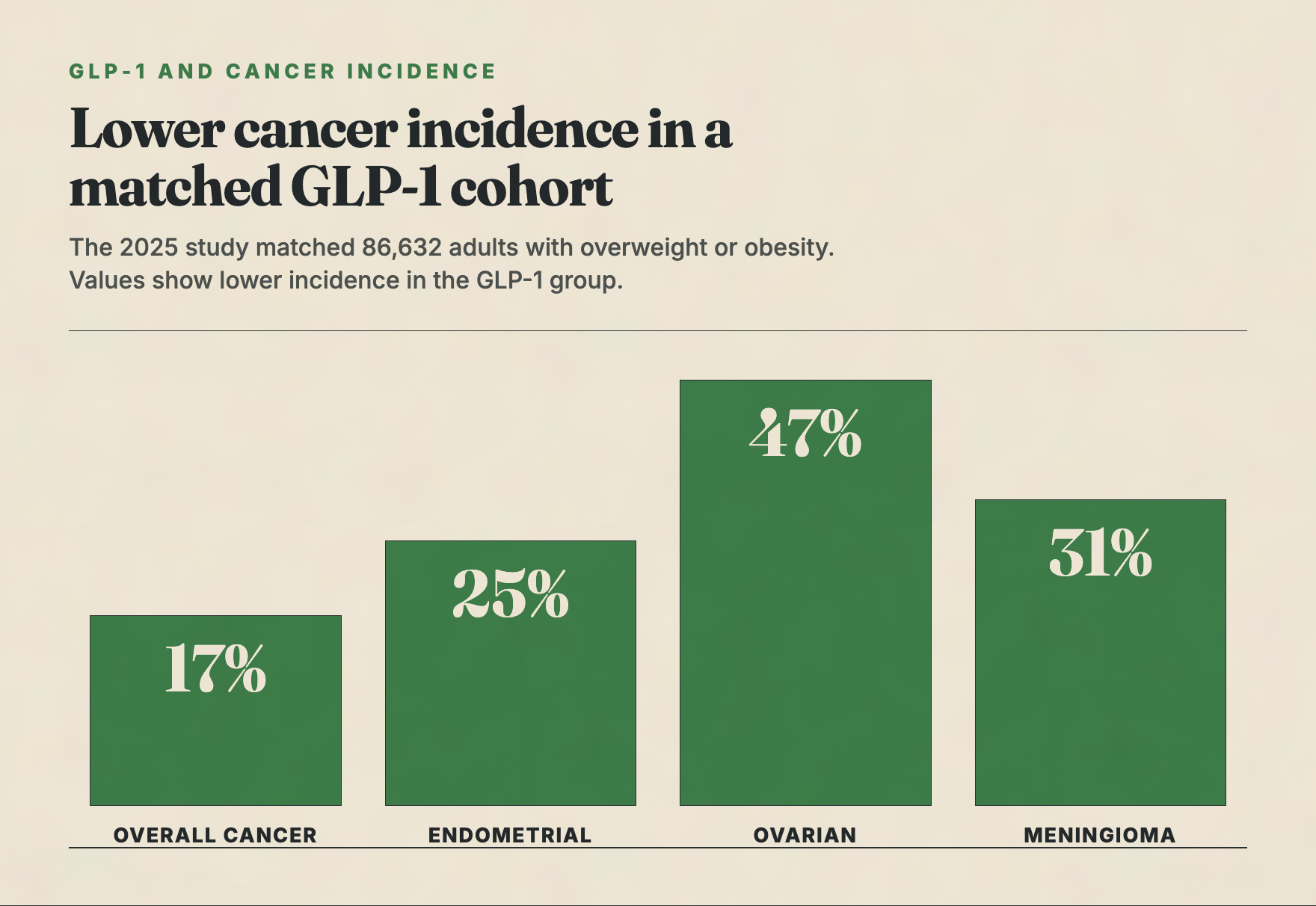
Matched cohort of 86,632 adults with overweight or obesity. The design can show association. Causation needs a randomized trial. Dai et al., JAMA Oncology 2025.
This is a matched cohort, not a randomized trial. It shows association, not proof. I've believed for a long time that metabolic dysfunction plays a bigger role in cancer risk than the genetics-first framing most people grew up with. This is the first large dataset I've seen that puts a number on that belief for GLP-1s specifically. Whether that turns out to be the actual mechanism, I don't know yet.
Where these receptors actually sit
GLP-1 drugs land on receptors well beyond the gut, and two papers now show exactly where.
One is a mouse study out of the Drucker lab. It found that semaglutide lowers blood pressure through GLP-1 receptors on vascular smooth muscle cells, the muscle layer inside blood vessel walls (Medak 2026). The study pinpointed the effect to that specific cell type. Receptors on the endothelium and on nearby immune cells didn't drive it. The muscle cells relax the vessel directly. It's mouse data, so I'd hold off calling this settled in humans, but it's a clean mechanism for something Part 2 could only gesture at.
The other used a technique called Mendelian randomization, which looks at people's genetic variants to estimate what a lifetime of a drug's effect on a receptor might look like, without anyone actually taking the drug (PMID 42028610). Across more than 633,000 people in the All of Us database, the genetic pattern that mimics constant, low-level GLP-1 signaling tracked with heart failure, chronic kidney disease, and coronary artery disease risk all running 2 to 4 percent lower. Small numbers, because this is lifetime genetic exposure, not a drug dose. Still, it's a different kind of evidence than a trial, and it points the same direction SELECT and FLOW already pointed.
Bone, narrower than I said last time
In Part 2 I speculated that a steady low dose might protect bone rather than thin it. There's now a real dataset that says something sharper and more limited than that. A large records-based study, built to mimic a randomized trial using tens of thousands of matched patients, found that in people with obesity and type 2 diabetes, starting semaglutide cut the three-year risk of a major fracture by 16 to 31 percent compared to other diabetes drugs or usual care (PMID 42010367). In people with obesity but no diabetes, there was no fracture signal either way.
The likely reason is specific to diabetes. High blood sugar over years stiffens collagen in bone through a process called glycation, where sugar molecules crosslink with collagen and weaken it independent of bone density. Fix the blood sugar and some of that damage seems to reverse. Bone protection is real. It's just narrower than what I speculated in Part 2. It shows up in diabetics, not in everyone losing weight on these drugs.
The muscle math, one more time
I want to revisit the muscle number that scared people, because it’d be good to sharpen the explanation I made it in Part 2. It comes from a DEXA scan, the standard body-composition scan, and a measurement it produces called lean mass. Lean mass includes muscle, tendon, ligament, organ tissue, and the water stored with glycogen (Prado 2024). Muscle itself is only a fraction of that total lean mass figure, nowhere close to all of it. A drop in lean mass on a scan is not the same as losing a proportional amount of muscle.
Bone loss has a simpler explanation that doesn't require blaming the drug directly either. Lose weight fast and you lose the load your bones carry every day. Less load means less signal telling bone to stay dense. That's true of any rapid weight loss, not something specific to these drugs. Protect the muscle with protein and resistance training, and you're protecting the mechanical loading that keeps bone dense at the same time. Same advice as Part 1. Now there's a clearer reason why it works.
The dosing problem is still an industry problem
I've written twice now about favoring a lower, steadier dose over the label-max protocol most trials used. The industry built around these drugs hasn't caught up to that idea. A JAMA study published in July 2026 sent researchers to shop 49 online GLP-1 websites the way a real patient would (Chetty 2026). Forty-five of the 49 sites issued a prescription. Only 26.5 percent required a video visit with a clinician. Just 6.1 percent required a phone call. Two compounded orders got approved in under 5 minutes.
Instead of individualized care, you’re getting a vending machine with a website in front of it. When I talk about starting low and adjusting based on how someone actually responds, I mean something closer to a half dose or three-quarter dose for most patients, built around bloodwork and how they're doing, instead of a fixed ladder a website runs everyone through in five minutes. The tool itself works. But the way most of the market delivers it is not how I'd want a family member using it.
Fertility, sex differences, and a myth worth correcting directly
Women lose more weight on these drugs than men do. Across 14 randomized trials pooled together, women lost about a kilogram more and 1.7 percentage points more body weight than men (Yang 2025). In the STEP 1 trial specifically, the treatment effect over placebo was nearly twice as large in women as in men, 14 percent versus 8 percent (Wilding 2021). A 2026 brain atlas out of Mount Sinai mapped GLP-1 receptor distribution across 25 brain regions in mice, and the pattern differs by sex, with females showing more receptor density in reward circuitry and males showing more in regions tied to smell and appetite. That's mouse tissue, offered as a possible reason for the human pattern, not proof of it.
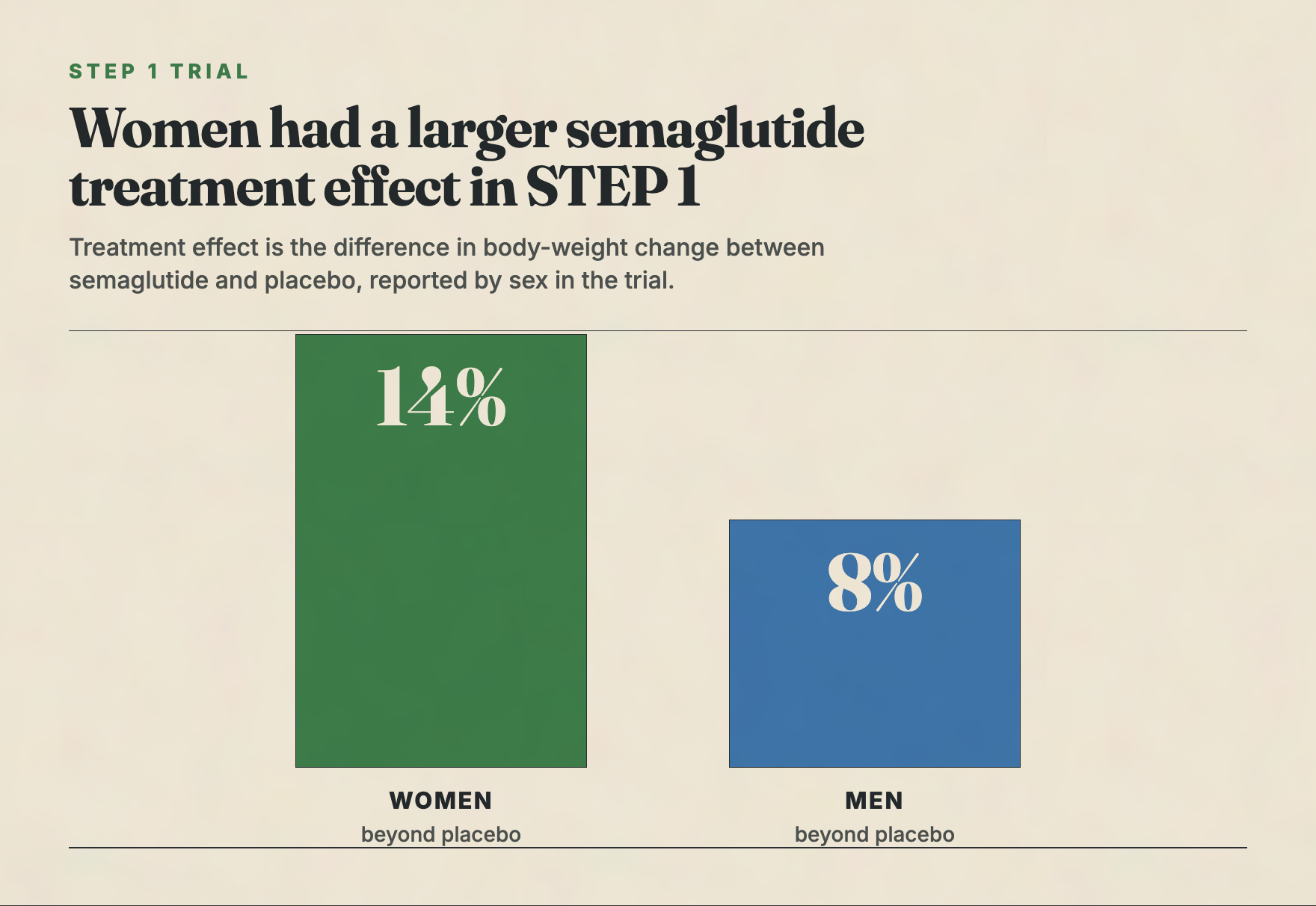
STEP 1 trial. Average treatment effect by sex, reported beyond placebo. Wilding et al., New England Journal of Medicine 2021.
Then there's fertility. Better insulin sensitivity in polycystic ovary syndrome (PCOS), a hormonal condition where high insulin drives excess androgen production and irregular ovulation, restores ovulation in some women within 6 to 12 weeks. That's likely behind the online groups of people calling their kids Mounjaro babies. Now there is something I want to address that I’ve seen stated wrongly elsewhere. Semaglutide specifically does not lower blood levels of birth control hormones. Older GLP-1 drugs like exenatide and liraglutide can, by up to 45 percent, through slower gastric emptying. The unplanned pregnancies aren't semaglutide breaking anyone's birth control. They're ovulation coming back in women who weren't ovulating before.
A postmenopausal-specific finding is worth naming too. A Mayo Clinic study following 120 postmenopausal women on tirzepatide for at least a year found those also on hormone replacement therapy lost more weight than those on tirzepatide alone, 19.2 percent versus 14.0 percent (Hurtado Andrade 2026). It's an observational study, not a randomized one, so the senior author was careful to say it doesn't prove HRT caused the extra loss. Better sleep and energy from HRT could just as easily be doing the work by making the rest of the plan easier to stick to.
If this article helped you, please share it. Your shares help keep Sage Matters free, and I only ask you to share it if you genuinely found it useful.
One open question I don't think has a clean answer yet. In women with androgen-dominant PCOS, meaning higher baseline testosterone and related symptoms, there's a real possibility that starting a GLP-1 too fast can temporarily worsen hair loss and other androgen symptoms before things improve, tied to how quickly insulin and androgen levels shift together. I haven't seen a study I'd call definitive on this. It’s not an established risk, but it is a real question worth considering versus finding out the hard way.
Two more pieces worth knowing about
Statins and GLP-1 have an odd relationship. A 2024 study found statins reduce circulating GLP-1 through a gut microbiome-dependent pathway, which the authors tie to the well documented link between statins and higher insulin resistance (PMID 38325336). If you're on a statin and a GLP-1 at the same time, that interaction is worth knowing about, even though it doesn't change what I'd recommend for either drug on its own.
And the gut can complicate things too. A small 2025 study testing 99 patients on GLP-1 drugs for microbial overgrowth found 76 percent tested positive for small intestinal bacterial overgrowth, or SIBO, bacteria growing where they shouldn't in the small intestine (Damianos 2025). Most of those patients had diabetes, and the study didn't compare against people not taking a GLP-1, so I can't tell you the drug caused it. But slowing the gut down is exactly the mechanism that would make SIBO more likely, and SIBO raises a molecule called lipopolysaccharide that drives the same insulin resistance these drugs are meant to treat. If that connection holds up under better study design, it's one more reason these drugs will work better when taking gut health into account, instead of blindly making them the whole plan.
The mood question deserves its own honest paragraph
A 2024 study in Scientific Reports followed 162,253 matched patients with obesity and found GLP-1 use associated with a near doubling of any psychiatric disorder diagnosis, close to a tripling of major depression, and roughly double the risk of anxiety and suicidal ideation or attempts (Kornelius 2024). Women showed the highest depression risk in that dataset, and younger adults showed the highest risk of suicidal ideation.
That number stays in this piece exactly as reported. It doesn't settle the question. Other datasets have found the opposite direction, lower depression risk in some GLP-1 users, and a Swedish national cohort found the picture depends heavily on whether someone already had depression or anxiety before starting. The Kornelius data reflects standard, label-level dosing, the kind used in the original approval trials, not the microdose range I actually recommend in practice. Nobody has specifically studied mood outcomes at a microdose yet, so I can't tell you that gap erases the risk. My own read is that it likely narrows it. Anyone starting a GLP-1 with a personal history of depression, anxiety, or suicidal thoughts should still have that conversation with their prescriber before the first dose, not after the first month.
Where this leaves us
That's a lot of new ground since Part 2, and it lands at different levels of certainty. The drop in heavy drinking days came out of a real randomized trial. The cancer numbers come from a large matched cohort pointing one direction, useful but not proof. The mast cell and skin reports I've heard from other physicians are still individual patient stories, worth watching and nothing more yet.
Taken together, there are more reasons than ever to consider a GLP-1 as part of a long-term regimen, at what I call a microdose. A large number of patients are already on these peptides, and the range of positive reports keeps growing. I expect more of them. At a microdose, the concerns I've walked through in this piece shrink down close to background noise. The risk doesn't disappear entirely. In my practice, it gets small enough that it stops being the deciding factor for most patients. The calculus changes once someone isn't using the maximum trial dose the way the FDA studies did.
Have that conversation with your physician. Decide if it's right for you.
Ready to start restoring your health?
The membership is $300 a month, month to month. You get a written plan, teaching, and coaching. Sage does not diagnose you or give you a personal medical reading.
See the membershipReferences14
- Hendershot CS, Bremmer MP, Paladino MB, et al. Once-Weekly Semaglutide in Adults With Alcohol Use Disorder: A Randomized Clinical Trial. JAMA Psychiatry. 2025;82(4):395-405.
- Dai Y, et al. GLP-1 Receptor Agonists and Cancer Risk in Adults With Obesity. JAMA Oncology. 2025.
- Medak KD, et al. Semaglutide reduces murine blood pressure through the vascular smooth muscle GLP-1 receptor. 2026. PMID 41774502.
- Long-Term Efficacy and Safety of GLP-1R Agonist and SGLT2 Inhibitor Therapy in the General Population: A Mendelian Randomization Study. Circulation: Genomic and Precision Medicine. PMID 42028610.
- Associations of Semaglutide With Skeletal Outcomes in People With Obesity, With and Without Type 2 Diabetes: A Target Trial Emulation. PMID 42010367.
- Prado CM, et al. Muscle matters: the effects of medically induced weight loss on skeletal muscle. Lancet Diabetes Endocrinol. 2024.
- Chetty AK, Chen AS, Ross JR, Ramachandran R. Online prescribing of GLP-1 receptor agonists. JAMA. Published online July 6, 2026. doi:10.1001/jama.2026.9131.
- Yang, et al. Sex differences in GLP-1 receptor agonist weight loss response, meta-analysis of 14 randomized trials. Journal of Diabetes. 2025.
- Wilding JPH, et al. Once-Weekly Semaglutide in Adults with Overweight or Obesity (STEP 1). N Engl J Med. 2021;384(11):989-1002. PMID 33567185.
- Icahn School of Medicine at Mount Sinai. Sex-specific atlas of GLP-1 receptor distribution in the brain. Brain Medicine. March 10, 2026.
- Hurtado Andrade MD, et al. Hormone therapy and tirzepatide in postmenopausal women. The Lancet Obstetrics, Gynaecology & Women's Health. February 2, 2026.
- Statins aggravate insulin resistance through reduced blood glucagon-like peptide-1 levels in a microbiota-dependent manner. 2024. PMID 38325336.
- Damianos JA, Fredrick TW, Jin MF, Ospina-Velasquez L, Wang XJ. GLP-1 Receptor Agonist Use Is Associated With Small Intestinal Bacterial Overgrowth and Intestinal Methanogen Overgrowth. Foregut. 2025;5(4):433-437.
- Kornelius E, Huang JY, Lo SC, Huang CN, Yang YS. The risk of depression, anxiety, and suicidal behavior in patients with obesity on glucagon-like peptide-1 receptor agonist therapy. Scientific Reports. 2024;14:24433.
More from Sage Matters
I read the FDA's own review of seven peptides. Their scientists said no to all of them.
I read the FDA's own review of seven peptides. Their scientists said no to all of them.
READ ARTICLE
GHK-Cu: A Small Copper Peptide With Large Biological Ambitions
GHK-Cu: A Small Copper Peptide With Large Biological Ambitions
READ ARTICLE
GLP-1s might be the best longevity medicine we have-Part 2
GLP-1s might be the best longevity medicine we have
READ ARTICLE
Why I don't chase the scale with GLP peptides- Part 1
Why I don't chase the scale with GLP-1s
READ ARTICLE