Introduction
A psychiatric clinic once looked back through the records of 72 adults who had added CBD to their usual care. Within the first month, anxiety scores had dropped in 57 of them and sleep scores had improved in 48. Only 3 people didn't tolerate it well (Shannon 2019). It was a look back at charts with no placebo group, so it can't prove the CBD did the work. It does tell us what a lot of real people experienced.
By hemp oil, I mean a CBD-rich extract from the hemp plant. CBD, short for cannabidiol, is the compound in the plant that doesn't make you high. The hemp seed oil on a grocery shelf has little or no CBD. In 2018 the World Health Organization's drug dependence committee reviewed pure CBD and found it had no psychoactive properties and no potential for abuse or dependence (WHO 2018).
CBD comes from Cannabis sativa, the same plant species as marijuana and marijuana is the source of THC which is the drug that gets you high. Growers can breed it to produce a great deal of THC, the compound that gets you high. Industrial hemp is the variety that makes very little THC. Until now, federal law has counted a plant as hemp if it has 0.3% THC or less by dry weight (Leafwell 2026).
Sleep and anxiety
In that clinic's records the anxiety improvement held over time. The sleep improvement showed up for about two out of three people in the first month and then moved up and down over the months that followed (Shannon 2019).
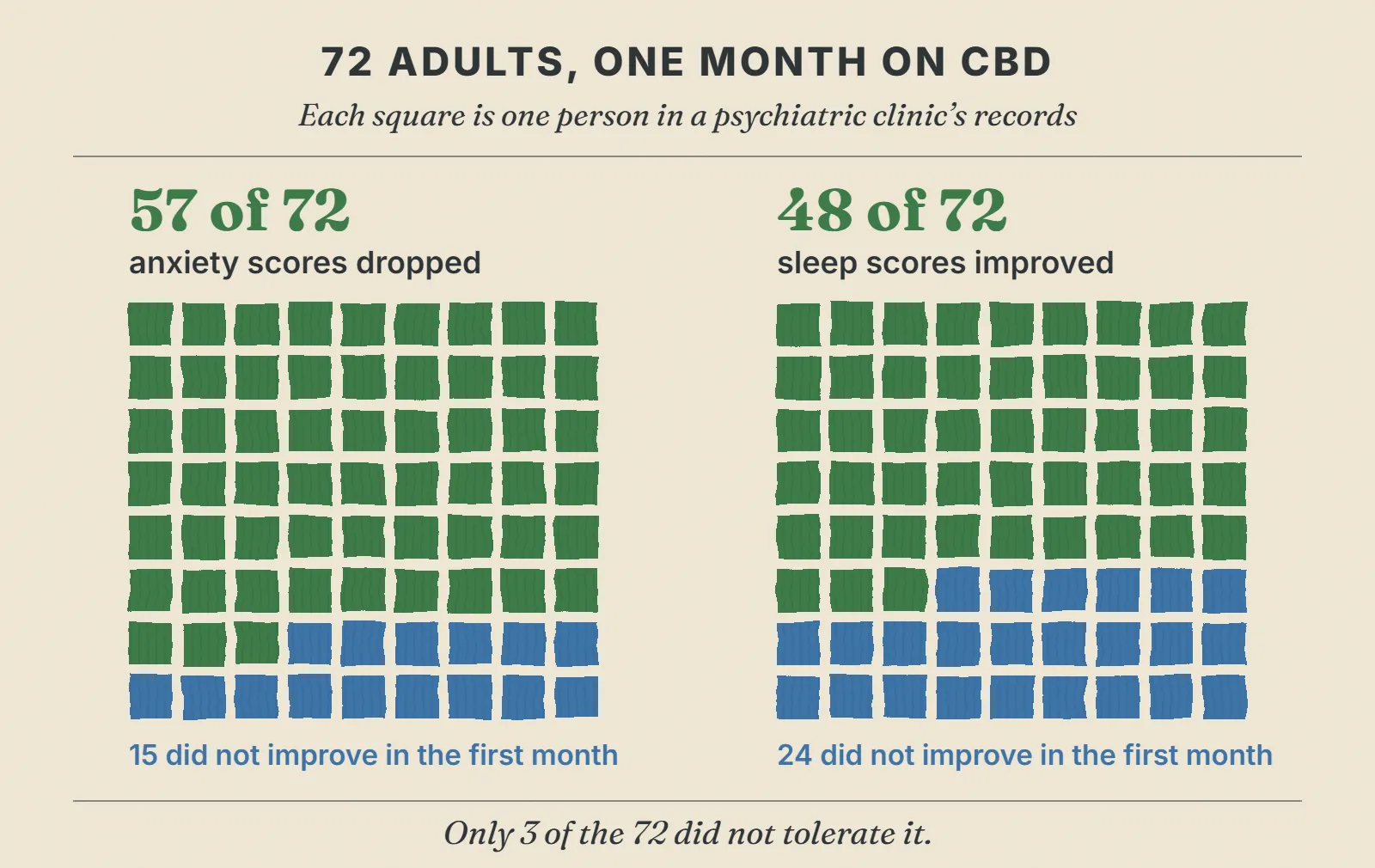
Shannon S, et al. (2019), The Permanente Journal. A look back at the records of 72 adults at one psychiatric clinic who added CBD to their usual care, with scores from the first month. There was no placebo group, so this cannot prove the CBD caused the change.
A smaller study looked at anxiety more closely. Twenty-four people with social anxiety who had never been treated were asked to give a simulated speech. Half took a single 600 mg dose of CBD beforehand and half took a placebo. The CBD group felt less anxious, less mentally foggy, and less uncomfortable, and on those measures they did not differ significantly from a group of healthy volunteers (Bergamaschi 2011). That was 12 people per group on a single afternoon, so the research is still early. It shows the effect is worth studying further.
Depression has the least support of anything here. A 2020 review calls CBD a potential new alternative for treating anxiety, depression, and psychotic disorders (García-Gutiérrez 2020). I don't have a trial of CBD oil in people with depression to hand you.
Pain, inflammation, and the gut
Inflammation is part of many painful conditions, and inflammation is where CBD has the most laboratory support. Two 2020 reviews describe how CBD and the body's own endocannabinoid system, a network of receptors that helps regulate immune cells, influence immune responses (Nichols and Kaplan 2020, Almogi-Hazan and Or 2020). Both are reviews of the research, not trials.
I don't have a trial of CBD oil alone for pain that I can put here. I'd rather say that than stretch a study. Pain is a reasonable thing to test carefully and judge by how you feel.
"Leaky gut" is the everyday name for a gut lining that lets more through than it should. Researchers paired CBD with palmitoylethanolamide, or PEA, a fatty compound the body makes naturally. They reported that the pair prevented inflammation-induced leakiness of the human gut in laboratory cultures and in a randomized, placebo-controlled, double-blind trial (Couch 2019). The same lead author found CBD and PEA were anti-inflammatory in the acutely inflamed human colon (Couch 2017). CBD was paired with PEA both times, so the credit can't go to CBD alone.
Choosing a product before December 11
Full-spectrum oil keeps the plant's other natural compounds along with the CBD. Isolate is CBD alone. The reasoning behind full spectrum is the entourage effect, the idea that these compounds work better together.
One paper found that purified CBD works best at a middle dose and loses its effect as the dose climbs, and that an extract enriched in CBD overcame that pattern (Gallily 2015). A 2018 paper on treatment-resistant epilepsy reported potential clinical benefits of CBD-rich extracts over purified CBD (Pamplona 2018). I'd call the idea promising and unproven.
Quality is the first problem. A 2017 JAMA study tested CBD extracts sold online to see whether the label matched what was inside, and many did not match (Bonn-Miller 2017). A batch-specific report from an independent lab tells you how much CBD is in the bottle and whether it is free of contaminants such as pesticides and heavy metals. If a company can't show you one, I'd pass.
A 2023 review examined how CBD interacts with standard chemotherapy drugs (Buchtova 2023). If you take chemotherapy or any prescription medicine, talk with the physician who prescribes it before you start.
Then treat it as a real trial. Change one thing at a time and keep a short daily note on your sleep, anxiety, and pain, so you can tell whether it's helping you.
One warning before you buy. Starting December 11, 2026, a finished hemp product with more than 0.4 mg of total THC per container no longer counts as hemp under federal law (Vicente LLP 2026, Leafwell 2026). The limit is an amount per bottle, not a percentage or an amount per dose. Per container!
If this article helped you, please share it. Your shares help keep Sage Matters free, and I only ask you to share it if you genuinely found it useful.
Full-spectrum oil keeps the plant's trace THC, and even a tiny percentage adds up across a whole bottle. By my math, a 30 mL bottle that is only 0.1% THC holds about 28 mg, roughly 70 times the limit. As the law is written, most full-spectrum oils will not pass. Isolate and broad-spectrum products, which have the THC taken out, can come in under the limit, and the batch lab report is how you'd know (Leafwell 2026). Bills to delay or repeal the change have been introduced, and none had passed as of October 2026 (Leafwell 2026).
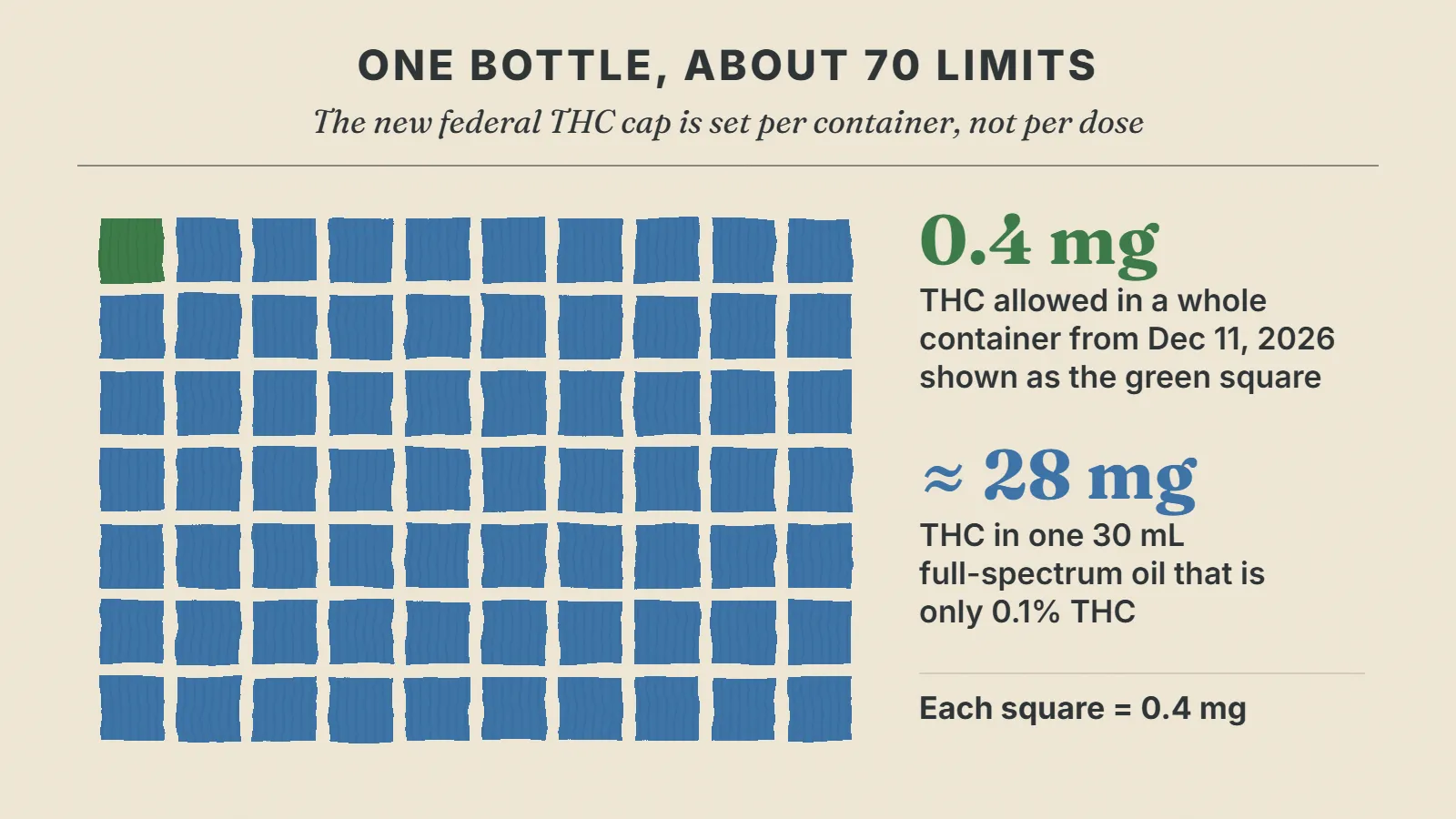
The 0.4 mg per container limit starts December 11, 2026 (Vicente LLP 2026, Leafwell 2026). The 28 mg figure is my estimate for a 30 mL oil at 0.1% THC, assuming the oil weighs about 0.92 grams per mL. Real products vary, so check the batch lab report.
If you want to try a full-spectrum oil, buy it before December 11. The change has no grandfather clause and no period for sellers to sell off the stock they already hold (Learn Brands 2026, Herb Agency 2026), so after that date a full-spectrum oil over the limit can't be sold as hemp. It will be considered as THC and regulated by those laws! You will likely not find one on a hemp seller's shelf. I could not find a clear answer on whether the law reaches a bottle you purchase before the deadline. You need to consider that but I believe that to be a minimal risk. State rules differ, so check yours before you stock up.
How to use it
We’re all different, so start low and go slow. Raise the dose every 4 to 5 days as you see how it affects you. The drop counts below are based on the 2,800 mg full-spectrum hemp oil from Twisted River Farms, where each drop holds about 5 mg of CBD. A different product or strength changes the math.
Starting doses by goal
Sleep. Start with 5 to 10 drops. Wait 4 to 5 days, then increase. Most people end up around 25 to 30 drops, and some go higher.
Inflammation. Most of us carry some inflammation, and unfortunately you can’t feel it. Follow the same plan as for sleep. You may want to split the total into a morning and an evening dose.
Pain. The upper range is about 200 mg, or 40 drops. Try splitting the dose and see how that works for you.
Brain fog. Go with smaller doses and go slow. Start with 3 drops in the morning. Too much will make you sleepy.
Anxiety and stress. 10 drops a day, up to 20, split between morning and evening.
Night sweats. 10 drops before bed.
Hot flashes. Start with 10 drops and expect to work up to as many as 40, depending on how severe your symptoms are.
Cautions
Loose stools. Back off a few drops.
Drug tests. At higher doses, full-spectrum oil can make you test positive for THC. If your job tests for drug use, keep that in mind.
Medications. Your body breaks CBD down with enzymes that many medicines also rely on, so taking them together can change how your medicine works. Use caution with seizure medicines, antidepressants, immunosuppressants, thyroid medicines, and blood thinners. A simple check: if your medicine carries a grapefruit warning, it uses the same pathway that matters with CBD. Talk with your prescriber before you start.
Your genetics. If you have a genetics report, check it for known problems with your detox pathways, since those are the enzymes that clear CBD.
Where to buy quality CBD oil
Twisted River Farms is the first seller listed here.
Business: Family hemp farm on 144 acres in Hartford, Wisconsin. Sells online and ships where allowed (site)
Products: Full-spectrum CBD and CBG oils, calming chews, teas, balms, pet oils
Oil prices as listed: 1,400 mg $100, 2,800 mg $200
Lab reports posted: Posted on the certificate of analysis page
More Colorado sources. These three Colorado companies post lab reports by batch.
Moon Mother Hemp, Boulder. Enter the batch code printed on the product to open its report. The reports come from SC Labs in Denver, and the page says the testing lab is ISO/IEC 17025 accredited. Hemp extract reports cover potency, heavy metals, pesticides, mycotoxins, microbes, and residual solvents. Finished tinctures and softgels are tested for potency and microbes. (lab reports)
Dragonfly Hemp CBD, Colorado-grown hemp. Reports are listed by product and lot number and come from Botanacor Laboratories in Denver, which the page describes as ISO 17025 accredited. Raw extract reports cover potency, terpenes, heavy metals, pesticides, and solvents. An asterisk next to a lot number means more contaminant reports exist for that lot. (lab reports)
Health Naturally, Colorado manufacturer. The page says its facility is registered with the USDA and licensed by the Colorado Department of Public Health and Environment. Its full-spectrum hemp oil has separate reports for microbials, pesticides, residual solvents, heavy metals, and mycotoxins from Botanacor and Pro Verde Laboratories. (lab reports)
Before you buy. Vetting is up to you. Ask any seller for the lab report for your batch number, and check that it comes from an independent lab and covers CBD content, pesticides, heavy metals, residual solvents, and microbials.
Ready to start restoring your health?
The membership is $300 a month, month to month. You get a written plan, teaching, and coaching. Sage does not diagnose you or give you a personal medical reading.
See the membershipReferences16
- Shannon S, et al. (2019). Cannabidiol in anxiety and sleep: a large case series. The Permanente Journal. https://pmc.ncbi.nlm.nih.gov/articles/PMC6326553/
- World Health Organization Expert Committee on Drug Dependence (2018). https://www.who.int/news-room/questions-and-answers/item/who-expert-committee-on-drug-dependence-review-of-cannabis
- Bergamaschi MM, et al. (2011). Cannabidiol reduces the anxiety induced by simulated public speaking in treatment-naïve social phobia patients. Neuropsychopharmacology. https://pmc.ncbi.nlm.nih.gov/articles/PMC3079847/
- García-Gutiérrez MS, et al. (2020). Cannabidiol: a potential new alternative for the treatment of anxiety, depression, and psychotic disorders. Biomolecules. https://doi.org/10.3390/biom10111575
- Nichols JM, Kaplan BLF (2020). Immune responses regulated by cannabidiol. Cannabis and Cannabinoid Research. https://doi.org/10.1089/can.2018.0073
- Almogi-Hazan O, Or R (2020). Cannabis, the endocannabinoid system and immunity. International Journal of Molecular Sciences. https://www.ncbi.nlm.nih.gov/pmc/articles/PMC7352399/
- Couch DG, et al. (2019). Palmitoylethanolamide and cannabidiol prevent inflammation-induced hyperpermeability of the human gut in vitro and in vivo. Inflammatory Bowel Diseases. https://doi.org/10.1093/ibd/izz017
- Couch DG, et al. (2017). Cannabidiol and palmitoylethanolamide are anti-inflammatory in the acutely inflamed human colon. Clinical Science. https://doi.org/10.1042/CS20171288
- Gallily R, et al. (2015). Overcoming the bell-shaped dose-response of cannabidiol by using cannabis extract enriched in cannabidiol. Pharmacology & Pharmacy. https://doi.org/10.4236/pp.2015.62010
- Pamplona FA, et al. (2018). Potential clinical benefits of CBD-rich cannabis extracts over purified CBD in treatment-resistant epilepsy. Frontiers in Neurology. https://doi.org/10.3389/fneur.2018.00759
- Bonn-Miller MO, et al. (2017). Labeling accuracy of cannabidiol extracts sold online. JAMA. https://pmc.ncbi.nlm.nih.gov/articles/PMC5818782/
- Buchtova T, et al. (2023). Drug-drug interactions of cannabidiol with standard-of-care chemotherapeutics. International Journal of Molecular Sciences. https://doi.org/10.3390/ijms24032885
- Vicente LLP (October 2026). Federal hemp update: definition change delayed to December 11. https://vicentellp.com/insights/federal-hemp-definition-change-delay/
- Leafwell (2026). Hemp THC ban 2026: dates, what's banned, how to stay legal. https://leafwell.com/blog/federal-hemp-thc-ban
- Learn Brands (2026). Hemp THC ban 2026: now Dec 11. https://www.learnbrands.com/post/hemp-thc-beverage-ban-november-2026
- Herb Agency (2026). 2026 federal hemp ban: what brands and retailers need to know. https://www.herb.agency/post/federal-hemp-ban-brand-owners-retailers
More from Sage Matters
Ketones as a supplement and not as a result of a low carb diet
I have written about ketones as a supplement previously. I am more intrigued the more I look at the benefits from using ketones as a fuel source. You body
READ ARTICLE
BrocElite Sulforaphane
What Johns Hopkins Found in Broccoli and Why It Belongs in Your Longevity Plan
READ ARTICLE
Do the supplements you buy have valid science supporting that expense?
A physician's guide to evaluating supplement evidence, understanding regulatory gaps, and making informed decisions about what's actually worth taking.
READ ARTICLE
Move Like Your Life Depends On It, Because It Does
A few years ago I came across a study that stuck with me.
READ ARTICLE