Introduction
I have written about ketones as a supplement previously. I am more intrigued the more I look at the benefits from using ketones as a fuel source. You body does this naturally in a fasted state or a carb restricted state. This is more about making ketones available as a source of fuel. Several of you asked for more on the science and how to actually choose between the products. This is that piece.
I have been impressed as I use these products and learn more about them. They aren’t cheap. Some are very nasty tasting. The salts have the downfall of loading with more of the minerals than you don’t need. Like sodium. Read on through some of the benefits and then we’ll get to sources and my current choice as I continue to explore the market.
In 2003, DARPA started a program called Metabolic Dominance. The goal was blunt. Find something a soldier could eat that would keep his body and his mind working for several days in the field with no resupply. They handed the problem to two scientists. Richard Veech, a biochemist at the National Institutes of Health, and Kieran Clarke, a physiologist at Oxford. Years later, what came out of that work was the first ketone ester you could actually drink.
Most physicians have never heard of it. The research is worth a closer look, so here it is.
Veech spent 40 years at the NIH studying how the body uses ketones. He trained in the lab of Hans Krebs, the man who mapped the cycle that carries his name and won a Nobel Prize for it. Veech published more than 70 papers on ketone metabolism. He died in 2020 at 84. The compound he spent much of his career on still hasn't reached most doctors' offices.
What a ketone actually is
You were probably taught that the brain runs on sugar. That's mostly true. But the brain has a backup. When the liver breaks down fat, it makes small molecules called ketones, and the brain can burn those instead. Your body already does this when you fast, when you go long and hard on a workout, or when you eat very few carbohydrates.
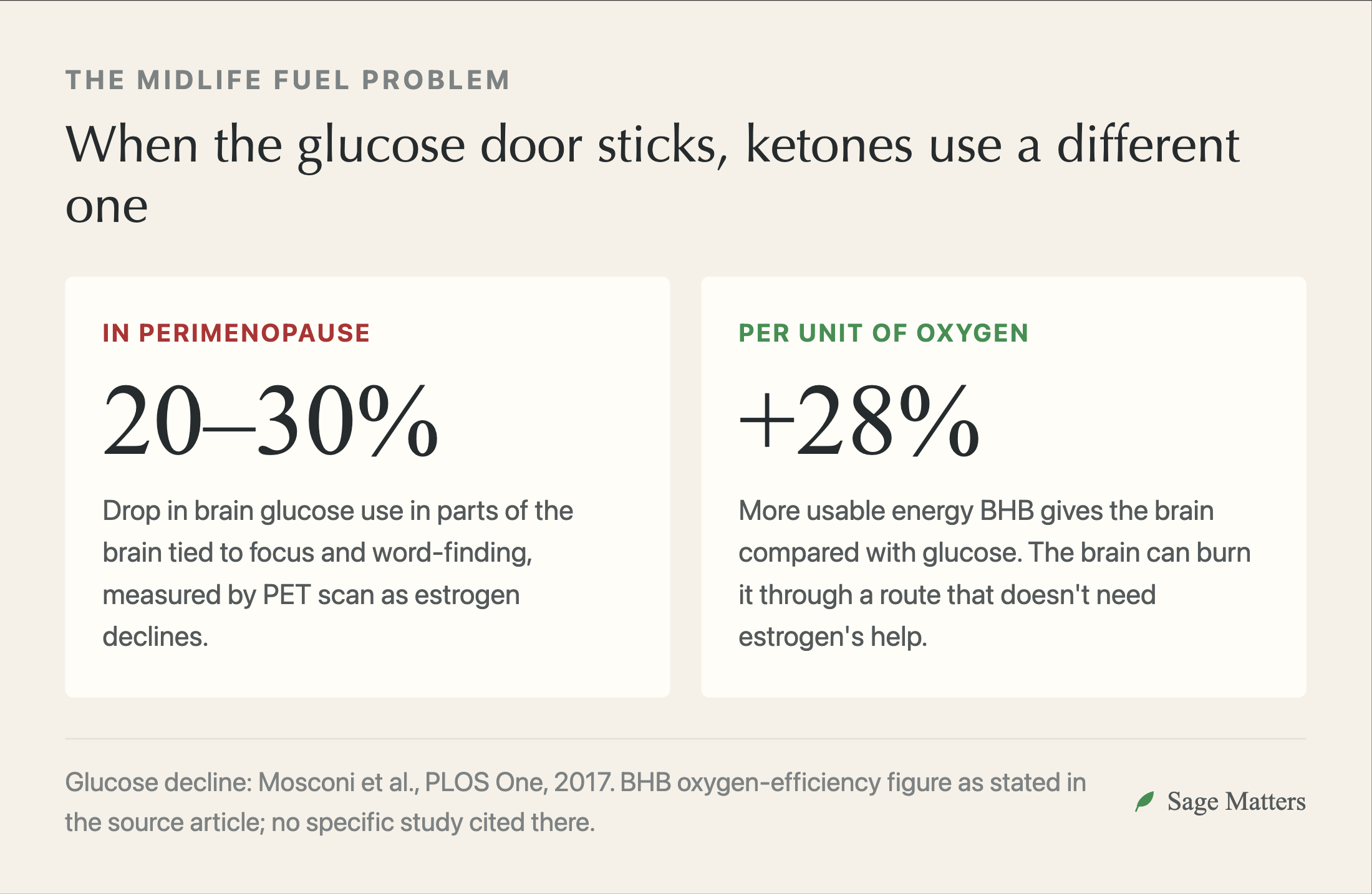
The main one the brain uses is beta-hydroxybutyrate, BHB for short. Per unit of oxygen burned, BHB gives the brain about 28% more usable energy than glucose does. For most of human history we only made ketones when food ran short. The new part is that you can drink them now.
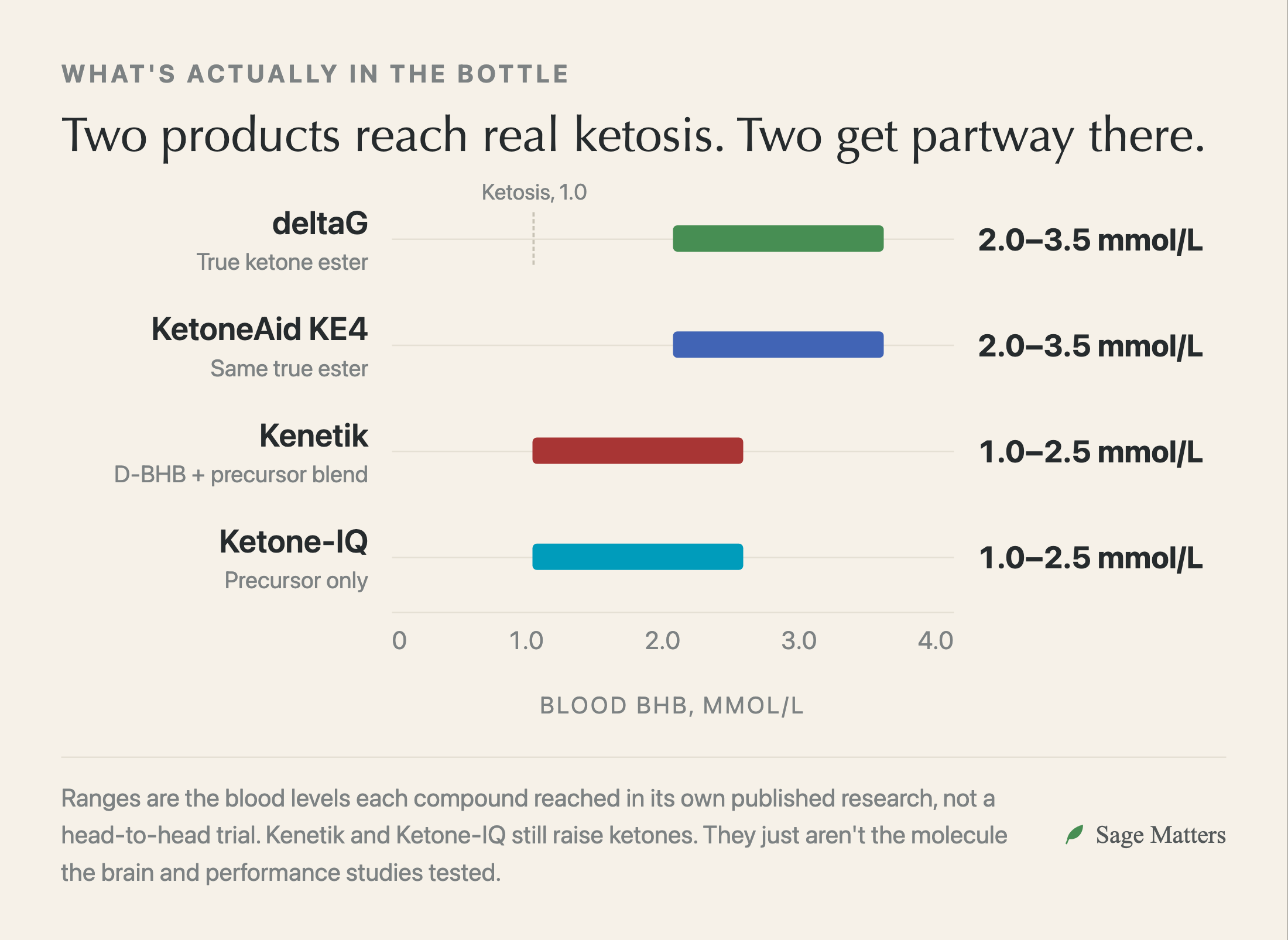
There are three ways to get ketones from outside the body. Esters, salts, and precursors. The compound Veech built, the one in the clinical trials, is a true ester. Its full name is D-beta-hydroxybutyrate-(R)-1,3-butanediol monoester. When you drink it, enzymes in your gut snap it apart within minutes and release BHB straight into your blood. A true ester pushes blood BHB to somewhere between 2.0 and 3.5 mmol/L inside an hour. That's the range the research actually studied.
Why this gets interesting in midlife
Estrogen helps the brain use sugar. It keeps the glucose machinery in neurons working, especially in the front of the brain, where focus and word-finding live. When estrogen drops in perimenopause and menopause, glucose use in parts of the brain can fall 20 to 30%, and you can see it on a PET scan (Mosconi et al., PLOS One, 2017).
A lot of women in their 40s and 50s describe the same thing. They lose words mid-sentence, and a fog settles in that a good night's sleep doesn't clear. That's not in their heads, and it isn't only stress. There's a fuel problem underneath it.
Ketones get interesting here because they reach the brain through a different door than glucose. So they can feed neurons even when the glucose door is sticking. A 2025 randomized controlled trial gave 50 adults over 55 with metabolic syndrome 25 grams of a ketone ester three times a day for four weeks. Using a scan that reads brain chemistry directly, the researchers confirmed the brain was actually using the ketones, and they saw lower glutamate, a signal tied to overexcited, stressed neurons (Effects of oral Ketone Ester on brain metabolism and cognition, PMC, 2025). One human trial doesn't settle anything for good. But that's real data, measured in the brain, not a guess.
What the research shows, and what it doesn't
I'll keep the solid and the unproven clearly apart, because that line matters.
What's reasonably solid. You can raise brain ketones by drinking them, and the 2025 trial measured it directly. Under real physical stress, the brain holds up better on ketones. Dominic D'Agostino at the University of South Florida tested 16 military personnel in low-oxygen conditions in 2024. The ones on the ketone ester kept their thinking and their blood oxygen up where placebo didn't (McClure et al., Experimental Physiology, 2024).
What's promising but not proven. In Veech's own lab, mice fed the ketone ester built up less of the amyloid and tau that show up in Alzheimer's, and they did better on memory tests (Kashiwaya et al., 2020). That's mice. There's an early single-patient report in a human, which is a starting point, not evidence. Traumatic brain injury is a similar story. The mechanism makes sense, the animal work is encouraging, and the human trials aren't done.
A few numbers float around the marketing that I'd treat carefully. An 87% jump in "brain network stability," a 7% bump in cognition, a 23% rise in EPO after exercise. I can't tie those to a clean published source, so treat them as claims that need checking before anyone leans on them.
What I won't tell you is that ketone esters fix cognitive decline. Nobody knows that yet. My honest position is that the science is good enough to take seriously and watch closely.
The inflammation angle
BHB does one more thing worth knowing. It quiets a piece of cellular machinery called the NLRP3 inflammasome, one of the main switches for chronic inflammation (Youm et al., Nature Medicine, 2015). When that switch is stuck on, it pumps out signals that drive things like gout and the low-grade inflammation behind metabolic disease. BHB turns it down without shutting off your immune system across the board.
This is part of why endurance athletes got there first. In Oxford's work, competitive cyclists who co-ingested the deltaG ester with carbohydrates improved their 30-minute time trial output by about 2% compared to carbohydrates alone (Cox et al., Cell Metabolism, 2016). Make of the athlete numbers what you will. They point in a consistent direction.
What you're actually buying
This is where the marketing gets slippery, so I want to be plain. These products are not the same molecule, and that changes what you get. The compound from the trials, the true ester, is in only two products I can find. deltaG and KetoneAid. Everything else is a cousin.
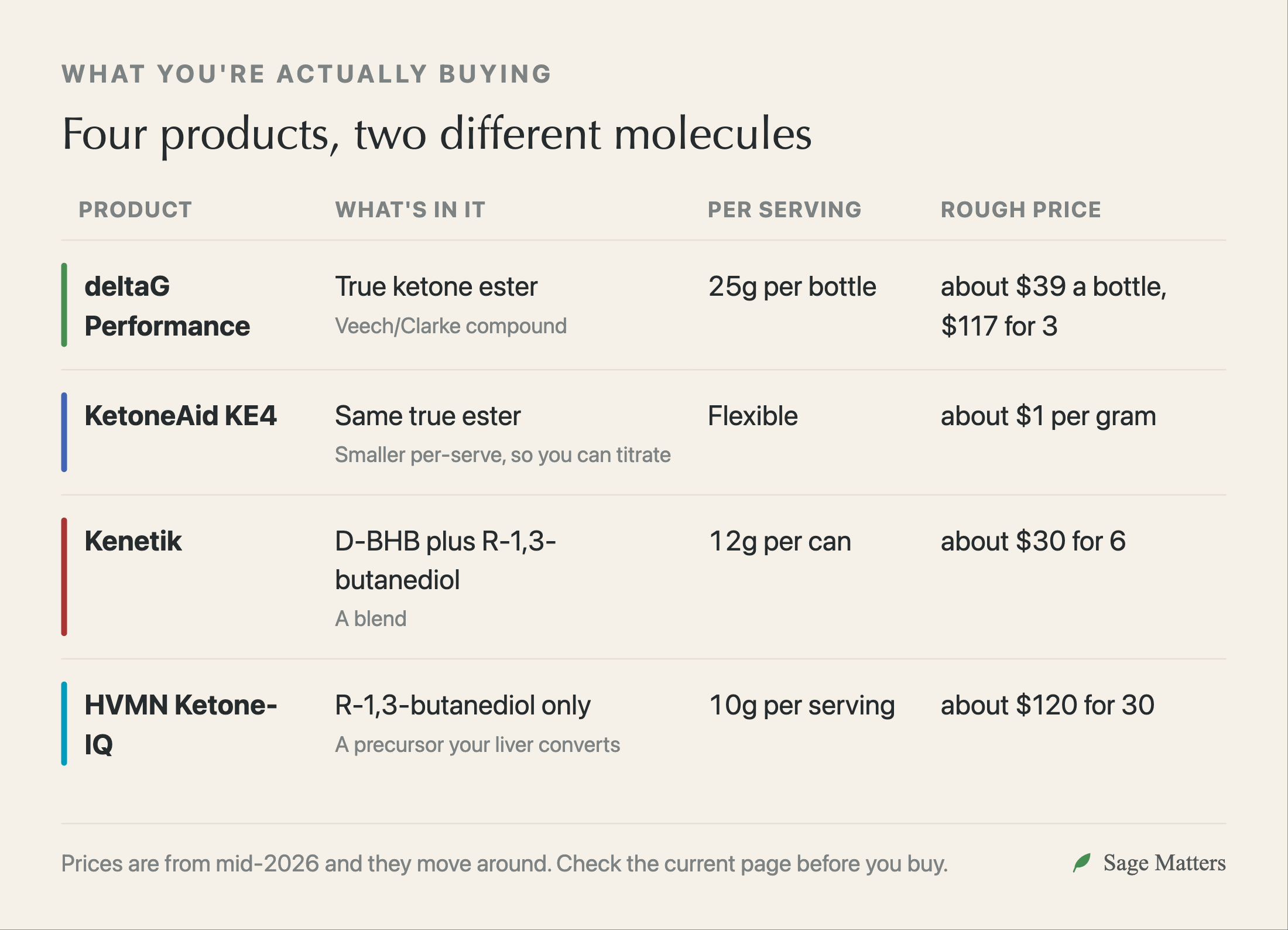
Prices are from mid-2026 and they move around, so check the current page before you buy.
Kenetik is the easy on-ramp. Its 12 grams of D-BHB do raise your ketones, and the taste is the most approachable of the four. The molecule is a blend with a precursor, not the Veech/Clarke true ester. The company is clear about that distinction.
Ketone-IQ runs on R-1,3-butanediol, a precursor your liver converts to BHB. HVMN used to sell the true ester and switched to this cheaper, better-tasting version. The studies they cite trace back to the true-ester research, so read the fine print before assuming the data applies to what's in the bottle.
deltaG is the research compound. It tastes bad, and the company all but admits it. That's the molecule the Oxford trials used and the one behind the Alzheimer's mouse work. If the data is your reason for doing this, that's the compound that was actually tested.
KetoneAid's KE4 is the same true ester at a lower dose per serving, so you can start small. At about a dollar a gram, it's the more affordable way to the real thing.
If you want to try it
Start low and build up. The usual complaint in the first week or two is a queasy gut, and it tends to settle.
If this article helped you, please share it. Your shares help keep Sage Matters free, and I only ask you to share it if you genuinely found it useful.
For everyday mental work, one Kenetik can or one serving of Ketone-IQ, 30 to 60 minutes before you need to focus, is a reasonable start. For the research compound, half a bottle of deltaG, around 12 grams, is a gentle beginning. A full 25-gram bottle is the dose used in most of the performance studies. The brain-metabolism trial used 25 grams three times a day for four weeks, which is a real commitment in both money and stomach.
Two cautions I mean seriously. If you have diabetes or take insulin, a ketone ester drops your blood sugar a point or two on its own, and that can stack dangerously with your medication. Don't use it without your physician watching. And if you want to know whether it's even working, a cheap home ketone meter, the same kind people on keto diets use, will tell you. Test 45 to 60 minutes after a dose. Above 1.0 mmol/L means you're in ketosis. The true esters reliably hit 2.0 to 3.5.
Ketone esters aren't a replacement for hormone therapy or for the basics. They're one tool, with a real research base, that most practitioners simply haven't read yet. If you're working through brain fog in midlife, or you carry a family history of Alzheimer's that keeps you up at night, this is worth a conversation with a physician who will actually look at the evidence with you.
Ready to start restoring your health?
The membership is $300 a month, month to month. You get a written plan, teaching, and coaching. Sage does not diagnose you or give you a personal medical reading.
See the membershipReferences14
- The notes below are a buying companion to the product section above. Taste and price per 20 grams are the two practical variables the main comparison leaves out.
- On taste. The two true esters taste bad, and the companies know it. The compound releases a free acid in your gut, and your taste buds catch it before your liver gets to work. Most people drink it quickly, sometimes chased with something. Kenetik is the clearest exception here. It tastes like a mild sparkling drink, and that's a real difference for daily use.
- On price. Per 20 grams, Kenetik and Ketone-IQ run 4 to 6 times less than deltaG and roughly half the price of KE4. For daily lower-level ketosis, that's enough of a gap to affect what you'd actually stick with.
- On testing. deltaG is BSCG certified and WADA compliant, screened for over 240 banned substances. If you compete in a tested sport, that distinction counts. For everyone else, it signals something about the company's relationship with the research.
- On HVMN. HVMN switched from the true ester to R-1,3-butanediol, a liver-converted precursor. The headline trials they reference in their marketing used the original true-ester compound, not R-1,3-butanediol. Check the actual study before assuming the efficacy data applies to what's in the bottle.
- Prices are as of mid-2026. Check current pages before purchasing.
- My current choice due to price, taste, and the basic science of which ketone is offered is Kenetik. You can buy the basic drink in cans on Amazon. The more concentrated form, Kenetik Pro, isn’t available on Amazon at this time. Watch our web site for an affiliate link. Amazon Prime has occasionally had a discount but not too often. Stay tuned. We’re continuing to explore.
- Cox PJ, Kirk T, Ashmore T, et al. Nutritional Ketosis Alters Fuel Preference and Thereby Endurance Performance in Athletes. Cell Metabolism, 2016; 24(2):256-268. https://www.cell.com/cell-metabolism/fulltext/S1550-4131(16)30355-2
- Kashiwaya Y, Bergman C, Lee JH, et al. A Dietary Ketone Ester Normalizes Abnormal Behavior in a Mouse Model of Alzheimer's Disease. PMC, 2020. https://www.ncbi.nlm.nih.gov/pmc/articles/PMC7036949/
- McClure TS, et al. Ketone monoester attenuates declines in cognitive performance and oxygen saturation during acute severe hypoxic exposure under resting conditions. Experimental Physiology, 2024. https://physoc.onlinelibrary.wiley.com/doi/10.1113/EP091794
- Mosconi L, et al. Perimenopause and emergence of an Alzheimer's bioenergetic phenotype in brain and periphery. PLOS One, 2017. https://journals.plos.org/plosone/article?id=10.1371/journal.pone.0185926 (https://journals.plos.org/plosone/article?id=10.1371%2Fjournal.pone.0185926)
- Effects of oral Ketone Ester on brain metabolism and cognition: a randomized controlled trial. PMC, 2025. https://pmc.ncbi.nlm.nih.gov/articles/PMC12739581/
- Youm YH, Nguyen KY, et al. The ketone metabolite beta-hydroxybutyrate blocks NLRP3 inflammasome-mediated inflammatory disease. Nature Medicine, 2015; 21(3):263-269. https://www.nature.com/articles/nm.3804
- Product pages: deltaG (https://www.deltagketones.com (https://www.deltagketones.com/)) · KetoneAid (https://www.ketoneaid.com (https://www.ketoneaid.com/)) · Kenetik (https://www.drinkkenetik.com (https://www.drinkkenetik.com/)) · HVMN Ketone-IQ (https://www.ketone.com (https://www.ketone.com/))
More from Sage Matters
DECEMBER 11 DEADLINE: CBD oil may be worth a careful trial
This article is being published out of our normal sequence because a clock is ticking and soon it will become very difficult if not impossible to obtain full spectrum CBD oil
READ ARTICLE
BrocElite Sulforaphane
What Johns Hopkins Found in Broccoli and Why It Belongs in Your Longevity Plan
READ ARTICLE
Do the supplements you buy have valid science supporting that expense?
A physician's guide to evaluating supplement evidence, understanding regulatory gaps, and making informed decisions about what's actually worth taking.
READ ARTICLE
Move Like Your Life Depends On It, Because It Does
A few years ago I came across a study that stuck with me.
READ ARTICLE