
Introduction
In a recent interview, a physician and longevity researcher named Bill Lawrence made a point that stuck with me. Search YouTube for the word longevity and you'll find more than 500,000 videos using it. Lawrence has spent ten years running observational longevity studies and reviewing the literature, and he sorts what's out there into three buckets: hope, hype, and science.
I want to walk through how he separates those three, because his method matters more than the particulars of supplements and protocols. Then I want to explain why so many of the things that actually work never get the kind of proof pharmaceutical companies produce. We’ll also go through the basics that have already cleared a real bar of human evidence.

A ladder for judging any longevity claim
Lawrence uses what he calls an evidence hierarchy, and it's a useful mental model for reading any longevity content online.
At the bottom sits cell and animal research, mice, rats, and petri dishes. This is where almost everything starts, and where most hype lives. One step up is mechanistic plausibility, meaning the biology makes sense even without human data yet. Above that is observational human data, real people using something and getting tracked over time, without a randomized control group. Above that is the interventional human trial, a randomized, controlled study in people. At the top, and rarest of all, sits a trial that's been independently replicated.
Almost nothing reaches the top two rungs. Most of what circulates as longevity advice never leaves the bottom one.
Why the bottom rung rarely climbs higher
Here's the discomforting math behind that. A rigorous analysis of animal-to-human drug translation found that only about 5% of therapies that succeed in animal studies ever reach human regulatory approval, and that is out of 367 interventions tracked across 54 diseases (Ineichen et al., PLOS Biology 2024). Most fail from unexpected toxicity or a plain lack of effect once you're dealing with a human body instead of a mouse.
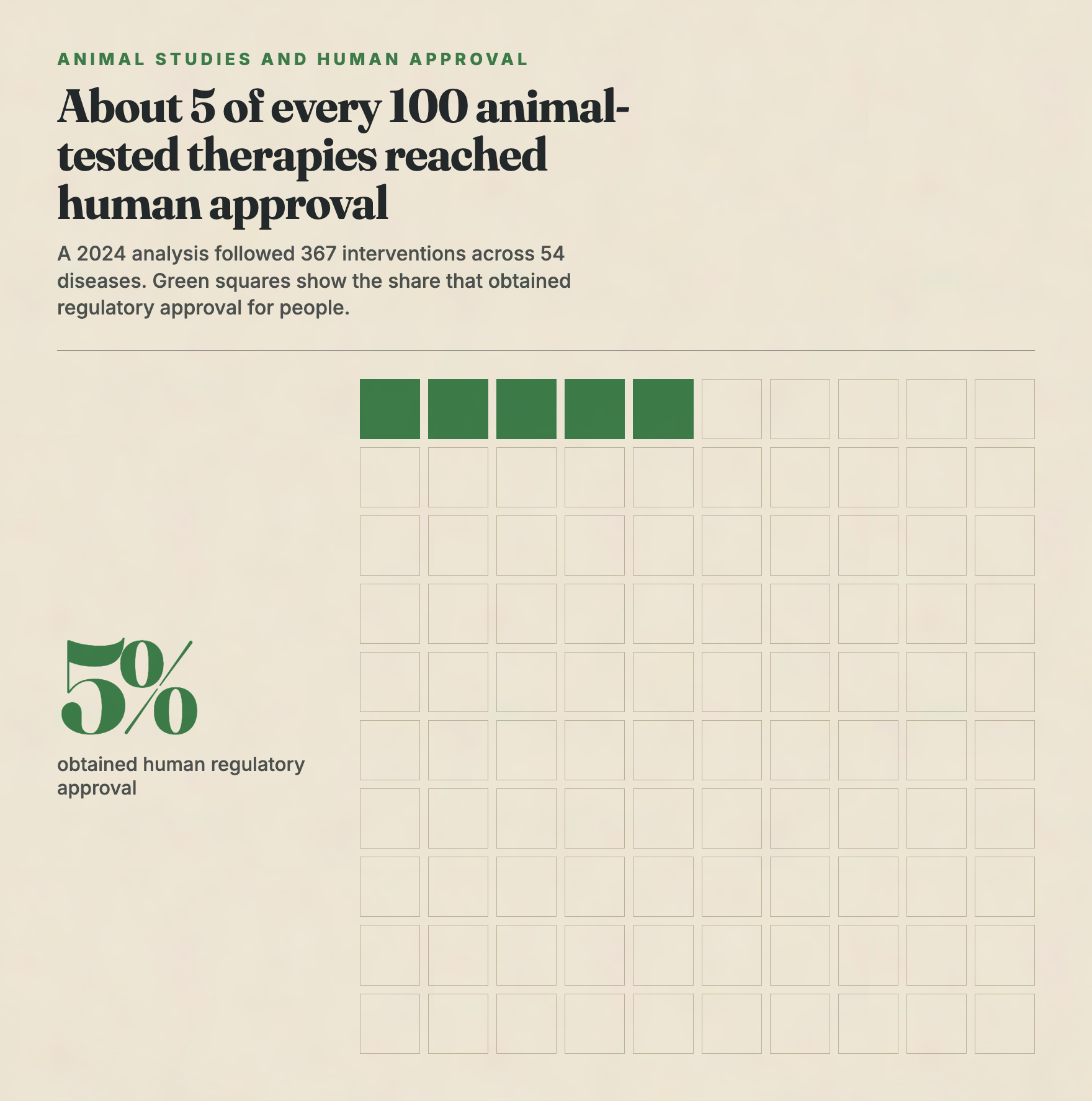
Animal-to-human translation analysis, 367 interventions across 54 diseases. About 5% reached regulatory approval. Ineichen et al., PLOS Biology 2024.
Taking a single drug through the three phases of FDA trials costs a staggering amount. Estimates for total research and development per approved drug run past $2.5 billion once every failed compound along the way gets counted, and the median cost of just the pivotal trials that support an FDA approval runs close to $19 million each, with the largest programs running into the hundreds of millions (DiMasi et al., Journal of Health Economics 2016; Moore et al., JAMA Internal Medicine 2018).
The David Sinclair story is the clearest cautionary tale I know. In 2008, GlaxoSmithKline paid about $720 million for Sirtris Pharmaceuticals, a company Sinclair co-founded, betting on resveratrol-related compounds that had shown dramatic results in rodents. The lead compound didn't hold up. In a cancer trial, patients developed kidney damage, and the drug wasn't working well enough to justify the risk. GSK shut the whole program down by 2013. No one involved did anything wrong. The rodent data was good, but it simply didn't survive contact with human biology. Not even for a company with hundreds of millions on the line.
That's the trap. If an intervention is a lifestyle change, an out-of-patent compound, or a natural extract, there's usually no company positioned to spend that kind of money proving it, win or lose. A missing multimillion-dollar trial doesn't prove an intervention fails. Most of the time, no one stood to recover that money by running the study in the first place.
The basics that already clear the bar
These are the interventions with real human mortality data behind them, most of them free or nearly free, all of them in use for decades without a pattern of harm.
Sleep. A 2025 meta-analysis pooling 79 studies found that sleeping under 7 hours a night tracks with roughly 14% to 34% higher mortality risk compared with 7 to 8 hours, depending on how far below that range someone falls (Ungvari et al., GeroScience 2025). A separate large cohort study found something I hadn't seen before, that sleep regularity, going to bed and waking at consistent times, predicted death more strongly than duration did on its own, with the most regular sleepers showing 20% to 48% lower all-cause mortality than the most erratic ones (Windred et al., Sleep 2024). If you fix one thing on this list, a consistent sleep schedule is probably the cheapest, best-supported move on it.
Exercise. The exact number shifts with how a study measures activity, but a large accelerometer-based study found that people with more overall daily movement and less sedentary time had a substantially lower risk of dying during follow-up, in a dose-response pattern that kept improving well past what most guidelines recommend (Ekelund et al., BMJ 2019). You don't need to be an athlete. The studies finding these effects are mostly measuring ordinary movement, walking, chores, stairs, not marathon training.
A Mediterranean-style eating pattern. This is the closest thing to what Blue Zone populations already eat, heavy on vegetables, olive oil, fish, and legumes, light on processed food. Meta-analyses in older adults find that high adherence tracks with roughly a 20% to 25% lower risk of dying from any cause compared with low adherence.
Caloric restriction. This is the one item here with an actual randomized controlled trial behind it in healthy humans, not just animals. The CALERIE trial put non-obese adults on a moderate calorie reduction for two years and found it slowed a validated biological aging clock by about 3%, alongside measurable drops in cellular senescence markers (Waziry et al., Nature Aging 2023). The trial wasn't long enough to measure mortality directly, but in separate cohort data, a 3% slower pace of aging on that same clock has tracked with about a 15% lower mortality risk. It's a real effect, just a modest one, and it takes real discipline to sustain.
Mental attitude. A meta-analysis pooling six studies and more than 180,000 people found people with a more optimistic outlook had about a 13% lower all-cause mortality risk (American Journal of Medicine, 2022). Morgan Freeman, who's 89 and still working, was once asked how he stays so healthy. His answer was that he keeps the old man away. I don't have a clinical study on that specific line, but the sentiment lines up with the data.
Social connection. I've written before about how much this one matters, and the numbers here echo what I found then. Married men show about a 31% lower all-cause mortality risk than unmarried men, a gap that's notably smaller for women, who appear to get more of their protective social connection outside marriage alone. People living alone show roughly a 32% higher risk of premature death, and chronic social isolation carries about a 29% higher risk (Surgeon General's Advisory, 2023). If you can't find a spouse, a dog appears to help too, with dog owners showing about a 24% lower all-cause mortality risk (Kramer et al., Circulation: Cardiovascular Quality and Outcomes 2019).
Sauna. A Finnish cohort study following more than 2,300 men for two decades found that men using a sauna four to seven times a week had about 40% lower all-cause mortality than men using one once a week (Laukkanen et al., JAMA Internal Medicine 2015). Heat is a mild, repeatable stress, similar in spirit to exercise, and the body appears to adapt to it in ways that show up on a mortality table.
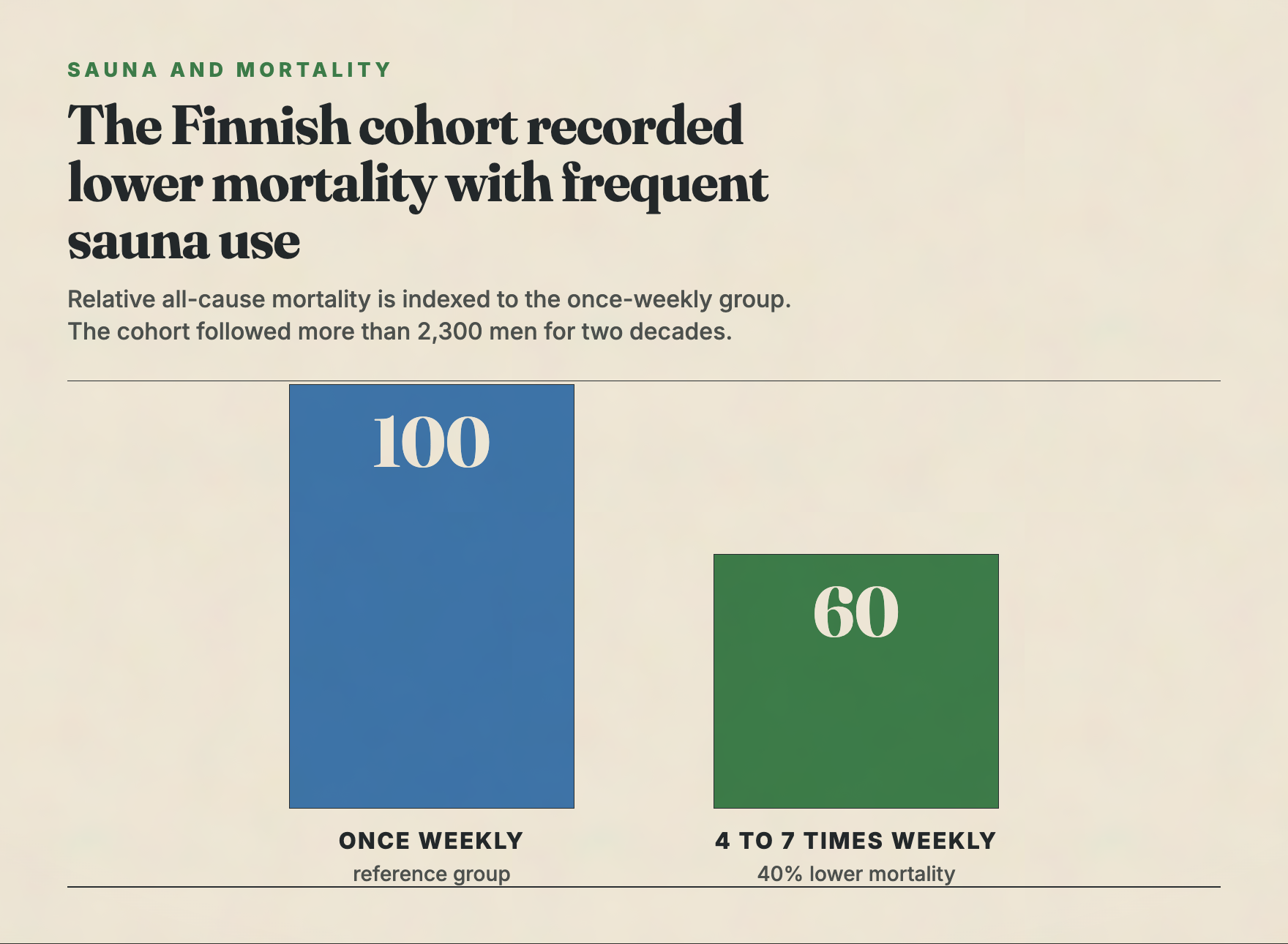
Finnish cohort of more than 2,300 men followed for two decades. The cohort design can show association. Causation needs a randomized trial. Laukkanen et al., JAMA Internal Medicine 2015.
None of these will ever get a $500 million trial. None of them need one. The evidence already sitting in observational cohorts and the occasional real randomized trial is stronger than what backs plenty of prescription drugs on the market today.
The one still stuck in the gray zone
Peptide bioregulators are where this gets more complicated.
The late Vladimir Khavinson ran a research program out of the Saint Petersburg Institute of Bioregulation and Gerontology for more than 40 years, publishing over 700 papers and holding nearly 200 patents. Two of his compounds, Thymalin and Epithalamin, are registered pharmaceuticals in Russia and have been used clinically there since the 1980s. That's a sustained body of work, and can’t be written off as a fringe internet supplement.
What's less settled is how that work holds up outside Russia. Lawrence, in the interview, described older Soviet-era studies of institutionalized elderly adults where a peptide extracted from the pineal gland was associated with meaningfully lower mortality over years of follow-up compared with a non-treated group. Those numbers are dramatic. They also haven't been independently replicated at that scale outside Russia and Ukraine, and I don't have access to the original data to verify them myself. I'd treat them the way Lawrence himself treats most longevity claims, as observational human data, a real rung up from an animal study, but well short of a randomized trial with independent confirmation.
The first independent Western data point on this only arrived in 2025, when researchers at Brunel University London tested one of these compounds, Epitalon, on human cell lines in a lab dish. They found it extended telomeres in normal cells through the enzyme telomerase, and separately extended telomeres in breast cancer cell lines through a different pathway called ALT, one usually associated with more aggressive cancers (Al-Dulaimi et al., Biogerontology 2025). That second finding is part of why longevity clinics using this peptide generally exclude anyone with an active or recent cancer history.
I have my own history with this, longer than Lawrence's. I ordered Khavinson's bioregulators back in the late 1990s, and what showed up was a box of blister packs printed entirely in Russian, no English anywhere on them. This was well before you could point a phone at foreign text and have Google translate it on the spot, so figuring out which pack treated which organ took real effort. I kept using them anyway, because the underlying research had already convinced me, and I've believed in their value for close to three decades now.
Lawrence is the attorney and researcher who has spent 10 years administering that observational study. He doesn't sell these peptides and doesn't treat patients directly, the doctors in his program do that. His decade of data collecting left him convinced of the same thing I already believed.
The peptide bioregulator research from Khavinson's group is thin by Western randomized-trial standards, and the independent replication so far is one lab-dish study. But I've used these compounds myself for most of my adult life and watched them do roughly what the observational data says they should. That's enough for me to keep taking them while the rest of the science catches up.
Where I land
The things on this list that already clear a high bar of evidence share something in common. They're boring, they're cheap, and no one owns a patent on walking, sleeping on a schedule, or eating more vegetables. That's why they'll never get a flashy $500 million trial, and it's exactly why the absence of trials shouldn't count against them.
If this article helped you, please share it. Your shares help keep Sage Matters free, and I only ask you to share it if you genuinely found it useful.
The things still climbing the ladder deserve real curiosity. They also deserve the same question you'd ask about anything else on that bottom rung. Has this actually been tested in people, by someone other than the person selling it to you?
Ready to start restoring your health?
The membership is $300 a month, month to month. You get a written plan, teaching, and coaching. Sage does not diagnose you or give you a personal medical reading.
See the membershipReferences15
- Ineichen BV, Furrer E, Grüninger SL, Zürrer WE, Macleod MR. Analysis of animal-to-human translation shows that only 5% of animal-tested therapeutic interventions obtain regulatory approval for human applications. PLOS Biology. 2024;22(6):e3002667.
- DiMasi JA, Grabowski HG, Hansen RW. Innovation in the pharmaceutical industry: new estimates of R&D costs. Journal of Health Economics. 2016;47:20-33.
- Moore TJ, Zhang H, Anderson G, Alexander GC. Estimated costs of pivotal trials for novel therapeutic agents approved by the FDA, 2015-2016. JAMA Internal Medicine. 2018;178(11):1451-1457.
- GlaxoSmithKline's shutdown of the Sirtris resveratrol program. Fierce Biotech; BioSpace; WRAL TechWire, 2013.
- Ungvari Z, Fekete M, Varga P, et al. Imbalanced sleep increases mortality risk by 14-34%: a meta-analysis. GeroScience. 2025;47:4545-4566.
- Windred DP, et al. Sleep regularity is a stronger predictor of mortality risk than sleep duration: a prospective cohort study. Sleep. 2024;47(1):zsad253.
- Ekelund U, Tarp J, Steene-Johannessen J, et al. Dose-response associations between accelerometry measured physical activity and sedentary time and all cause mortality. BMJ. 2019;366:l4570.
- Mediterranean diet adherence and all-cause mortality in older adults: systematic review and meta-analysis. 2020s meta-analyses.
- Waziry R, Ryan CP, Corcoran DL, et al. Effect of long-term caloric restriction on DNA methylation measures of biological aging in healthy adults from the CALERIE trial. Nature Aging. 2023;3:248-257.
- Association of optimism with cardiovascular events and all-cause mortality: systematic review and meta-analysis. American Journal of Medicine. 2022.
- Sex differences in the association between marital status and the risk of cardiovascular, cancer, and all-cause mortality: a systematic review and meta-analysis of 7,881,040 individuals. 2020.
- Murthy VH. Our Epidemic of Loneliness and Isolation. U.S. Surgeon General's Advisory. HHS. 2023.
- Kramer CK, Mehmood S, Suen RS. Dog ownership and survival: a systematic review and meta-analysis. Circulation: Cardiovascular Quality and Outcomes. 2019;12(10):e005554.
- Laukkanen T, Khan H, Zaccardi F, Laukkanen JA. Association between sauna bathing and fatal cardiovascular and all-cause mortality events. JAMA Internal Medicine. 2015;175(4):542-548.
- Al-Dulaimi S, Thomas M, Matta C, Roberts T. Epitalon increases telomere length in human cell lines through telomerase upregulation or ALT activity. Biogerontology. 2025.
More from Sage Matters

Toxic burden and chronic illness
A person can feel terrible and still be told every test is normal.
READ ARTICLE
What we actually know about microplastics in your body
In 2024, researchers in Italy removed carotid artery plaque from 257 patients during surgery and tested it for plastic.
READ ARTICLE
What are the important things to consider for longevity?
Focus on these things for a long and healthy life
READ ARTICLE
Your Metabolism Isn’t Broken: Why Metabolic Guidelines Aren’t One-Size-Fits-All
Nutrition guidelines are framed as an absolute. Follow this ratio and you will get optimal results, don’t and your body will suffer. But at the end of the
READ ARTICLE