
Introduction
A person can feel terrible and still be told every test is normal.
The fatigue is real. The brain fog is real. Food, odors, or medications that never caused trouble before suddenly set off symptoms. Yet the usual laboratory work comes back inside the normal range, and the patient leaves with no explanation.
Functional medicine starts by asking what changed before the illness appeared and what may still be pushing it forward. Chronic illness seldom fits into the same box as strep throat.
Strep gives us a fairly clean sequence. A bacterium causes an infection, a test identifies it, and an antibiotic treats it. A person with a chronic illness may have poor sleep, insulin resistance, an infection, medication effects, and years of exposure at home or work. Those factors can pile up and feed one another.
The usual medical workup is still necessary. It can find anemia, thyroid disease, diabetes, autoimmune disease, sleep apnea, heart disease, and other known causes of fatigue or brain fog. But it may miss the setting in which the illness began.
That setting deserves attention.
The exposome
Scientists have a name for the sum of a person's lifetime exposures. They call it the exposome.
It includes chemicals in air, water, food, soil, dust, and consumer products. It also includes infections, medicines, noise, stress, diet, activity, and the conditions where a person lives and works. Researchers developed the idea because genes explain only part of why disease appears in one person and spares another (Vermeulen et al. 2020).
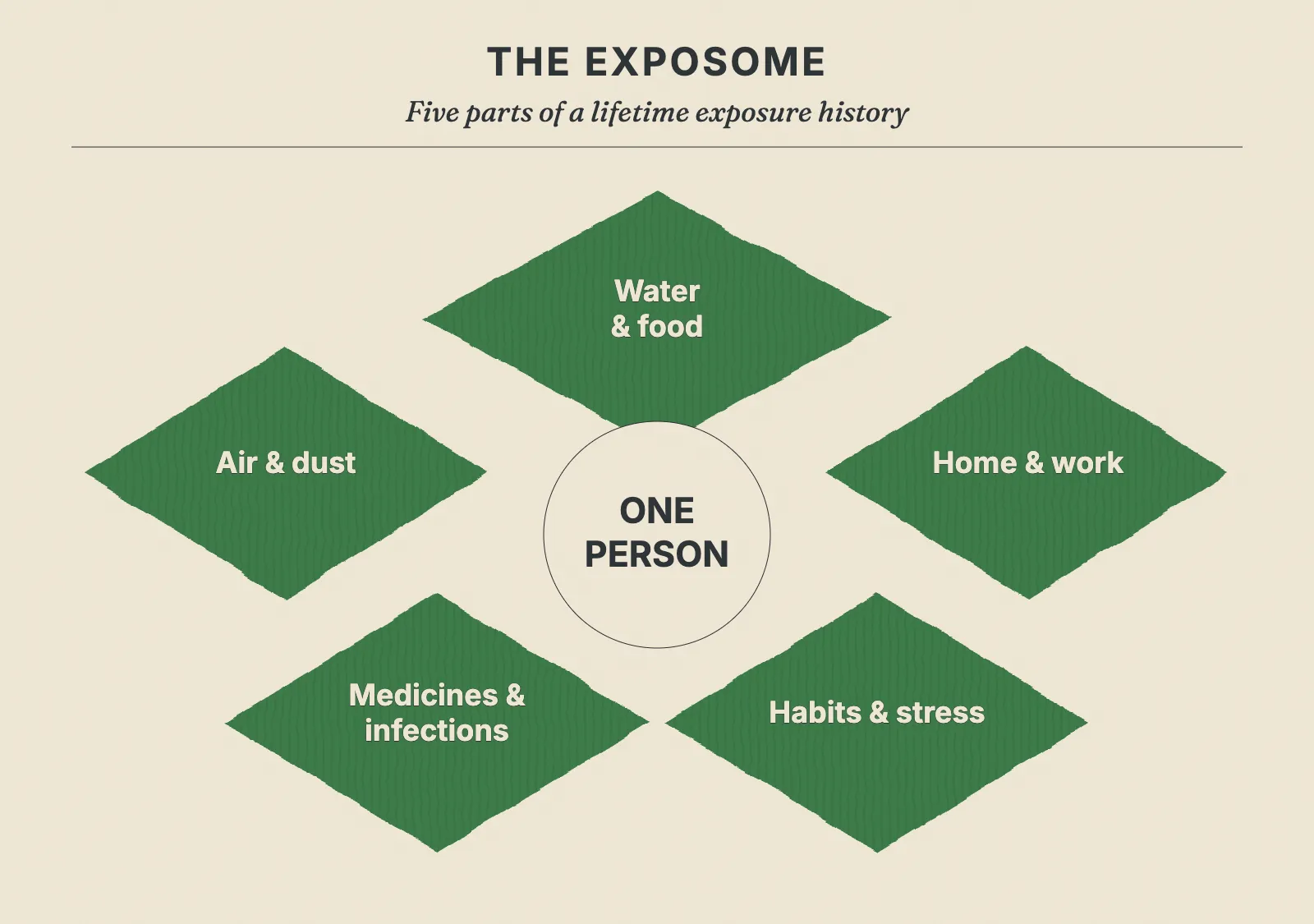
A conceptual map of major exposure domains, following the exposome framework (Vermeulen et al. 2020). The shapes do not show relative exposure levels or risk.
CDC biomonitoring has found environmental chemicals or their breakdown products in blood and urine samples from the United States population. The program tracks metals, pesticides, phthalates, PFAS chemicals, volatile organic compounds, and several other groups (CDC 2024).
A detected chemical confirms exposure. The result alone cannot tell us that the chemical caused a disease. CDC makes that distinction in its own guidance because the dose, timing, source, and health meaning may still be unknown (CDC 2024).
Some exposures have well-established effects. Lead can injure the nervous system and raise cardiovascular and kidney risk. Air pollution contributes to stroke, heart disease, lung disease, and premature death (WHO 2023). Research on certain PFAS chemicals has found associations with immune suppression, altered metabolism, some cancers, and other health problems, though thousands of PFAS compounds remain poorly studied (NIEHS 2024).
We also encounter mixtures. A person may breathe traffic pollution, drink water with a persistent contaminant, and work around solvents. Most safety studies examine one substance at a time. Exposome research is trying to understand what years of combined exposure do to human biology (Vermeulen et al. 2020).
We don't have good answers for much of that yet.
The history may show what the laboratory missed
A careful history takes time. A timeline can expose a connection that a panel of blood tests never will.
When did the symptoms start? What changed before they started? Does the person improve when away from home or work? Was there water damage, smoke, a renovation, pesticide use, a tick bite, COVID, or a new medication?
Those details guide the workup. They also protect us from turning every vague symptom into the same diagnosis.
Fatigue, dizziness, palpitations, rashes, digestive trouble, and poor concentration occur in many illnesses. A physician needs to consider common causes and plausible exposures together. Choosing a favorite theory too early can waste months and expose the patient to treatment that carries its own risk.
Functional medicine is most useful here when it widens the history and keeps testing tied to a specific question.
Mold is real, and the testing dispute is real
Damp buildings can make people sick. The World Health Organization links persistent dampness and indoor mold with higher rates of respiratory symptoms, allergies, and asthma. Its guidance calls for preventing moisture problems and correcting them when they occur (WHO 2009).
Commercial urine mycotoxin testing is used in some functional medicine practices to investigate suspected mold exposure. CDC takes a different position.
CDC says commercial urine mycotoxin tests haven't been approved by the FDA for clinical diagnosis. Mycotoxins can come from food, low levels may appear in healthy people, and urine levels that predict disease haven't been established. CDC warns that an unvalidated result can lead to a wrong diagnosis and treatment that may cause harm (Kawamoto and Page 2015).
This disagreement should be stated plainly. A positive commercial urine result doesn't settle the cause of a person's symptoms under current CDC guidance.
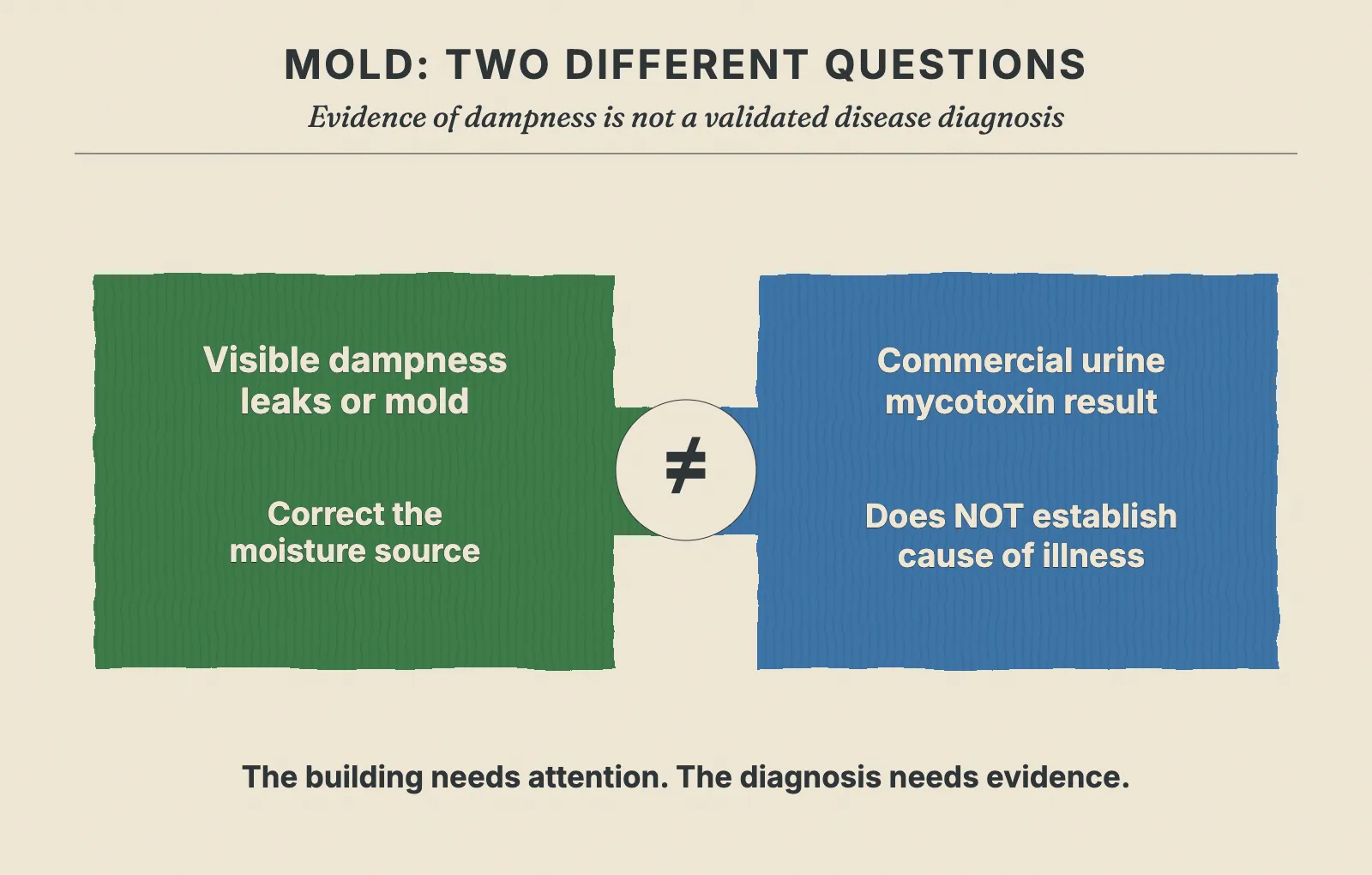
WHO guidance supports correcting dampness and mold in buildings; CDC cautions that commercial urine mycotoxin results do not establish a clinical diagnosis (WHO 2009; Kawamoto and Page 2015).
The building still needs attention. Visible mold, musty odor, leaks, and persistent dampness call for correction. People with respiratory symptoms may need evaluation for asthma, allergy, hypersensitivity pneumonitis, or fungal infection when their medical history supports it.
Removing an active exposure comes before trying to treat its effects.
Testing needs a job
Environmental testing works best when the history points toward an exposure and the result changes what happens next.
A blood lead level after occupational or household exposure has a defined clinical use. Testing for mercury or another metal may make sense when diet, work, or a specific event raises concern. A public water report or a properly collected private-well sample can identify a contaminant at its source.
Large commercial panels create a harder problem. Sensitive instruments can detect tiny amounts of many substances. Detection can be mistaken for proof of disease, even when no accepted threshold connects the result to the patient's symptoms.
I would ask 4 questions before ordering a test.
Does the history identify a plausible source?
Has the test been validated for the clinical question?
Can the result be compared with a level tied to health risk?
Will the answer change treatment or remove an exposure?
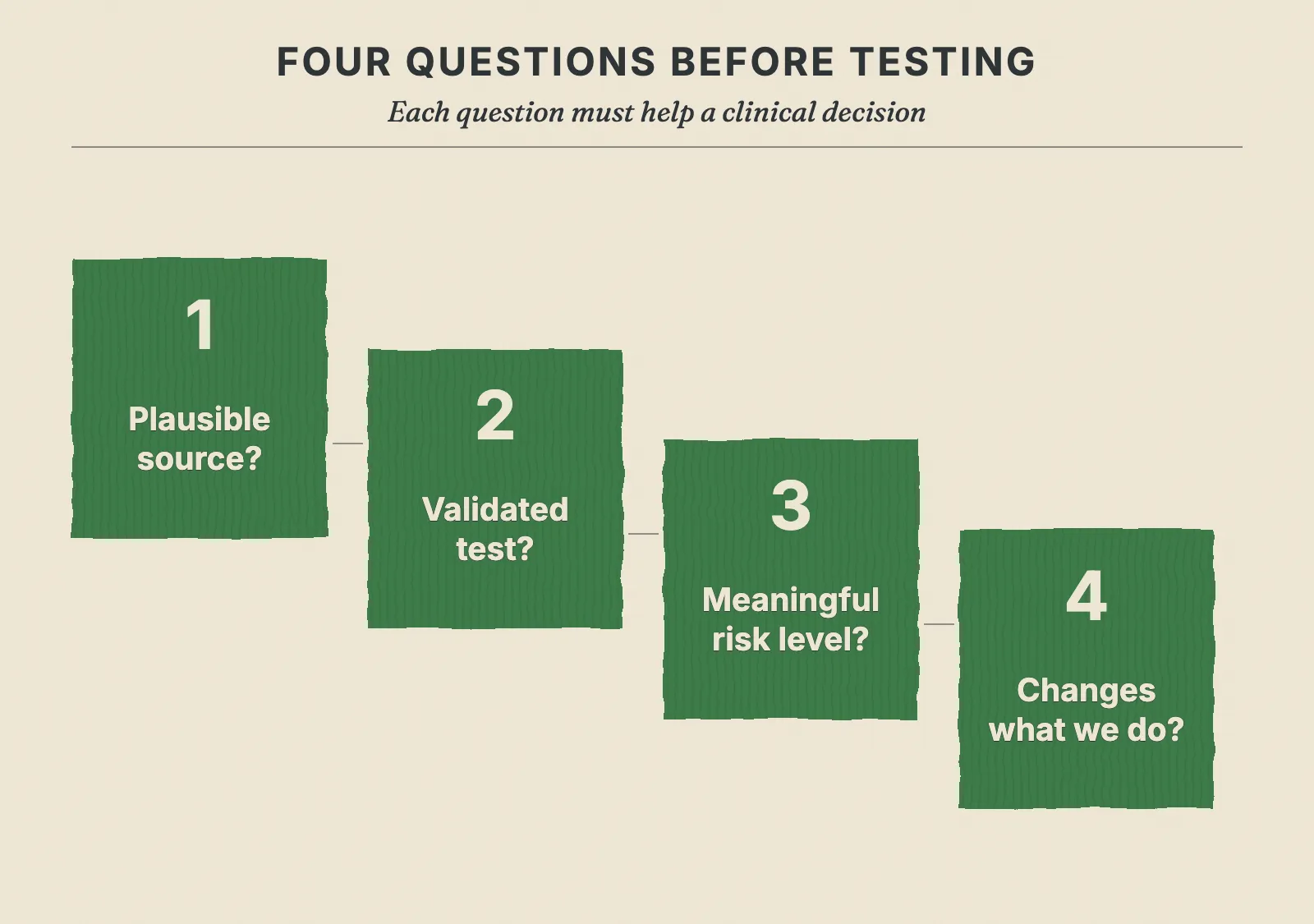
Four questions for exposure-focused testing, based on the clinical decision framework discussed above. This is a checklist, not a measure of medical risk.
If those questions have no clear answers, the test may create more confusion.
Treatment starts with the exposure
The liver and kidneys process and remove substances every day. The lungs, intestines, and skin take part as well. That normal physiology gets turned into a sales pitch whenever someone claims the body needs a generic cleanse.
Specific toxic exposures sometimes require specific medical treatment. Lead poisoning may require removal from the source and, in selected cases, supervised chelation. That has little in common with a supplement package sold for vague symptoms.
Treatment chosen from an unvalidated test starts with weak reasoning. CDC makes that point directly in its warning about urine mycotoxin testing, including the risk of an incorrect diagnosis followed by an unnecessary medical treatment (Kawamoto and Page 2015).
The treatments can carry real risk. FDA warns that unapproved chelation products can cause dehydration, kidney failure, and death (FDA 2020). Many antifungal medicines have been linked to liver injury (NIDDK 2017). Antibiotics raise the risk of Clostridioides difficile infection, an infection that causes diarrhea and inflammation of the colon, and their use contributes to antimicrobial resistance (CDC 2025, CDC 2026).
Anyone considering these treatments needs a physician who will explain the evidence, uncertainty, monitoring, and risks.
Reducing exposure without living in fear
You cannot avoid every environmental chemical. Fear can become its own burden, especially for someone who already reacts to food, smells, or medicines.
If this article helped you, please share it. Your shares help keep Sage Matters free, and I only ask you to share it if you genuinely found it useful.
Start with the larger exposures you can identify.
Fix leaks and persistent dampness. Visible mold needs proper removal along with repair of the moisture source.
Check the annual report from your water utility. Test a private well separately. Choose a certified filter for the contaminant you are trying to remove.
Keep smoke out of the home and ventilate combustion appliances. Use an outdoor-venting hood while cooking when you have one.
Follow local fish guidance, especially during pregnancy and for children. Vary the foods you eat so one source doesn't dominate your exposure.
Use the required protective equipment around solvents, pesticides, dust, and fumes at work or during hobbies.
These steps are sensible exposure control and belong inside a broader treatment plan for chronic illness.
Where I land
The medical system does dismiss people whose symptoms don't fit a familiar diagnosis. A normal basic panel can close the conversation too quickly.
Environmental history belongs in that conversation. The physician should build a timeline, investigate plausible sources, and use tests that can answer a defined question. The patient should hear where the evidence is firm and where clinicians disagree.
There is plenty we still don't know about combined exposure over a lifetime. Careful medicine keeps that uncertainty visible, listens to the patient, and refuses to sell certainty that the science hasn't earned.
Ready to start restoring your health?
The membership is $300 a month, month to month. You get a written plan, teaching, and coaching. Sage does not diagnose you or give you a personal medical reading.
See the membershipReferences11
- Centers for Disease Control and Prevention. National Biomonitoring Program. Updated April 24, 2024. https://www.cdc.gov/biomonitoring/
- Centers for Disease Control and Prevention. National Report on Human Exposure to Environmental Chemicals. Updated 2024. https://www.cdc.gov/environmental-exposure-report/
- Centers for Disease Control and Prevention. Healthy Habits, Antibiotic Do's and Don'ts. Updated 2025. https://www.cdc.gov/antibiotic-use/about/
- Centers for Disease Control and Prevention. About C. diff. Updated May 13, 2026. https://www.cdc.gov/c-diff/about/index.html
- Food and Drug Administration. Questions and Answers on Unapproved Chelation Products. Updated September 22, 2020. https://www.fda.gov/drugs/medication-health-fraud/questions-and-answers-unapproved-chelation-products
- Kawamoto M, Page E. Use of Unvalidated Urine Mycotoxin Tests for the Clinical Diagnosis of Illness, United States, 2014. Morbidity and Mortality Weekly Report. 2015, 64(6), 157-158. https://www.cdc.gov/mmwr/preview/mmwrhtml/mm6406a7.htm
- National Institute of Environmental Health Sciences. Perfluoroalkyl and Polyfluoroalkyl Substances. Updated 2024. https://www.niehs.nih.gov/health/topics/agents/pfc
- National Institute of Diabetes and Digestive and Kidney Diseases. Antifungal Agents. LiverTox. Updated May 18, 2017. https://www.ncbi.nlm.nih.gov/books/NBK548396/
- Vermeulen R, Schymanski EL, Barabási AL, Miller GW. The exposome and health, where chemistry meets biology. Science. 2020, 367(6476), 392-396. https://doi.org/10.1126/science.aay3164
- World Health Organization. WHO Guidelines for Indoor Air Quality, Dampness and Mould. 2009. https://www.who.int/publications/i/item/9789289041683
- World Health Organization. Guidance on Air Pollution and Health. Updated 2023. https://www.who.int/tools/compendium-on-health-and-environment/air-pollution-and-health
More from Sage Matters

What we actually know about microplastics in your body
In 2024, researchers in Italy removed carotid artery plaque from 257 patients during surgery and tested it for plastic.
READ ARTICLE
Longevity basics that actually have evidence behind them
Longevity basics that actually have evidence behind them
READ ARTICLE
What are the important things to consider for longevity?
Focus on these things for a long and healthy life
READ ARTICLE
Your Metabolism Isn’t Broken: Why Metabolic Guidelines Aren’t One-Size-Fits-All
Nutrition guidelines are framed as an absolute. Follow this ratio and you will get optimal results, don’t and your body will suffer. But at the end of the
READ ARTICLE