Introduction
In 2024, researchers in Italy removed carotid artery plaque from 257 patients during surgery and tested it for plastic. Just over 58% of the samples contained polyethylene, the plastic used in shopping bags and water bottles. The patients whose plaque tested positive were 4.5 times more likely to have a heart attack, a stroke, or die of any cause over the next 34 months than the patients whose plaque tested clean (Marfella 2024).
It's a peer-reviewed, prospective study published in the New England Journal of Medicine, with a risk number most cardiologists would take seriously for any other finding in a patient's chart.
I want to divide what's actually proven about microplastics from what's still theory, as most of this topic’s literature blends the two together. We need to understand which part of the story has real evidence and which is someone’s best guess.
The exposure is true, but the "credit card a week" number isn't
You may have heard that the average person eats a credit card's worth of plastic every week. That number came from a 2019 report and it's off by a wide margin. When researchers went back and checked the math, the actual estimate dropped by more than a hundredfold for most people (Cox 2019).
The real number, from a study that pooled 26 separate research papers, puts annual ingestion somewhere between 39,000 and 52,000 particles a year from food and drink. Add inhalation and that climbs to roughly 74,000 to 121,000 particles a year (Cox 2019).
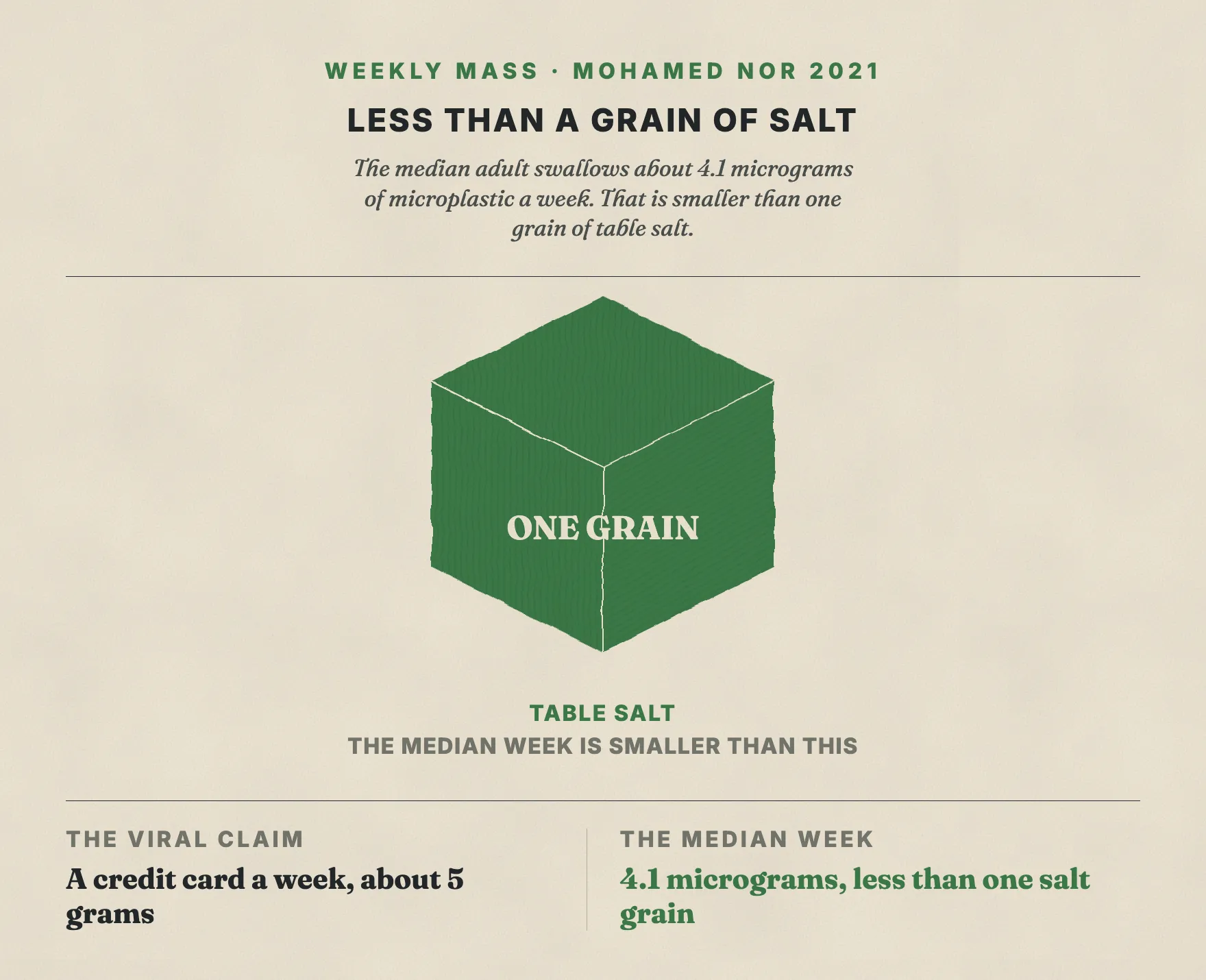
Mohamed Nor et al., Environmental Science & Technology, 2021. Median adult intake is 4.1 micrograms a week, about 0.0041 milligrams. Wageningen University described that as less than a grain of table salt. The credit card a week figure is a separate mass claim that does not represent an average person.
If you drink only bottled water, tack on another 90,000 particles annually compared to someone drinking tap water (Cox 2019).
The real number is nowhere near a credit card. You're breathing in and swallowing tens of thousands of tiny plastic fragments a year, mostly without noticing, from ordinary sources like synthetic carpet fibers, food packaging, and the dust that settles on your kitchen counter. Ingestion and inhalation are the two exposure routes with the most research behind them. Absorption through skin is real too, and early evidence shows plastic particles can get past the skin barrier and trigger inflammation there, but far less has been studied on that route (Microplastics and Nanoplastics 2025).
The carotid plaque study wasn't a one-off finding. A 2026 study tested human brain tissue and found microplastics in nearly every sample examined, including tissue from people with no known disease. Brain concentrations ran 7 to 30 times higher than what the same researchers found in liver or kidney tissue from the same donors. The heaviest plastic loads showed up in donors who'd had dementia (Nature Health 2026).
The same study looked at brain tumor tissue specifically and found even higher microplastic concentrations there than in healthy brain tissue, with tumor size tracking the amount of plastic surface area inside it (Nature Health 2026). I'll come back to that finding, as it connects to something I think you'll find interesting.
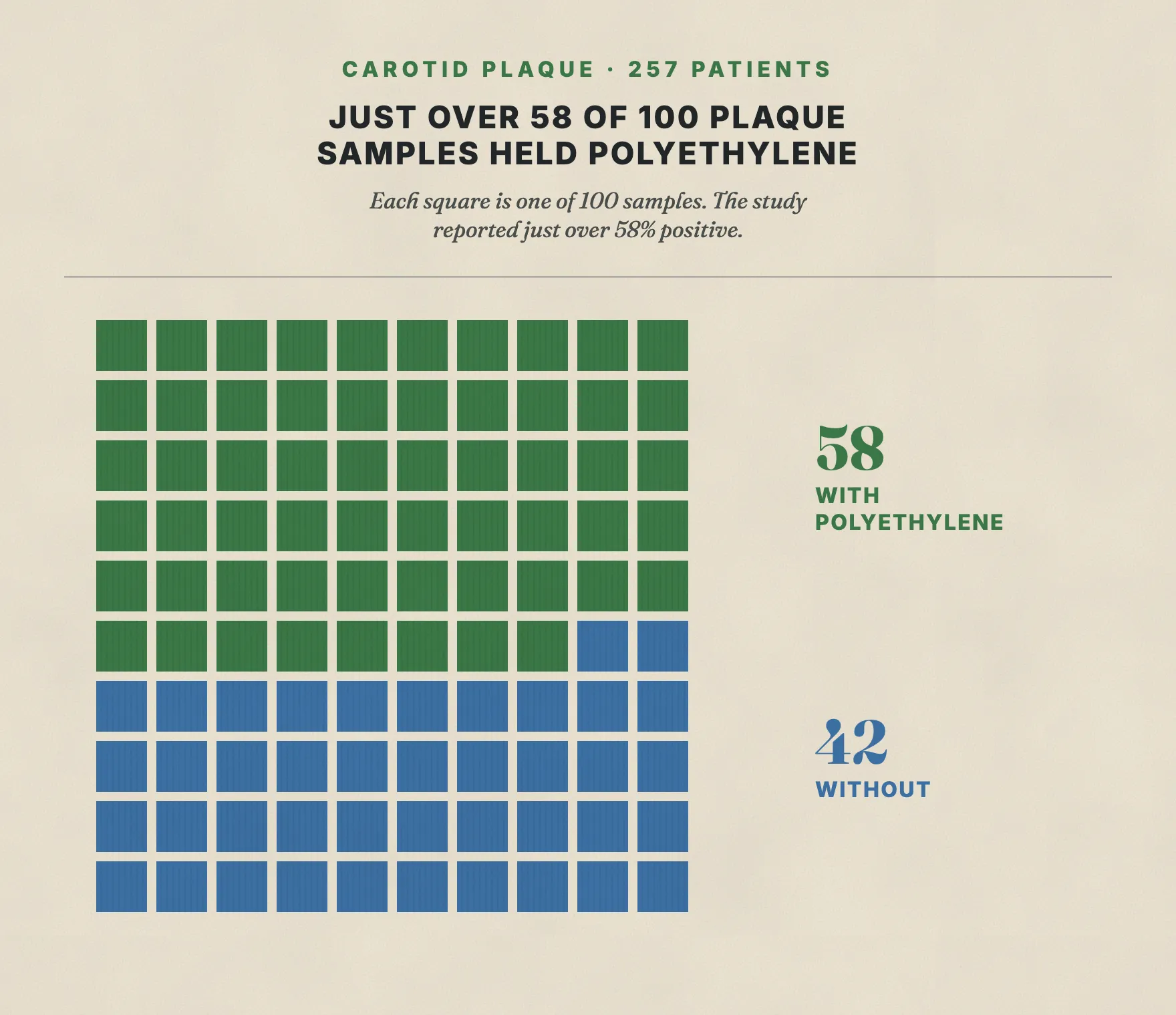
Marfella et al., New England Journal of Medicine, 2024. 257 patients. Each square is 1 of 100 plaque samples. The study reported just over 58% positive for polyethylene.
Separate from the plastic particles themselves, plastic manufacturing leaves behind chemical residue. Bisphenol A (BPA) and phthalates, the chemicals that make plastic hard or soft, are established endocrine disruptors. That's not a fringe claim. The Endocrine Society's own scientific task force has reviewed the evidence and concluded these chemicals interfere with estrogen and testosterone signaling (Endocrine Society 2024).
Phthalates block testosterone's effects on tissue. People with higher phthalate exposure measured in their blood or urine tend to have lower testosterone, in men, women, and children alike (Endocrine Society 2024). If you've had unexplained hormone symptoms and normal-looking labs, this is one more variable worth asking your physician about, alongside sleep, stress, and diet.
A theory worth knowing about, even though it isn't proven
Here's the piece I found quite interesting. Patrick Coles holds a PhD in chemical engineering from UC Berkeley and a master's in biochemistry from Cambridge, and he's worked as a researcher at Los Alamos National Laboratory. He's a trained scientist, not a physician, reading the same biopsy literature everyone else has access to yet he draws a different conclusion from it. In an interview on The Human Upgrade podcast, he laid out something he calls the toxin sequestration theory. His idea is that a tumor isn't damaged tissue growing out of control, but rather tissue the body deliberately builds to store toxins it can't safely process anywhere else. In other words, a kind of backup storage unit for whatever the liver, kidneys, and fat tissue can no longer handle (Coles 2026).
Coles points to the same kind of finding as evidence, citing biopsied tumors that show elevated levels of oxalates, heavy metals, mold toxins, and microplastics compared to healthy tissue nearby. He argues chemotherapy makes this worse in some cases, because killing the tumor cells bursts open a container of stored toxins and dumps them back into circulation all at once (Coles 2026).
Obviously, this is theory and not proven science. But it's put forward by a smart scientist who has devoted considerable time to researching this topic. Something worth following.
If this article helped you, please share it. Your shares help keep Sage Matters free, and I only ask you to share it if you genuinely found it useful.
This is interesting background on a pattern that several independent research groups keep finding, but it is not medical advice to change cancer treatment. It is however worth understanding the pattern, where tumors and diseased tissue carry a heavier toxin load than healthy tissue nearby, even if the explanation for it stays unresolved.
What actually helps
One intervention has real trial evidence behind it, though for a narrower target than most people assume. A randomized clinical trial in Australian firefighters found that regular blood donation lowered serum PFAS (the "forever chemicals" used in nonstick coatings and firefighting foam) by about 10%, and plasma donation lowered it by about 30%, with the reduction holding for at least three months afterward (Gasiorowski 2022). That trial measured PFAS, not microplastic particles themselves, so donating blood as a microplastic strategy specifically is still more assumption than proof. Sauna use is often paired with the same idea, clearing toxins through sweat, but the data quantifying how much plastic or PFAS actually leaves the body that way is thinner than the blood donation trial.
Beyond that, the changes that cut your ongoing exposure are mostly about heat and plastic never touching each other. Tea bags are often heat-sealed with plastic, so loose leaf tea skips that. Boiling food in a plastic pouch (sous vide) forces hot water through plastic under pressure directly against your food. Nonstick pans shed plastic coating into whatever you cook. Swap those for stainless steel or cast iron, store and reheat food in glass instead of plastic, boil water in a stainless kettle instead of a plastic electric one, and skip the pod coffee makers that push hot water through plastic tubing.
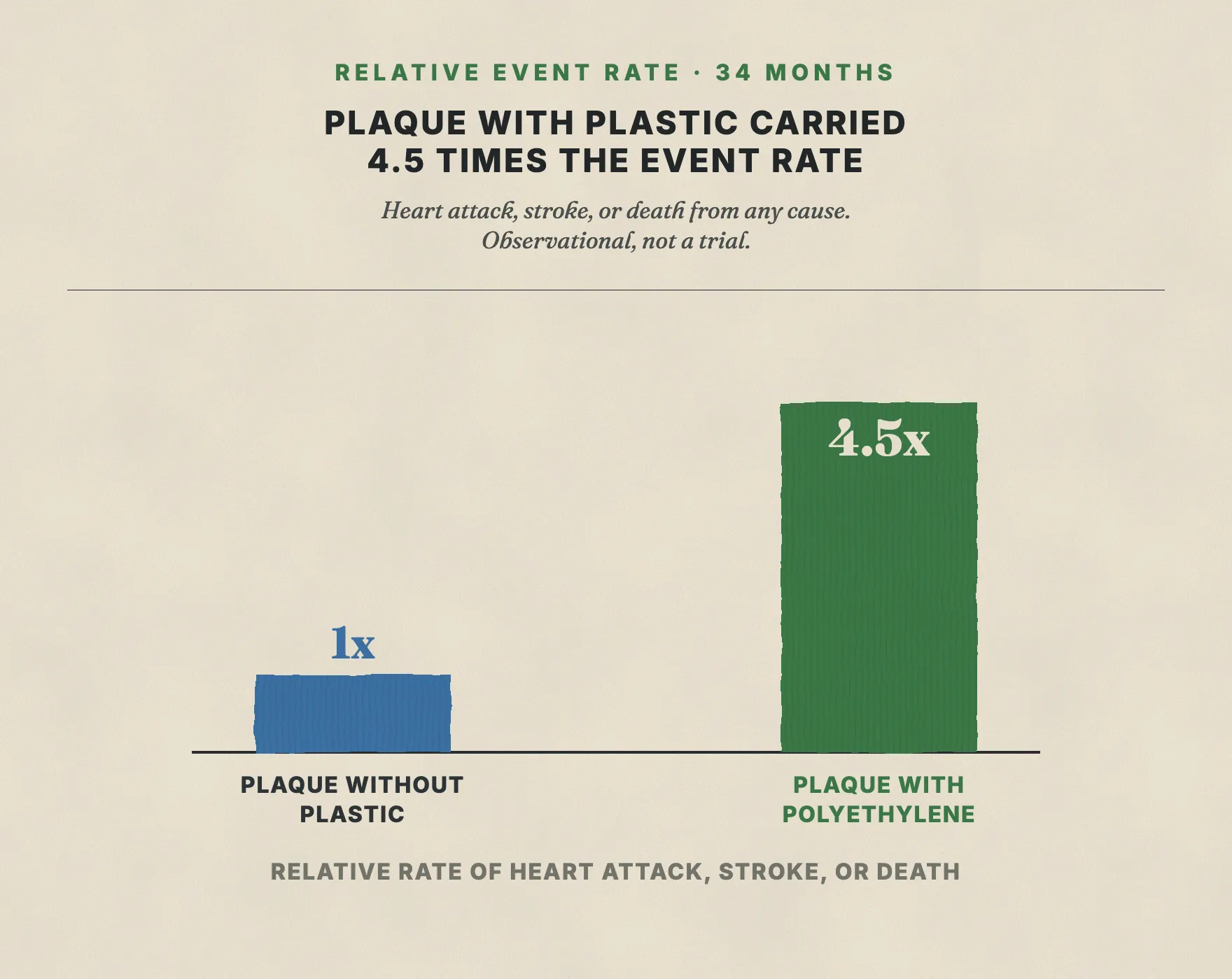
Same study. Heart attack, stroke, or death from any cause over 34 months, plaque with plastic versus plaque without. Relative risk 4.5. Observational, not a trial.
The same logic extends past the kitchen. Paper towels are often coated with BPA or its substitute BPS, so cotton or linen cloths are the cleaner swap. Synthetic pillows, rugs, and clothing shed plastic fibers into the air you breathe indoors, so wool, cotton, and other natural fibers cut that source down. None of this gets you to zero as plastic is woven into too much of daily life for that to be realistic. But it does move your exposure meaningfully toward the low end of that 39,000 to 121,000 particle range instead of the high end.
On a related note, there is a company called Winnow Labs that sells a probiotic marketed to bind and remove microplastics from the gut. Their published research screened 784 bacterial strains for microplastic-binding ability and found some that increased microplastic excretion by about 34% in animal studies (Winnow Labs 2025). As of yet there is no published human trial showing the product lowers total body plastic burden in people, and a law firm opened an investigation into the company's marketing claims in 2025. I'd treat it the way I'd treat any supplement with promising animal data and no human trials yet, worth watching, not something to build your whole strategy around.
Ready to start restoring your health?
The membership is $300 a month, month to month. You get a written plan, teaching, and coaching. Sage does not diagnose you or give you a personal medical reading.
See the membershipReferences9
- Marfella R, Prattichizzo F, Sardu C, et al. Microplastics and Nanoplastics in Atheromas and Cardiovascular Events. New England Journal of Medicine. 2024.
- Cox KD, Covernton GA, Davies HL, et al. Human Consumption of Microplastics. Environmental Science & Technology. 2019.
- Mohamed Nor NH, Kooi M, Diepens NJ, Koelmans AA. Lifetime Accumulation of Microplastic in Children and Adults. Environmental Science & Technology. 2021.
- Endocrine Society. Plastics, EDCs & Health (scientific statement, updated 2024).
- Nature Health. Microplastics and nanoplastics in brain tumours and the healthy human brain. 2026.
- Microplastics and Nanoplastics (journal). Dermal exposure: review of current knowledge on the uptake of micro- and nano-plastics. 2025.
- Coles P. Interview with Dave Asprey. Redefining Cancer: The Toxin Sequestration Theory. The Human Upgrade podcast. 2026.
- Winnow Labs. The Science Behind Winnow. winnowlabs.com/pages/science (http://winnowlabs.com/pages/science). 2025.
- Gasiorowski R, Forbes MK, Silver G, et al. Effect of Plasma and Blood Donations on Levels of Perfluoroalkyl and Polyfluoroalkyl Substances in Firefighters in Australia: A Randomized Clinical Trial. JAMA Network Open. 2022.
More from Sage Matters
Toxic burden and chronic illness
A person can feel terrible and still be told every test is normal.
READ ARTICLE
Longevity basics that actually have evidence behind them
Longevity basics that actually have evidence behind them
READ ARTICLE
What are the important things to consider for longevity?
Focus on these things for a long and healthy life
READ ARTICLE
Your Metabolism Isn’t Broken: Why Metabolic Guidelines Aren’t One-Size-Fits-All
Nutrition guidelines are framed as an absolute. Follow this ratio and you will get optimal results, don’t and your body will suffer. But at the end of the
READ ARTICLE