Introduction
I have very good deep well water.
It begins deep underground, protected from many of the contaminants that affect surface water. It tastes good and is probably better than much of the water sold in plastic bottles.
I still run it through reverse osmosis.
That may sound unnecessary, but clear water is not necessarily clean water. Some important contaminants have no color, taste, or odor. Deep groundwater can contain naturally occurring arsenic, uranium, radium, manganese, fluoride, and other elements.
The only way to know what is in the water is to test it.
The Environmental Protection Agency recommends testing private wells annually for coliform bacteria, nitrate, total dissolved solids, and pH. Additional testing should reflect local geology, agriculture, industry, septic systems, and other nearby activity. About one in five wells in a large US Geological Survey sample contained at least one contaminant above a human-health benchmark. [1,2]
Water quality deserves more attention than it gets. We drink water, cook with it, bathe in it, and use it to wash our food. It is also the medium in which nearly every biological process in the body takes place.
Water and the movement of ions
Water is not simply something that fills space in the body. It is the medium in which electrically charged minerals move.
Sodium, potassium, calcium, magnesium, chloride, bicarbonate, phosphate, and other ions travel through the body in water. Their movement across cell membranes creates the electrical gradients that allow nerves to fire, muscles to contract, the heart to beat, and mitochondria to produce energy.
In this sense, the body becomes an active ion-exchange system.
Cell membranes are selective boundaries. Ion channels and transport proteins determine what enters and leaves. The kidneys continually adjust the final mixture. Hormones such as aldosterone, vasopressin, and parathyroid hormone help regulate water and mineral balance.
Hydration cannot be reduced to the number of glasses of water we drink.
Water provides the medium. Minerals provide the ions. The body regulates their movement.
Exposure is not limited to drinking
Most discussions of water focus on oral exposure. We should also consider the skin and lungs.
During a shower or bath, the skin is in direct contact with water over a large surface area. Some chemicals can cross the skin. The amount absorbed depends on the chemical, its concentration, water temperature, contact time, and the condition of the skin.
Volatile compounds create another route of exposure. They can leave warm water and enter the bathroom air. We can then inhale them while showering. The Agency for Toxic Substances and Disease Registry evaluates both inhalation and dermal uptake when assessing household water containing volatile and semi-volatile chemicals. [3]
Not everything in water is readily absorbed through the skin. Many dissolved substances cross the skin poorly. But a filter under the kitchen sink might not solve every water problem.
If testing identifies volatile organic compounds or another contaminant relevant to bathing, whole-house treatment may be worth considering. The treatment should be selected for the particular contaminant.
Why I use reverse osmosis
Reverse osmosis forces water through a semipermeable membrane. Water passes through while many dissolved substances are rejected.
Depending on the system, RO can reduce dissolved salts, nitrate, fluoride, arsenic, lead, copper, radionuclides, and some synthetic organic chemicals. Properly certified systems can also reduce certain PFAS. [4,5]
I prefer reverse osmosis because it gives me a broad final barrier, even when the source water is already good. It is not perfect, but it is one of the most useful household purification technologies available.

Share of private wells in a large US Geological Survey sample with at least one contaminant above a human-health benchmark (US EPA, Private Drinking Water Wells).
A system should be independently certified under NSF/ANSI 58. I also want to see certification for the specific contaminants found in my source water. A general certification mark obviously does not mean that every model removes every contaminant. [6]
RO systems require maintenance. Prefilters must be replaced. The membrane does not last forever. Storage tanks and lines should be sanitized. I periodically test the finished water rather than assuming the equipment is still working.
Distillation and remineralization
Distillation heats water, captures the vapor, and condenses it in a separate chamber. Many minerals, metals, microorganisms, and other nonvolatile substances remain behind.
It can be effective, but it is slow and uses energy. The boiling chamber must be cleaned. Some volatile chemicals can travel with the steam unless the unit vents them or includes an appropriate activated-carbon stage.
Distilled water is very low in minerals. RO water usually contains few minerals as well. This leads to an important question. After cleaning the water, should we put minerals back?
Water is not usually our main source of nutrition. Most of our calcium, magnesium, potassium, copper, and other essential elements should come from food.
Water can still make a meaningful contribution. Some tap and bottled waters provide useful amounts of calcium and magnesium. The World Health Organization has examined the possible health significance of these minerals in drinking water. [7,8]
Commercial remineralization cartridges usually add calcium carbonate, magnesium, or both. These minerals can improve taste, raise alkalinity, and make purified water less corrosive.
I think this is reasonable, but remineralization should be controlled.
A cartridge that adds known amounts of calcium and magnesium is different from adding a concentrate containing dozens of elements in uncertain quantities. The label should tell us what is being added and how much ends up in the finished water.
The overlooked trace elements
The body uses some elements in very small quantities. While small does not mean unimportant, it also does not mean that more is better.
Copper is essential for iron metabolism, connective tissue, energy production, and antioxidant enzymes. Both deficiency and excess can cause problems. [9]
Boron may influence bone health and mineral metabolism. It has not been formally classified as an essential human nutrient, and there is no established recommended daily allowance. [10]
Trace lithium in drinking water has been studied in relation to mood, suicide, and dementia. Some findings are intriguing, but they remain observational and inconsistent. They do not establish an ideal dose or justify supplementation for everyone. [11,12]
Minerals have dose-response curves. Identity, chemical form, concentration, purity, and total intake all matter.
Biotite as a mineral source
Biotite is a naturally occurring member of the mica family. The US Geological Survey describes it as a potassium, magnesium, iron, aluminum silicate. Its approximate composition is K(Mg,Fe)3AlSi3O10(OH,F)2. The exact composition varies from one deposit to another. [13]
Commercial ionic biotite products generally use an acid extraction process to convert constituents of weathered black mica or vermiculite into soluble mineral salts.
A US patent granted in 1988 describes a water-purifying reagent made by dissolving vermiculite weathered from black mica in an inorganic acid. The extract was added to water to promote precipitation and agglomeration, followed by filtration. [14]
The patent gives biotite-derived water treatment a real history. It does not prove a clinical health benefit.
At least one current manufacturer recommends adding its ionic sulfate mineral product to reverse-osmosis or distilled water. Its published composition lists iron, magnesium, potassium, phosphorus, calcium, manganese, zinc, and numerous trace elements. [15]
I can confirm that biotite is a mineral-bearing raw material and that commercial products are sold for adding ionic minerals to RO and distilled water.
What I cannot confirm is that biotite extract has been shown in independent human studies to be safer, more bioavailable, or more beneficial than controlled remineralization with calcium and magnesium.
Before using an ionic biotite product, I would want a current, batch-specific certificate of analysis showing the final concentrations of aluminum, arsenic, lead, cadmium, mercury, iron, manganese, fluoride, and other relevant elements after dilution.
If a product causes contaminants to precipitate, those particles must be physically removed. Changing a contaminant's chemical form is not the same as removing it from the glass.
Biotite-derived minerals remain an interesting option. For now, I consider them an experimental form of remineralization rather than an established requirement.
The energetic side of water
Water has measurable energetic and electrochemical properties. Temperature, pH, conductivity, dissolved gases, oxidation-reduction potential, mineral composition, and electrical charge all influence how water behaves.
Water next to proteins, membranes, and mineral surfaces does not behave exactly like water in the middle of a glass. Interfacial water is a legitimate field of physical chemistry.
The difficulty begins when valid chemistry is used to support broad claims about "living," "coherent," "hexagonal," or permanently structured drinking water.
Electrolyzed water provides a useful example. Some effects attributed to alkalinity, negative oxidation-reduction potential, or special structure may actually be produced by dissolved molecular hydrogen. Hydrogen-rich water is a legitimate research subject, but human studies remain relatively small. [16,17]
I remain open to this work. I simply do not want the strength of the claim to exceed the strength of the evidence.
Deuterium-depleted water
Deuterium is a naturally occurring heavy isotope of hydrogen. Deuterium-depleted water is manufactured to contain less of it than ordinary water.
Researchers are studying DDW in mitochondrial function, metabolism, oxidative stress, and cancer biology. The laboratory findings are interesting. The clinical evidence is preliminary.
A 2024 systematic review identified 15 eligible experimental and clinical cancer studies, but only one interventional human trial meeting its criteria. Larger controlled trials are needed before DDW can be recommended as a treatment or general longevity intervention. [18]
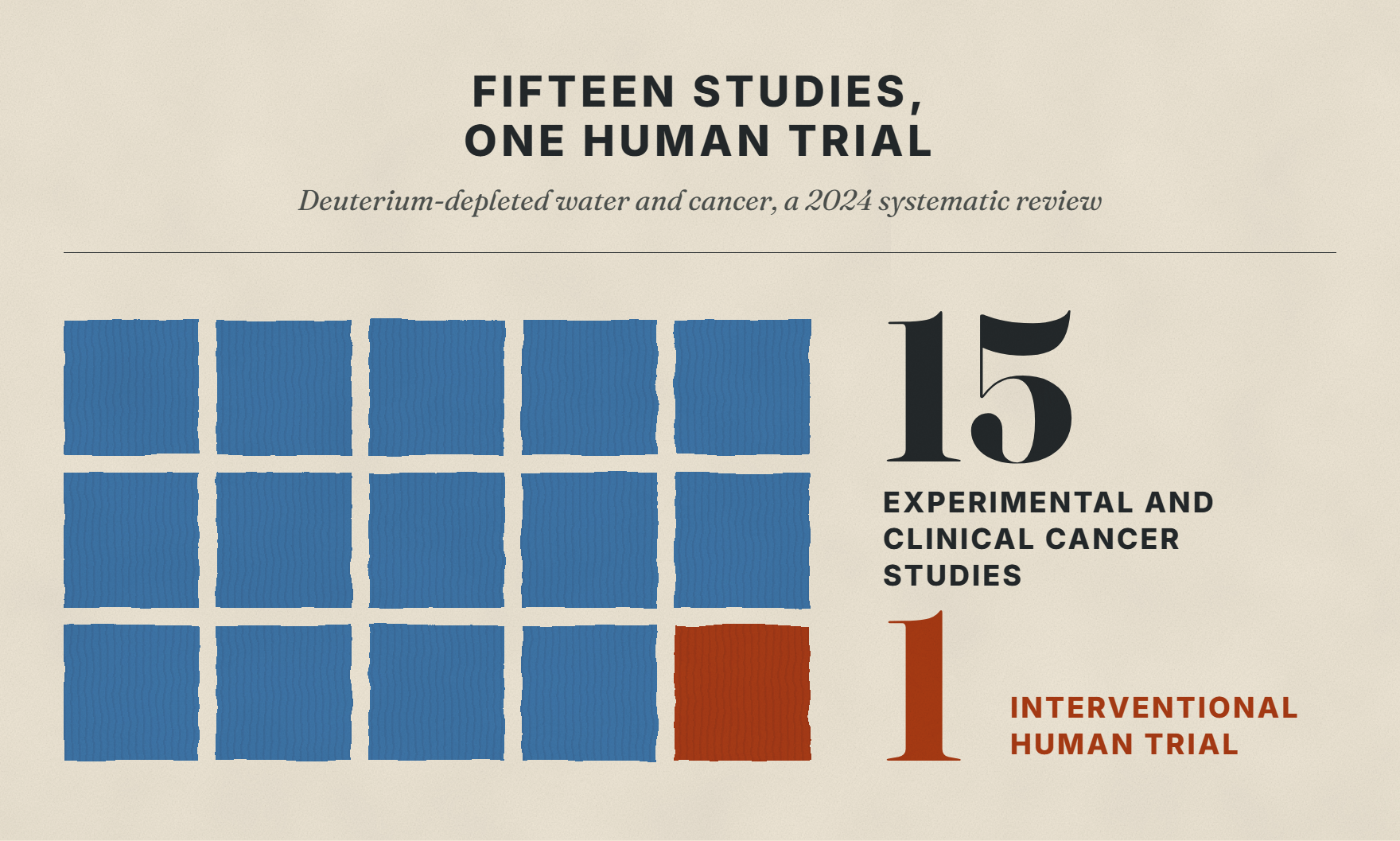
Studies identified in a 2024 systematic review of deuterium-depleted water in cancer, with the one interventional human trial highlighted (Lu and Chen, Nutrients 2024;16:1397).
I would not dismiss it, but I would not place it ahead of the basics.
How I obtain clean water
My process is straightforward.
Test the source water through an accredited laboratory.
Match treatment to what is actually present.
Use a certified point-of-use RO system for drinking and cooking when broad contaminant reduction is desired.
Consider whole-house treatment when contaminants affect bathing, inhalation, plumbing, or appliances.
Maintain the equipment and periodically test the finished water.
Remineralize in a controlled way if desired, or obtain minerals through food and carefully selected supplements.
Ionic biotite-derived products may add minerals to purified water. There is a patent and commercial history behind their use. The evidence is not yet strong enough for me to call them necessary or proven.
Clean water begins with measurement, not marketing.
Test it. Remove what should not be there. Verify the result. Maintain the equipment. Then obtain the minerals you need in known, intentional amounts.
That is why I continue to use reverse osmosis, even though I am fortunate enough to begin with very good well water.
References
US Environmental Protection Agency. "Protect Your Home's Water." https://www.epa.gov/privatewells/protect-your-homes-water
US Environmental Protection Agency. "Private Drinking Water Wells." https://www.epa.gov/privatewells
Agency for Toxic Substances and Disease Registry. "SHOWER Model Evaluation Guidance." 2024. https://www.atsdr.cdc.gov/pha-guidance/resources/EDG-Shower-Model-508.pdf
US Environmental Protection Agency. "Overview of Drinking Water Treatment Technologies." https://www.epa.gov/sdwa/overview-drinking-water-treatment-technologies
US Environmental Protection Agency. "PFAS in Private Wells." https://www.epa.gov/cleanups/pfas-private-wells
NSF. "NSF/ANSI 58: Reverse Osmosis Drinking Water Treatment Systems." https://www.nsf.org/knowledge-library/nsf-ansi-58-reverse-osmosis-drinking-water-treatment-systems
Azoulay A, Garzon P, Eisenberg MJ. "Comparison of the Mineral Content of Tap Water and Bottled Waters." Journal of General Internal Medicine. 2001;16:168-175. https://pubmed.ncbi.nlm.nih.gov/11318912/
World Health Organization. Calcium and Magnesium in Drinking-water: Public Health Significance. 2009. https://www.who.int/publications/i/item/9789241563550
NIH Office of Dietary Supplements. "Copper: Fact Sheet for Health Professionals." https://ods.od.nih.gov/factsheets/Copper-HealthProfessional/
NIH Office of Dietary Supplements. "Boron: Fact Sheet for Health Professionals." https://ods.od.nih.gov/factsheets/Boron-HealthProfessional/
Memon A, et al. "The Association Between Lithium in Drinking Water and Neuropsychiatric Outcomes." 2020. https://pubmed.ncbi.nlm.nih.gov/33045847/
Muronaga M, et al. "Trace Lithium Levels in Drinking Water and Risk of Dementia." 2024. https://pmc.ncbi.nlm.nih.gov/articles/PMC11364728/
US Geological Survey. "Biotite HS28." https://pubs.usgs.gov/of/2003/ofr-03-395/DESCRIPT/M/biotite_hs28.html
Shimanishi A, et al. "Sterilizing Water-Purifying Reagent for Drink." US Patent 4,776,963. 1988. https://patents.google.com/patent/US4776963A/en
Adya, Inc. "Adya Clarity Ionic Minerals." Manufacturer composition and claims. https://adyawater.com/products/adya-clarity-ionic-minerals
LeBaron TW, et al. "Electrolyzed-Reduced Water: Review I." 2022. https://pmc.ncbi.nlm.nih.gov/articles/PMC9738607/
LeBaron TW, et al. "Electrolyzed-Reduced Water: Review II." 2022. https://pmc.ncbi.nlm.nih.gov/articles/PMC9736533/
Lu Y, Chen H. "Deuterium-Depleted Water in Cancer Therapy." Nutrients. 2024;16:1397. https://pmc.ncbi.nlm.nih.gov/articles/PMC11085166/
Ready to start restoring your health?
The membership is $300 a month, month to month. You get a written plan, teaching, and coaching. Sage does not diagnose you or give you a personal medical reading.
See the membershipMore from Sage Matters
Toxic burden and chronic illness
A person can feel terrible and still be told every test is normal.
READ ARTICLE
What we actually know about microplastics in your body
In 2024, researchers in Italy removed carotid artery plaque from 257 patients during surgery and tested it for plastic.
READ ARTICLE
Longevity basics that actually have evidence behind them
Longevity basics that actually have evidence behind them
READ ARTICLE
What are the important things to consider for longevity?
Focus on these things for a long and healthy life
READ ARTICLE