
Introduction
In 1983, two groups working separately saw immature red blood cells shed tiny membrane-wrapped packages as they matured.
One group was led by Rose Johnstone. The other was led by Clifford Harding, John Heuser and Philip Stahl (Johnstone history, 2013). Johnstone coined the word exosome in 1987.
For years the packages looked like cellular garbage bags, a way for a cell to dump unwanted proteins.
So what was actually inside them?
In 1996, Graça Raposo showed that B cells of the immune system release exosomes that can drive immune responses (Raposo et al., 1996).
In 2007, Hadi Valadi and colleagues showed that exosomes carry messenger RNA and microRNA from one cell to another, and that the receiving cell can use them (Valadi et al., 2007). RNA carries out the instructions in a cell's genes.
The membrane is the envelope and the RNA is the note inside. A package that carries instructions between cells is a messenger.

Stem cells send them too
Much of the benefit people credit to stem cells may come from what the cells release, and very little of it from the cells settling into tissue and becoming new tissue.
That idea changed the field in the last fifteen years, and it opened a cheaper path to repair than injecting cells.
In Episode 1, Caplan's MSC was the foreman who gives orders while the patient's own crew builds (Caplan, 2017). Exosomes are one way those orders travel.
In 2010, Sai Kiang Lim's group reported that MSCs secrete exosomes that reduce damage to heart muscle when blood flow returns after a blockage, a problem called reperfusion injury (Lai et al., 2010). The cells did not need to reach the heart for the benefit to appear. The orders got there without the foreman.
The first human use came in 2014. Kordelas and colleagues treated one patient with severe graft-versus-host disease, a dangerous immune reaction after bone marrow transplant, using MSC exosomes, and the patient improved (Kordelas et al., 2014). To offer a grain of salt, that was a single case and proves very little about whether the treatment works.
Drapeau offers a related claim. Of every 100 placenta or umbilical cord stem cells injected, he says about 85 die on the day of injection, and almost none remain four to six weeks later. So how could they help at all? His answer is that the benefit must come from what the cells release before they disappear, a kind of time-release delivery (Drapeau podcast interview).
The first half has independent support in outline, since infused MSCs are cleared quickly. The 85 percent figure is Drapeau's.
The term cell factors, which I used on purpose for its looseness, covers more than exosomes. A stem cell releases a whole mix of growth factors, signaling proteins and vesicles, and researchers call that mix the secretome. When cells are grown in a dish, the fluid they leave behind is called conditioned medium. It contains the secretome and can be collected without any cells in it.
Some of the earliest hair work used that fluid. Conditioned medium from adipose (fat) stem cells promoted hair growth in mice (adipose stem cell medium study). Conditioned medium from umbilical cord blood stem cells did the same, and a human trial is referenced in the paper (cord blood stem cell medium study). A small human trial of a similar hair tonic has also been published (Korean Journal of Dermatology, 2019).
What the evidence shows
So how good is the evidence? The best-studied route is skin and hair, and the evidence there is early.
A 2026 systematic review of microneedling with exosomes found 8 small studies covering 171 patients, about 21 patients a study. Most were case series, which have no comparison group, or split-face trials, where one side of the face is treated and the other is not. Follow-up was under six months (Dhaliwal et al., 2026, as covered by Dermatology Times). No one stopped treatment because of side effects.
One 28-patient split-face study found more collagen, the protein that keeps skin firm, on the side treated with exosomes (Park split-face study, as covered by Dermatology Times).
Another review of 201 articles found only 9 that covered topical exosomes for skin rejuvenation, about 1 in 22, with widely varying sources and delivery methods (NESPS 2025 meeting abstract). That tells me the field is moving faster than the evidence, and the studies do not yet agree on what an exosome product even is.
In microneedling, tiny channels are made in the skin and the product is applied on top. Local injection and intravenous infusion are the other routes, and they draw most of the FDA concern. I have not found good data on what a typical clinic product contains. Dose, source cell and processing method all vary, and a patient usually cannot tell which version they are getting. It is a can with the label torn off.
The wider exosome literature reports delayed granulomas, which are firm inflammatory lumps, along with pigmentation changes and anaphylaxis, a severe allergic reaction. Those reports come from injection rather than topical use (Dermatology Times).
A fair summary is that the biology is interesting, the animal data are encouraging, and the human data are thin and small.
Who sells them
Several companies make exosomes or related vesicle products. The table lists the ones I could identify. It is a starting list and not an endorsement.
| Company | Base | Product or focus | Note |
|---|---|---|---|
| Direct Biologics | Austin, TX | ExoFlo, bone marrow MSC vesicles | FDA expanded access for COVID-related ARDS in 2020. A Phase III ARDS trial is under way, with no results reported yet |
| Aegle Therapeutics | Miami, FL | AGLE-102, MSC vesicles | Clinical stage, dermatology focus |
| Organicell | Florida | Zofin, perinatal fluid vesicles | Trials announced for long COVID, knee osteoarthritis and COPD |
| Capricor | San Diego, CA | Cell and exosome developer | Listed in the same BioSpace piece |
| Kimera Labs | Miramar, FL | XoGlo, XoGlo Pro | Received an FDA warning letter dated September 1, 2023, listed on fda.gov |
| Rion | Rochester, MN | Purified Exosome Product | Tissue regeneration focus |
Industry lists also name Evox, ExoCoBio, Exopharm, Brexogen and ILIAS. The question I could not answer yet is who supplies the exosomes sold to clinics and whether any are made under good manufacturing practice, the standard used for drugs.
Platelet-rich plasma, the cell factor you already own
Platelet-rich plasma, or PRP, is the version of this idea that needs no donor, no import and no lab beyond a centrifuge, a machine that spins a tube fast enough to separate what is in it.
A clinician draws a small amount of your blood and spins it to concentrate the platelets. The result is injected or applied where repair is wanted. Because the blood is yours, no one has to worry about a stranger's cells.
Platelets are the small cell fragments best known for clotting. They also store growth factors, proteins that tell nearby cells to repair, and release them at an injury, like a first-aid kit that opens where you're hurt (Wu et al., 2025). Typical PRP preparations carry two to five times the platelets in whole blood, with growth factor levels three to five times baseline (Wu et al., 2025).
Platelets release exosomes too. A 2025 review states that platelet-derived exosomes make up about 75 percent of the exosomes in circulating plasma. It also cites a 2014 study in which PRP-derived exosomes increased the growth of marrow MSCs and their turning into bone-forming cells (Wu et al., 2025, citing Torreggiani et al., 2014).
So PRP is a crude version of the same messenger system, made from your own blood, and one of its targets in the lab is the stem cell.
Does PRP work
The evidence is the best of anything in this series, and it is still mixed.
For knee osteoarthritis, the wear-and-tear arthritis of the knee, a 2025 network meta-analysis pooled 23 randomized trials with 1,752 patients. It compared PRP types against hyaluronic acid and saline injections (Yu et al., 2025).
So which kind of PRP won? It depended on when you asked. Within three months, PRP rich in white blood cells ranked best for pain and function. At six months, PRP with few white blood cells and a high platelet increase ranked best for function and stiffness. By 12 to 18 months most results were no longer statistically clear.
The authors cite inconsistent protocols and scarce long-term data.
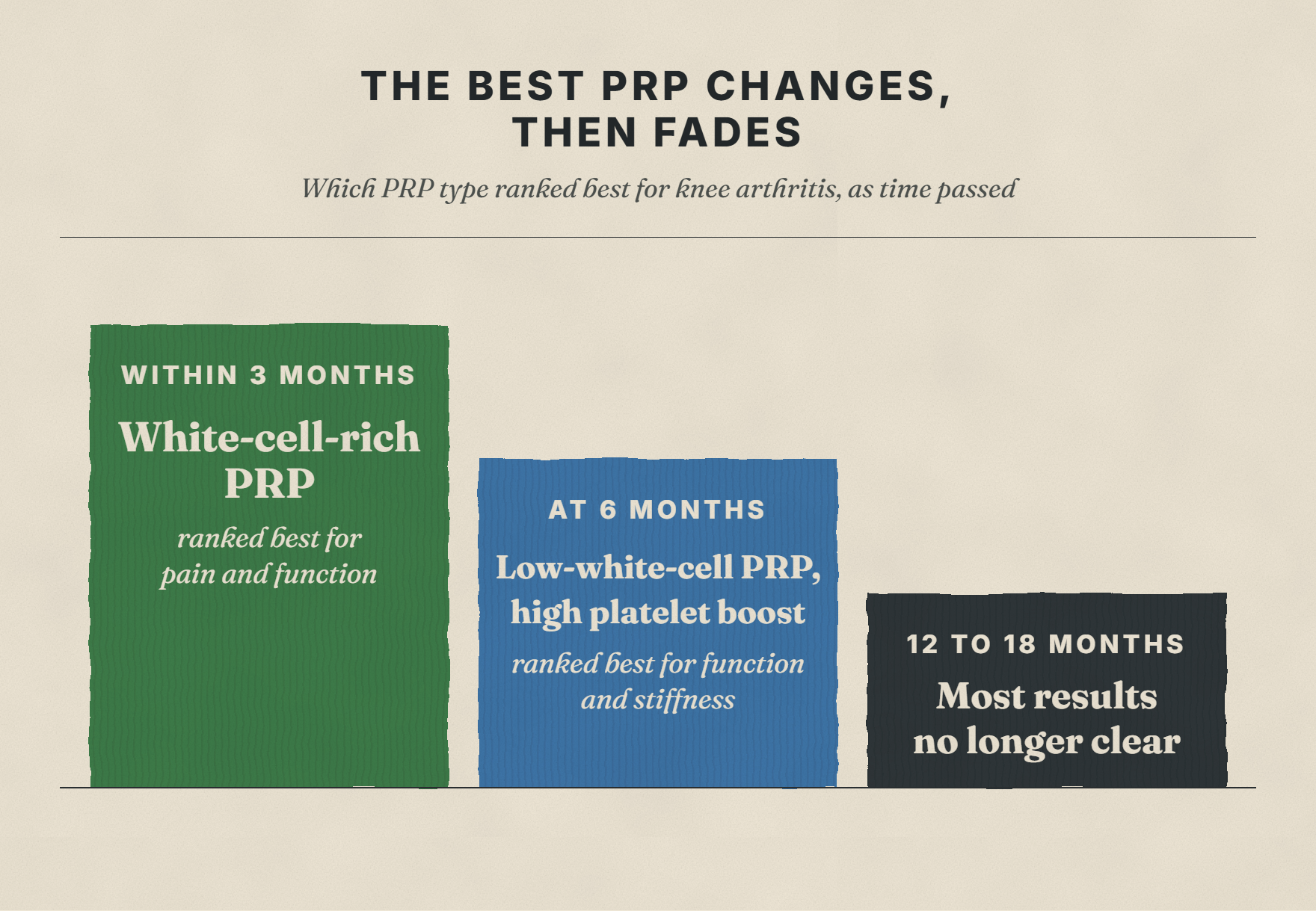
A 2025 network meta-analysis of 23 randomized trials with 1,752 patients compared PRP types for knee arthritis. The best type changed over time, and by 12 to 18 months most results were no longer statistically clear. Step heights show the idea, not measured values. Source: Yu, Zhao and Zhao, 2025, J Orthop Surg Res.
For hair loss, a 2024 meta-analysis of 13 randomized trials found PRP added about 28 hairs per square centimeter compared with placebo, a dummy treatment (95 percent confidence interval 14 to 41, the plausible range). A square centimeter is about the size of a pinky fingernail, so picture 28 more hairs on a patch that size. The studies disagreed widely with each other, hair thickness did not change significantly, and the authors rate the certainty of the evidence low (Kieling et al., 2024).
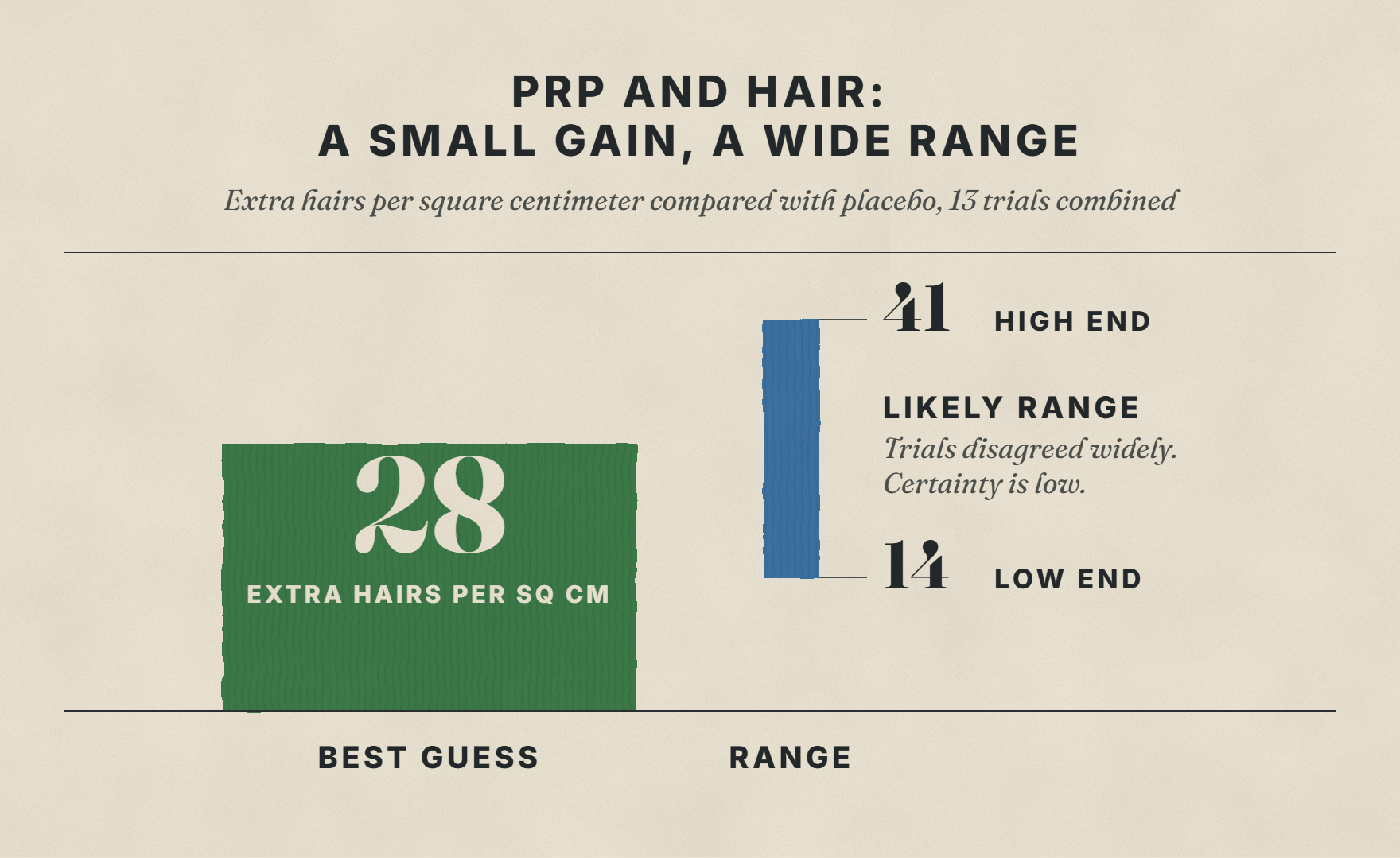
A 2024 meta-analysis of 13 randomized trials found PRP added about 28 hairs per square centimeter versus placebo (95% confidence interval 14 to 41). The studies disagreed widely, and the certainty of the evidence is low. Source: Kieling et al., 2024, An Bras Dermatol.
A separate review reports that hair density rose from baseline but not significantly more than with placebo, and that results looked similar to topical minoxidil, a hair-loss lotion (Wu et al., 2025).
The core problem is that PRP is not one product. More than 16 commercial systems exist, and they differ in platelet concentration, white blood cell content and activation method (Wu et al., 2025). A trial result for one preparation does not transfer to another, and a patient rarely knows which one they are getting.
My reading is that PRP shows the cell factor principle works in humans often enough to take seriously. It does not show that every preparation or every use works, and it does not substitute for stem cells.
Where this leaves us
Exosomes and other cell factors give repair a second path, and PRP offers a cheaper and better-studied version of it.
The human data are early and the products differ. Anyone selling certainty today is ahead of the science.
Episode 3 takes on what you can legally obtain, where, and at what price, and it looks at light and electromagnetic fields as possible amplifiers.
───
References
Johnstone and the exosome field, JCB history (2013) (https://rupress.org/jcb/article/200/4/367/37222/Exosomes-Looking-back-three-decades-and-into-the)
Raposo G et al. (1996). B lymphocytes secrete antigen-presenting vesicles. J Exp Med 183(3):1161-1172. PMID 8642258. See the Frontiers review (https://www.frontiersin.org/articles/10.3389/fimmu.2015.00073/pdf).
Valadi H et al. (2007). Exosome-mediated transfer of mRNAs and microRNAs is a novel mechanism of genetic exchange between cells. Nature Cell Biology. See the Assay Genie summary (https://www.assaygenie.com/blog/exosomes-small-players-with-a-big-role/).
Caplan AI (2017). Mesenchymal stem cells, time to change the name. Stem Cells Translational Medicine 6(6), 1445-1451 (https://doi.org/10.1002/sctm.17-0051)
Lai RC et al. (2010). Exosome secreted by MSC reduces myocardial ischemia/reperfusion injury. Stem Cell Res 4(3):214-222. PMID 20138817. See the Toh, Lai, Zhang and Lim review (https://pmc.ncbi.nlm.nih.gov/articles/PMC6103455).
Kordelas et al. (2014), Leukemia (https://www.nature.com/articles/leu201441)
Drapeau C. Podcast interview on stem cells and repair (2026).
Adipose stem cell conditioned medium and hair growth in mice (https://pubmed.ncbi.nlm.nih.gov/20203417/)
Cord blood stem cell conditioned medium and hair growth (https://www.mdpi.com/728026)
Efficacy of a hair tonic containing human umbilical cord blood mesenchymal stem cell-derived conditioned media in patients with androgenetic alopecia. Korean Journal of Dermatology (2019), 251-257.
Dermatology Times, microneedling with exosomes systematic review (2026) (https://www.dermatologytimes.com/view/microneedling-with-exosomes-shows-early-promise-across-multiple-skin-conditions-systematic-review-finds)
NESPS 2025 meeting abstract, 9 of 201 articles (https://meeting.nesps.org/program/2025/37.cgi)
Direct Biologics, CB Insights profile (https://www.cbinsights.com/investor/direct-biologics)
BioSpace, exosome and cell therapy companies (https://www.biospace.com/pandemic-highlights-opportunities-challenges-for-exosomes-and-related-cell-therapies)
Exosome biotech industry report (2020) (https://www.cellgs.com/blog/exosome-biotech-report-sept-2020.html)
Wu W-S, Chen L-R, Chen K-H (2025). Platelet-Rich Plasma, molecular mechanisms, actions and clinical applications. Int J Mol Sci (https://www.ncbi.nlm.nih.gov/pmc/articles/PMC12608683/)
Torreggiani E et al. (2014). Exosomes: novel effectors of human platelet lysate activity. Eur Cell Mater 28:137-151. PMID 25241964. Cited in Wu et al. (2025).
Yu D, Zhao J, Zhao K (2025). Efficacy of PRP preparation protocols in osteoarthritis, a network meta-analysis. J Orthop Surg Res (https://josr-online.biomedcentral.com/articles/10.1186/s13018-025-06026-1)
Kieling L et al. (2024). Autologous PRP and hair density in androgenic alopecia, a meta-analysis. An Bras Dermatol (https://www.ncbi.nlm.nih.gov/pmc/articles/PMC11551241/)
More from Sage Matters
Toxic burden and chronic illness
A person can feel terrible and still be told every test is normal.
READ ARTICLE
What we actually know about microplastics in your body
In 2024, researchers in Italy removed carotid artery plaque from 257 patients during surgery and tested it for plastic.
READ ARTICLE
Longevity basics that actually have evidence behind them
Longevity basics that actually have evidence behind them
READ ARTICLE
What are the important things to consider for longevity?
Focus on these things for a long and healthy life
READ ARTICLE