
Introduction
In the United States, whether you can buy a stem cell or exosome product depends on one decision, which is how the FDA classifies it. That classification explains the price, the clinic map, the warning letters and the line I keep hearing: that if you want stem cell treatment you should not get it in the U.S. This episode lays out what the rules say, what treatment costs, and whether light and electromagnetic fields help the cells do their work.

How the U.S. sorts human-derived products
The FDA regulates products made from human cells and tissues, called HCT/Ps, on two tracks. The first track covers tissue handled in a simple way, and the agency calls those products "361" HCT/Ps after the section of the Public Health Service Act that governs them. To qualify, a product must be minimally manipulated, used in the same way it works in the donor, not combined with other articles, and generally free of a systemic effect on the body. These products need no premarket approval (FDA enforcement summary, National Law Review).
Everything else falls on the second track, "351," where the product is treated as a drug or biologic. It then needs clinical trials and a license before it can be marketed. Cells grown in a lab, processed heavily or given to produce an effect elsewhere in the body usually land here.
The FDA's own consumer alert says the only stem cell products approved for use in the United States are blood-forming stem cells from umbilical cord blood, approved for disorders that affect blood production (FDA consumer alert, content current as of April 2024). That statement covers the entire approved list. Every other stem cell product in a clinic either sits inside a trial, falls under the narrow 361 exemption, or operates in a gray zone.
What the FDA says about exosomes
The FDA's consumer alert states plainly that there are currently no FDA-approved exosome products (FDA consumer alert). The agency issued a public safety notification on exosome products in December 2019 (FDA, 2019). It followed with a 2023 untitled letter to Regenerelle (JD Supra summary), a 2023 warning letter to Kimera Labs (FDA, 2023), a December 2024 warning letter to Evolutionary Biologics (FDA, 2024), and a May 2025 warning letter to Supreme Rejuvenation (FDA, 2025).
The pattern in those letters is consistent. Exosome products offered to treat or prevent disease count as unapproved drugs or biologics, and companies marketing them get enforcement attention. For anyone building a series on exosomes, that is the regulatory backdrop. The science in Episode 2 describes promising biology, and the legal status describes a product class with no approvals.
Florida barely opened a door
Florida changed part of the picture on July 1, 2025. Senate Bill 1768 lets physicians (MDs and DOs) use stem cell therapies that are not FDA approved, but only for orthopedics, wound care and pain management. Patients must sign informed consent and advertising must carry a notice (Holland & Knight on SB 1768). The bill passed 37 to 0 in the Senate and 112 to 0 in the House (Florida Senate bill summary).
The law has limits. It does not change federal law, and the state health department warned that physicians and suppliers could still face FDA action (Florida House analysis). It also covers three uses and says nothing about the anti-aging or cosmetic uses most people ask about. A unanimous vote does tell me that the public pressure for access is large.
Why people leave
When the United States offers an approved cord blood product and little else, people look elsewhere. Facilitator websites describe clinics in Mexico operating under COFEPRIS, the Mexican health regulator, and clinics in Colombia operating under INVIMA, the Colombian one (Bookimed, facilitator site). Quality varies a great deal from clinic to clinic, and those sites make money when patients book, so I treat their descriptions as marketing.
Whatever the country, a few questions apply to any provider. What exactly is in the product, and what cell or tissue does it come from? Where was it made and tested? Which regulator oversees the clinic and the product? What published evidence supports its use for this condition? A clinic that cannot answer those questions clearly has promoted something they can’t back up.
Preparing the ground
Drapeau argues that injected cells and exosomes mostly signal the patient's own stem cells and immune cells, so the result depends on how much repair capacity the patient has at the time of investigation. In his words, someone whose capacity has not been prepared comes back saying the treatment did not work (Drapeau). His preparation list includes stress management, sleep, lower inflammation, healthy circulation, and the building blocks of connective tissue such as collagen. He also proposes periodic multi-day fasting, while admitting that the data on fasting and bone marrow are mixed and that very long fasting appears to shrink red marrow. That advice comes from an investigator focused on this research for a few decades. He is also passionate about the product he has developed and sells. You always have to keep that fact in mind, “follow the money.” That said, I believe the science he uses to back his claims. It makes sense mechanistically. So much, that even with the expense, I have added it to my armamentarium.
What Stem Cell treatment costs
Every price I found comes from medical tourism marketers or cash-pay directories, and the ranges disagree with each other. Treat them as rough.
| Source | U.S. | Mexico | Other |
|---|---|---|---|
| Bookimed, article 1 | $20,000 to $50,000 | $3,500 to $15,000 | Colombia $5,500 to $14,000, Turkey $2,000 to $15,000 |
| Bookimed, article 2 | $8,100 to $12,700 | $1,600 to $9,500 | Thailand $1,800 to $13,000 |
| Medical Tourism Association | $15,000 to $30,000+ | $1,500 to $8,000 | None listed |
| Cash-pay directory | $5,000 to $8,000 per joint | $3,750 to $15,000 | Panama $25,000 to $60,000, Cayman $30,000 to $60,000 |
Two things stand out. The U.S. figures range from about $5,000 (exosomes) to $50,000 plus for the few clinics doing injections and trying to comply with the FDA. Depending on the source of the biologic, which may mean the sources describe different procedures. It’s the wild west out there. Be cautious and consider the responses you’re given. The same is true for Mexico. One facilitator site says U.S. regulation adds $10,000 to $15,000 to a treatment, and I found no independent support for that number. None of these pages separates exosome pricing from cell pricing.
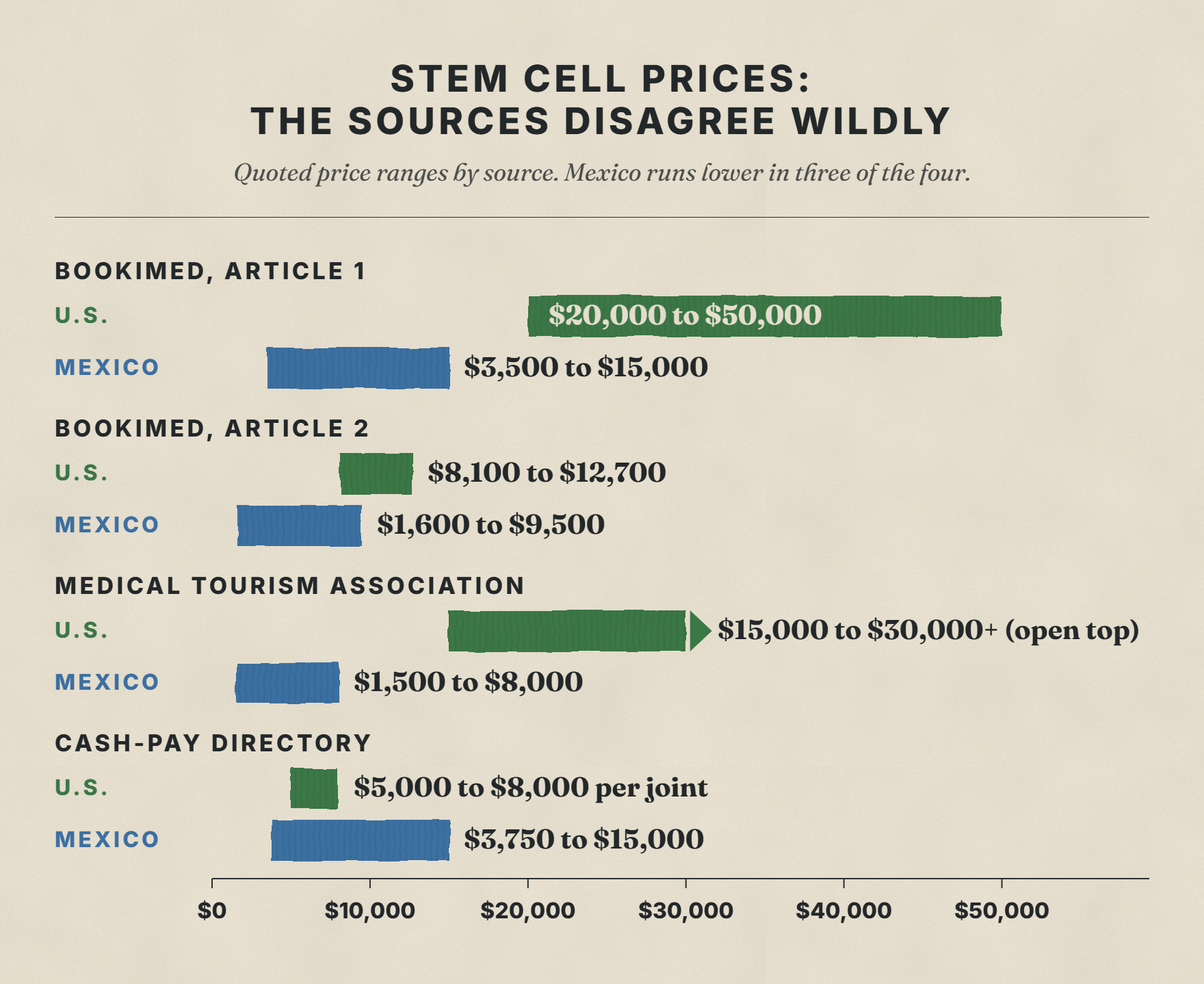
Four sources quote very different price ranges for stem cell treatment, and Mexico runs lower in three of them. Every figure comes from medical tourism marketers or cash-pay directories, so treat the ranges as rough. The Medical Tourism Association U.S. range has an open top, and the cash-pay directory prices its U.S. figure per joint. Source: Bookimed (two articles), Medical Tourism Association and a cash-pay directory, as listed in the table above.
PRP, the rung that sits outside this fight
Platelet-rich plasma is far easier to get in the United States than cells or exosomes, and the reason is regulatory. The devices that concentrate platelets are cleared by the FDA through its 510(k) pathway, for example a platelet and plasma separator for bone graft handling cleared in September 2024 (FDA 510(k) BK241083). A physician may use a cleared device for other purposes at their own discretion, which is called off-label use. Blood drawn from a patient and returned to the same patient during one procedure generally falls outside the tissue rules described above. That is why PRP is offered widely while exosomes draw warning letters.
Health insurers publish medical policies on PRP, including Blue Cross Blue Shield of Michigan and Blue Shield of California, and as far as I know most treat orthopedic uses as investigational and do not pay. Surprised?
Put together, the rungs look like this. PRP uses your own platelets and sits in the easiest regulatory position, with decent evidence for a few uses and a standardization problem. Exosomes and other cell factors sit in the middle, with promising biology, thin human data and active enforcement. Cell injections sit at the top, with the highest prices and the most regulation.
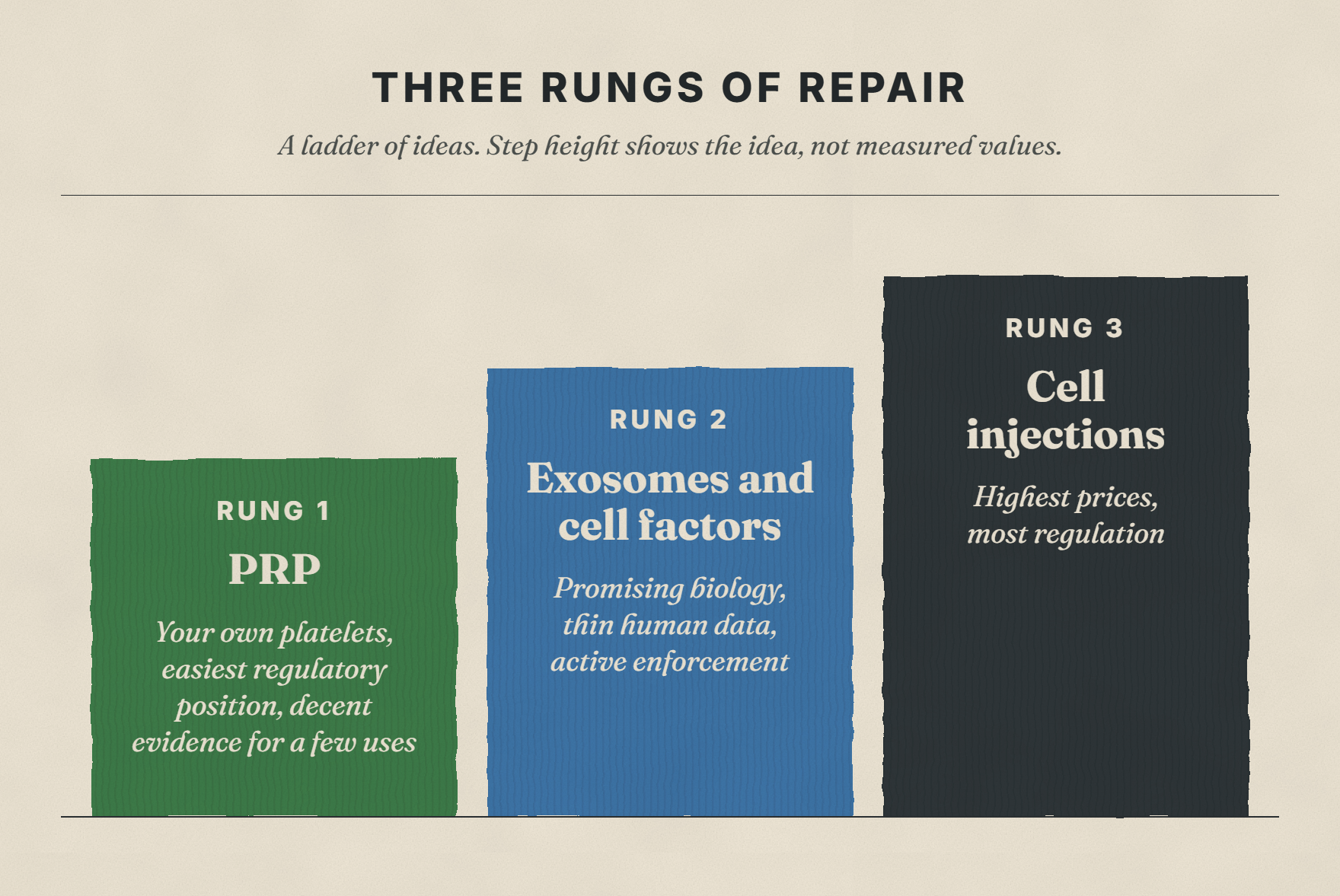
The three rungs from easiest regulation to most regulation. PRP sits lowest, exosomes and cell factors sit in the middle, and cell injections sit at the top. The step heights show the idea, not measured values. Source: FDA materials and the evidence reviewed in Episodes 2 and 3.
Light as an amplifier
Photobiomodulation, or PBM, applies low-power red or near-infrared light to tissue. The usual explanation is that mitochondria, the cell's energy structures, absorb the light and respond. Its connection to stem cells comes from lab work.
A review of 42 studies found that most low-power laser studies increased MSC proliferation, migration or differentiation, while two gave contradictory results (Ahrabi et al., 2019). The wavelength matters. In one lab's work, red light at 660 nanometers and near-infrared at 810 nanometers stimulated adipose stem cell growth, while blue and green light inhibited it (Hamblin group, adipose stem cell study). A 2026 review warns that PBM can inhibit or even harm MSCs under some settings (2026 PBM review, J Lasers Med Sci).
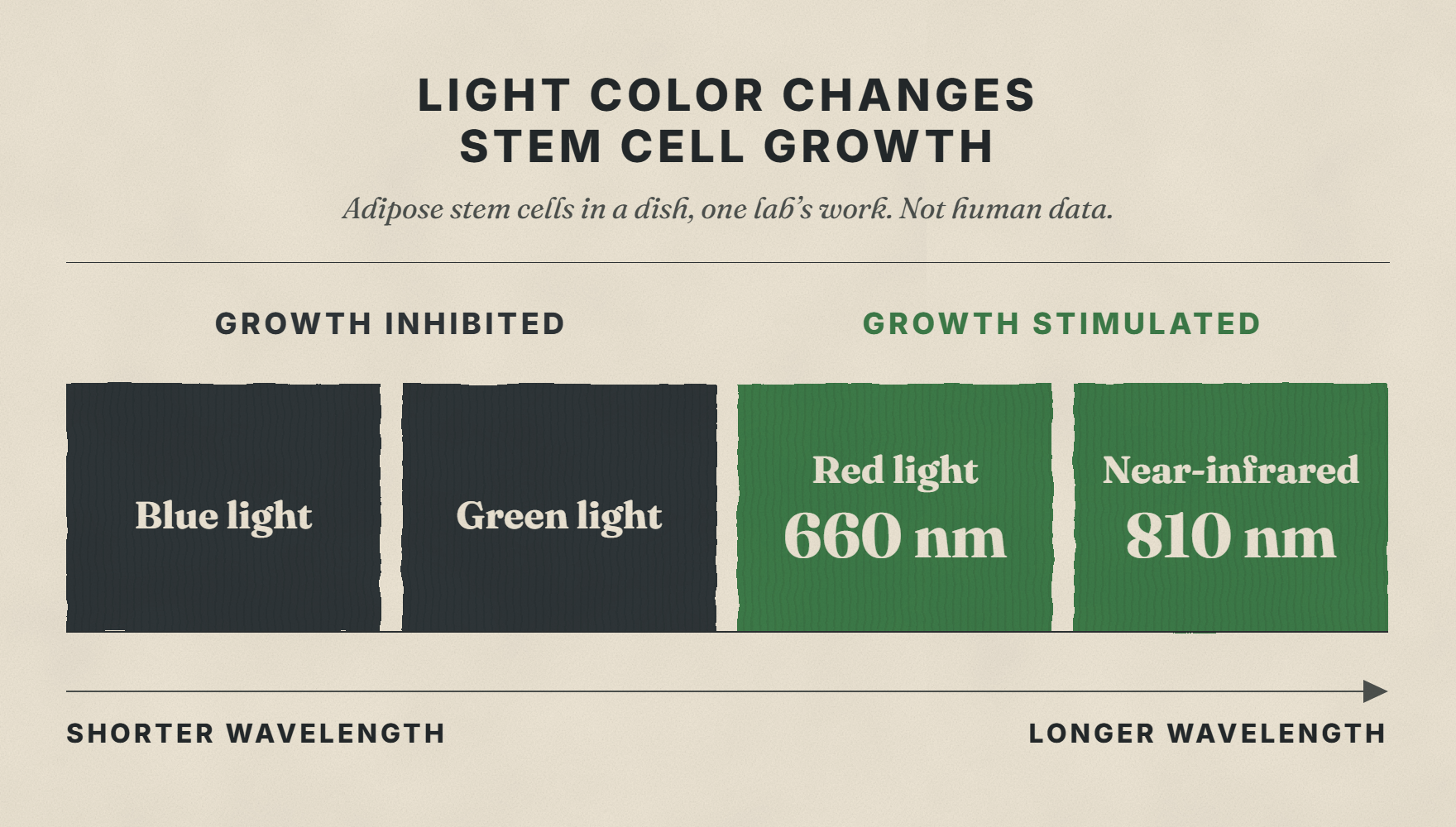
In one lab's cell culture work, red light at 660 nanometers and near-infrared light at 810 nanometers stimulated adipose stem cell growth, while blue and green light inhibited it. This is lab data and not human data, and the blocks are not drawn to scale. Source: Hamblin group, adipose stem cell study.
The gap is plain. Almost all of this is cell culture, and I could not find human studies showing more stem cell activity in the body after light exposure. Light may help, and the dose and wavelength may determine whether it helps or harms.
Drapeau rates red light therapy promising and not established, which fits what the lab data support (Drapeau).
Pulsed electromagnetic fields
Pulsed electromagnetic field therapy, or PEMF, sends brief magnetic pulses through tissue. Doctors have used it for bone healing and joint protection. In the lab, PEMF enhances the bone and cartilage differentiation of MSCs, possibly through adenosine receptors, which are cell-surface sensors for a signaling molecule (Varani et al., 2021). Only a few signal types have clinical support.
A 2024 review says PEMF can stimulate stem cell growth and differentiation, and it concludes the best settings remain unresolved (2024 PEMF review, Prog Biophys Mol Biol). An earlier review described the data on adult stem cells as inconsistent (Stem Cell Res Ther, 2016). Frequency, intensity and timing all matter, which means a device that works for bone may do nothing for skin.
Anyone shopping for a PEMF device should ask which signal type it uses and whether that signal has human data for the condition they care about. Expect to pay $10,000 or more for a reasonable device with good quality and delivering dose and frequency similar to what has been studied.
Other amplifiers to scope
I have not researched these yet, and each could be a future piece. Exercise and low-oxygen exposure may change stem cell activity. Plasma exchange builds on the Conboy findings from Episode 1. Clearing senescent cells, which are aged cells that stop dividing and release inflammatory signals, may make room in the niche around stem cells.
Where the series lands
Slowing damage and repairing damage belong together. The repair side has a real mechanism, cells and the signals they release, and it has real barriers in cost, regulation and thin human data. Light and electromagnetic fields are interesting amplifiers with promising lab evidence and little proof in people.
That is the honest state of repair today, and it is why I think it deserves more attention than it gets.
What I would do with this
If you can’t afford the StemRegen product, start adding spirulina and cracked cell chlorella to your daily supplement regimen. That isn’t the same blue-green algae that Drapeau researched (AFA), patented and markets as StemRegen but there are many benefits and stimulating stem cells is an expected benefit. I add a teaspoon of each to my morning protein drink in addition to the StemRegen product. As is usually the case we need more research desperately but who is going to pay when there isn’t a financial incentive? I order Spirulina and Cracked cell Chlorella from Pure Bulk every few months.
If you can afford it, consider Stem Regen. It is not established in large trials. The company is research focused and continues to advance the science that Christian Drapeau has been involved in for more than two decades. Sage may earn a commission if you purchase through this link, at no additional cost to you.
Stem cell infusions are expensive, and it is fair to ask whether the infused cells do more than increase exosome expression. Drapeau reports that most infused cells die on the day of injection (85%) and that the benefit comes from what the cells release, namely, exosomes (Drapeau). For people with a medical crisis and who need faster activity, I prefer an intermediate step, which is to consider cell growth factors. In my understanding they cost about 5 to 10 percent of what stem cell injections cost.
Talk with a qualified clinician before starting any supplement or treatment, especially if you take medication or have an autoimmune condition.
This series is education only. It does not offer medical advice, dosing guidance or a clinical relationship with the reader. Talk with a qualified clinician about any treatment decision.
Ready to start restoring your health?
The membership is $300 a month, month to month. You get a written plan, teaching, and coaching. Sage does not diagnose you or give you a personal medical reading.
See the membershipReferences19
- FDA, Consumer Alert on Regenerative Medicine Products Including Stem Cells and Exosomes (https://www.fda.gov/vaccines-blood-biologics/consumers-biologics/consumer-alert-regenerative-medicine-products-including-stem-cells-and-exosomes)
- FDA, Public Safety Notification on Exosome Products (December 2019) (https://www.fda.gov/vaccines-blood-biologics/safety-availability-biologics/public-safety-notification-exosome-products)
- National Law Review, FDA cracking down on unapproved HCT/Ps (https://natlawreview.com/article/fda-cracking-down-unapproved-hctps-fourth-untitled-letter-2023)
- JD Supra, FDA cracking down on unapproved HCT/Ps (Regenerelle) (https://jdsupra.com/legalnews/fda-cracking-down-on-unapproved-hct-ps-5284814)
- FDA warning letter, Kimera Labs (September 2023) (https://www.fda.gov/inspections-compliance-enforcement-and-criminal-investigations/warning-letters/kimera-labs-inc-649343-09012023)
- FDA warning letter, Evolutionary Biologics (December 2024) (https://www.fda.gov/inspections-compliance-enforcement-and-criminal-investigations/warning-letters/evolutionary-biologics-inc-681586-12302024)
- FDA warning letter, Supreme Rejuvenation (May 2025) (https://www.fda.gov/inspections-compliance-enforcement-and-criminal-investigations/warning-letters/supreme-rejuvenation-llc-700749-05052025)
- Holland & Knight, new Florida law on stem cell therapies (2025) (https://www.hklaw.com/en/insights/publications/2025/08/new-florida-law-attempts-to-provide-leeway-for-certain-stem-cell)
- Florida Senate bill summary, SB 1768 (https://flsenate.gov/Committees/billsummaries/2025/html/1768)
- Florida House analysis (https://flsenate.gov/Session/Bill/2025/1617/Analyses/h1617z.HPP.PDF)
- Bookimed, stem cell therapy cost (https://bookimed.com/article/stem-cell-therapy-cost/)
- Ahrabi et al. (2019), PBM and MSCs review (https://pmc.ncbi.nlm.nih.gov/articles/PMC6983866)
- Wavelength effects on adipose stem cells (Hamblin group) (https://koreascience.or.kr/article/JAKO202018136867977.page?lang=en)
- 2026 PBM and MSC review, J Lasers Med Sci (https://journals.sbmu.ac.ir/jlms/article/download/50273/36840/268124)
- Varani et al. (2021), PEMF and MSC differentiation (https://pmc.ncbi.nlm.nih.gov/articles/PMC7830993)
- 2024 PEMF and stem cells review (https://pubmed.ncbi.nlm.nih.gov/38280492/)
- 2016 PEMF and adult stem cells review, Stem Cell Res Ther (https://link.springer.com/10.1186/s13287-016-0312-5)
- Drapeau C. Podcast interview on stem cells and repair (2026).
- FDA, 510(k) BK241083 platelet and plasma separator for bone graft handling (September 2024) (https://www.fda.gov/vaccines-blood-biologics/substantially-equivalent-510k-device-information/bk241083-platelet-and-plasma-separator-bone-graft-handling)
More from Sage Matters
Toxic burden and chronic illness
A person can feel terrible and still be told every test is normal.
READ ARTICLE
What we actually know about microplastics in your body
In 2024, researchers in Italy removed carotid artery plaque from 257 patients during surgery and tested it for plastic.
READ ARTICLE
Longevity basics that actually have evidence behind them
Longevity basics that actually have evidence behind them
READ ARTICLE
What are the important things to consider for longevity?
Focus on these things for a long and healthy life
READ ARTICLE