The moldy wall
Years ago, as an occupational medicine physician, I consulted with a company that found dark mold growing on an interior wall. An old window air conditioner had leaked condensation down that wall for a long time.
The company moved everyone out of the room and sent the employees to me. A few had symptoms, and we started treatment. Word spread through the workforce, and at least one employee became temporarily unable to work.
The company took it seriously. It had already dealt with mold at a building in another state, tried remediation, and later tore that building down because it couldn't be assured the risk was gone.
The employees I saw covered the whole range of possible exposure. Some had worked in that room and some had symptoms, but others had never set foot in it.
We brought in a scientist who had developed lab methods to type the mold sampled from the room and compare it with findings from urine testing. In employees who reported exposure but had never entered the room, the results pointed to a different source. That let us separate a workplace source from mold they'd run into somewhere else.
That distinction is easy to miss in a humid climate. I've lived in rural Georgia for more than 30 years, and the north sides of the buildings and barns on my property often grew a green coat of mold.
Mold exposure is common in places like this, and some exposures can cause significant illness. The medical work is figuring out who was exposed, whether the exposure caused harm, and where it came from.
Ritchie Shoemaker has spent much of his career trying to answer those questions.
The fish
In 1997, fish were dying in the rivers around Pocomoke City, Maryland, and some had open sores. People who worked near those waterways started reporting headaches, skin problems, breathing symptoms, diarrhea, muscle pain, and trouble with memory.
Shoemaker was the local family physician. He'd studied molecular biology and medicine at Duke and came to Pocomoke in 1980 through the National Health Service Corps, later opening his own family practice there (Shoemaker 2023). The sick fish and the sick people living near them changed the direction of his career. He began studying Pfiesteria, an obscure dinoflagellate (a microscopic water organism) linked to fish kills in Chesapeake Bay waterways.
Reports of fish with lesions had shown up in the region before the bigger 1997 outbreak, and researchers were trying to learn whether toxin-producing Pfiesteria or related organisms were involved. A study in The Lancet documented learning and memory problems in people exposed to the affected waterways (Grattan et al. 1998).
Shoemaker opened a clinic for people who believed the waterways had made them sick. In a 1998 paper in the Maryland Medical Journal, he described lasting symptoms in self-referred patients and reported improvement after cholestyramine, a prescription drug that binds bile acids in the gut (Shoemaker 1998). It was an uncontrolled observational report. It could raise a useful question, but it couldn't prove the drug worked or that a specific toxin caused the illness.
Nearly 30 years later, he is still chasing one question. Why do some people stay sick after the exposure is gone?
His answer became chronic inflammatory response syndrome, or CIRS. It has given many chronically ill people words for symptoms that medicine struggled to explain, and it has also drawn serious criticism.
From fish to buildings
Shoemaker worked with neurotoxicologist H. Kenneth Hudnell on visual contrast sensitivity, a test of how well you can tell apart patterns of light and dark. They proposed that reduced contrast sensitivity could be an objective clue to effects on the nervous system after certain biotoxin exposures (biotoxins are poisons made by living things). Hudnell's 2005 review tied symptoms, thinking problems, contrast sensitivity, and response to cholestyramine together under the name chronic biotoxin-associated illness (Hudnell 2005).
Then Shoemaker saw that his Pfiesteria patients looked a lot like people who got sick after spending time in water-damaged buildings. Those patients often described fatigue, headaches, trouble concentrating or remembering, pain, numbness, sinus complaints, mood changes, and other symptoms across several parts of the body.
A damp building can grow molds and bacteria that make toxins of their own, so he wondered whether the same illness could start there.
A building is harder to study than one toxin. Damp buildings can hold fungi and fungal fragments, bacteria and endotoxins (pieces of bacteria that set off inflammation), allergens, volatile chemicals, and material released as the building itself breaks down. In 2004 the National Academies concluded that damp indoor spaces were linked to coughing, wheezing, upper respiratory symptoms, and asthma symptoms in susceptible people. For many neurologic and whole-body complaints, the evidence at the time was inadequate or insufficient (Institute of Medicine 2004).
Shoemaker believed a subgroup of exposed people developed a lasting immune disturbance that standard allergy testing couldn't explain. He proposed a chain of events involving genetic susceptibility, activation of the innate immune system (the body's fast, first-line defenses), complement proteins, inflammatory signaling, hormone changes, abnormal blood flow, and effects on the brain. He later named the condition CIRS.
In 2006, Shoemaker and Dennis House published a time-series study and a small double-blind, placebo-controlled trial in people who had occupied water-damaged buildings. They reported changes in symptoms and contrast sensitivity after cholestyramine, and they looked at inflammatory and hormone markers that became part of his model (Shoemaker and House 2006). The study tried to move past testimonials by measuring what happened before and after treatment, but the trial was small and came from the same clinic that was building the model.
He wrote Mold Warriors in 2005 and Surviving Mold in 2010, and he trained physicians in a stepwise protocol that starts with removing the ongoing exposure, then uses prescription binders and other treatments aimed at whatever abnormalities turn up in testing. The protocol kept changing as he added tests and revised his view of what drives the illness.
Chasing proof
His group studied brain MRI scans processed with NeuroQuant, software that measures the size of specific brain structures. A 2014 study compared patients with illness tied to water-damaged buildings against a medical control group and reported differences in several brain regions. The authors proposed that chronic inflammation could affect the blood-brain barrier and brain structure. The sample was small, and the findings needed replication by independent groups (Shoemaker, House, and Ryan 2014).
Next came gene expression. Your DNA sequence tells you which genes you carry, and gene expression tells you which ones are more or less active when you're tested. Shoemaker and molecular biologist James Ryan used whole-blood transcriptomics (a read of gene activity in a blood sample) to study people who stayed ill after ciguatera fish poisoning. Their 2015 paper found altered activity in immune and inflammatory pathways in a small group of patients, and it stretched the CIRS idea past mold to a chronic response that could follow different biological toxins (Ryan, Wu, and Shoemaker 2015).
That work led to GENIE, short for Genomic Expression by Inflammation Explained. Shoemaker believes patterns of gene activity can point to inflammatory pathways and, in some cases, to the type of environmental trigger. His recent work has focused on actinobacteria (a large group of bacteria), endotoxins, immune receptors, energy production, and effects on the brain.
In a 2025 interview with Scott Forsgren, Shoemaker called "mold illness" an incomplete label for the mix found inside water-damaged buildings. He argued that bacteria and bacterial products may explain illness in some patients who were assumed to be reacting mainly to fungi or mycotoxins (toxins made by molds). He also said older inflammatory markers such as TGF-beta 1 and C4a can't identify a specific trigger by themselves (Forsgren 2025).
He has stayed committed to his core model, and the proposed cause inside it has kept changing.
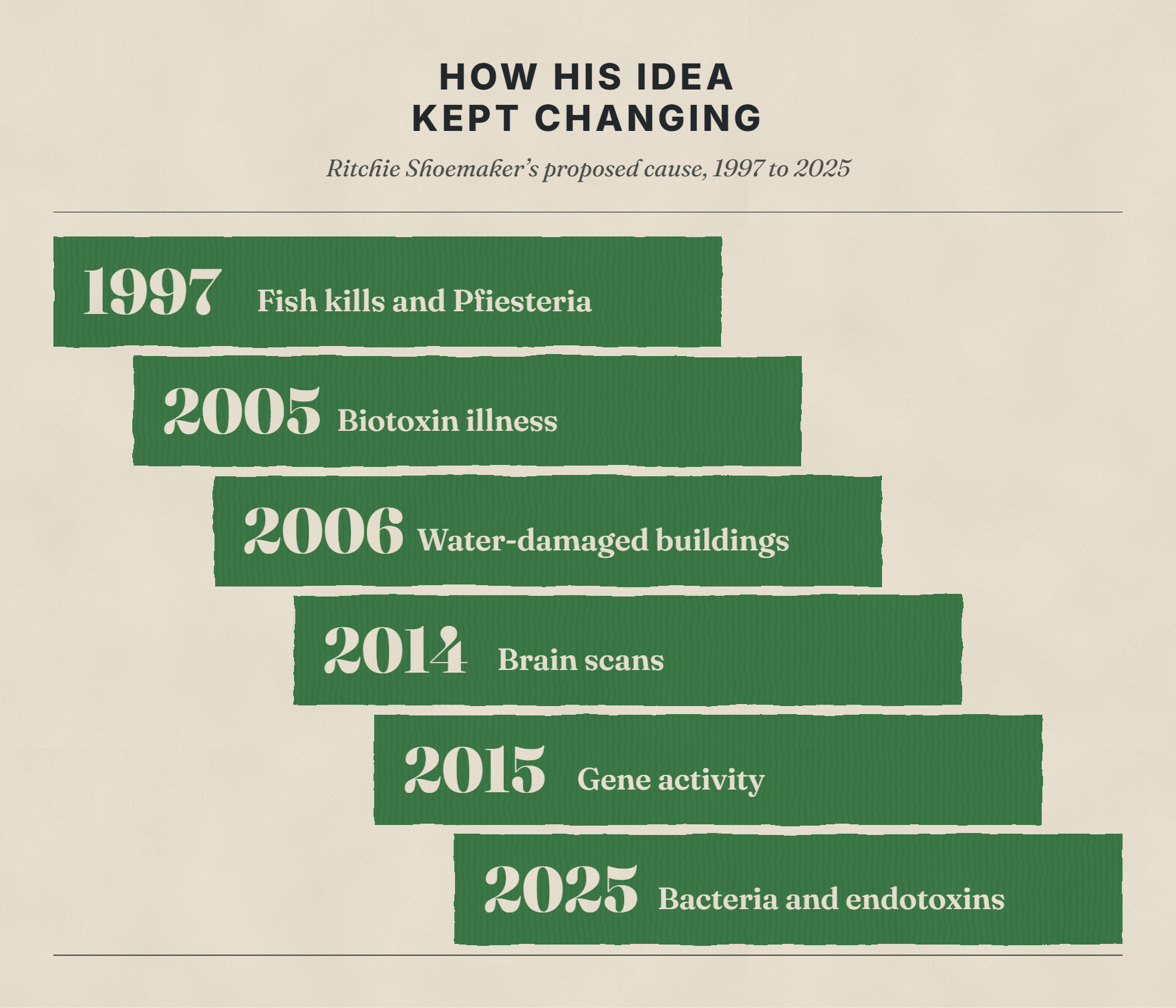
The milestones in Shoemaker's work, as described above, with the cause he proposed at each stage.
The fight
Mainstream medicine accepts that damp, moldy buildings can harm health. Respiratory disease, worsening asthma, allergic reactions, and hypersensitivity pneumonitis (lung inflammation from breathing in something you've become sensitized to) are recognized concerns, and the standard advice is to fix water intrusion and remove mold growth (Institute of Medicine 2004, EPA 2026).
CIRS goes much further. It proposes a chronic illness across many body systems, a signature set of biomarkers (measurable signs in blood and other tests), genetic susceptibility, brain effects, and a defined treatment sequence. Major medical societies and government health agencies haven't accepted that full model as a validated diagnosis or standard of care. A 2018 Australian parliamentary inquiry heard extensive patient testimony but concluded that medical consensus hadn't been reached on the cause, testing, or treatment of CIRS-like illness (Parliament of Australia 2018).
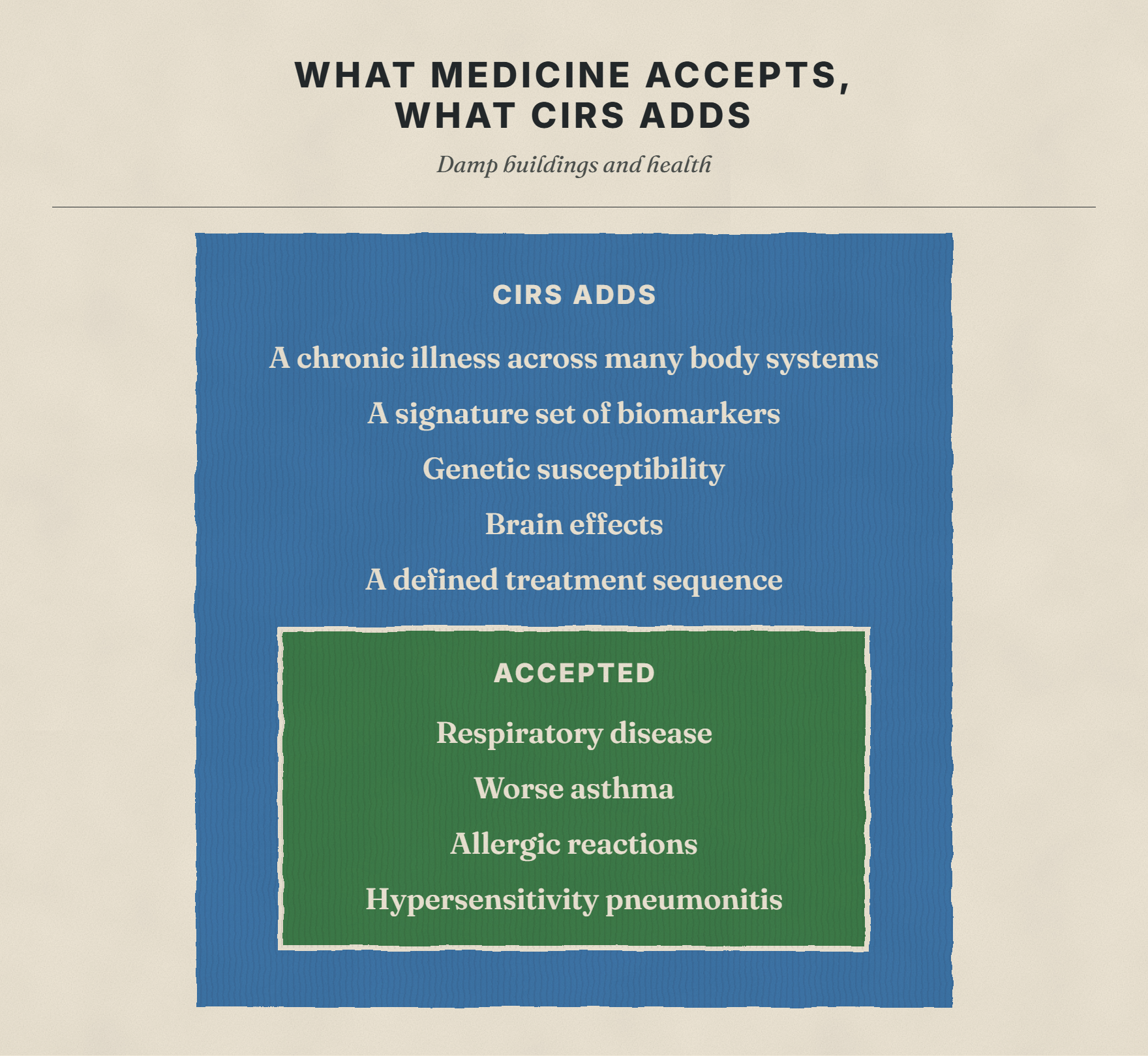
What mainstream medicine accepts about damp buildings, and what the CIRS model adds, as described in this article. The sizes are illustrative, not measured.
The evidence has real weaknesses. Many studies are small, several lack independent replication, and many of the proposed biomarkers haven't been independently validated. Much of the diagnostic and treatment research comes from Shoemaker, clinicians trained in his protocol, or organizations committed to the CIRS model. A 2024 review reported favorable results for the Shoemaker protocol, but the literature it drew on was limited and its authors work within the CIRS clinical field (Dooley, Vukelic, and Jim 2024).
His clinical record belongs in this history too. In 2013 the Maryland State Board of Physicians reprimanded Shoemaker after finding that he failed to meet the standard of care. His practice had already closed. The Board stated that he'd be placed on probation for at least 2 years if he resumed practicing in Maryland (Maryland State Board of Physicians 2013).
I have my own view of what happened. I believe Shoemaker was treated unfairly when he closed his family practice to concentrate on environmental illness. The Board action belongs in the record, and so do his research and the patients he followed.
His work also sits in a hard corner of medical research. There's no obvious patentable product in finding a damaged building, removing an exposure, using an older prescription binder, or tracking a set of lab markers. Without a commercial sponsor willing to pay for large trials and pursue a specific regulatory approval, the evidence builds slowly.
I saw what that means in occupational medicine. Insurers could point to the lack of broad acceptance or regulatory approval and decline to pay for the testing needed to sort out an exposure. The missing evidence became the reason not to fund the work that might produce better evidence.
There's danger on the other side too. Fatigue, thinking problems, pain, and neurologic symptoms need a careful search for other causes. Environmental testing and long treatment protocols can get expensive, and unproven tests can create a certainty the science hasn't earned.
Shoemaker paid attention to people who were sick before medicine had a good category for them, and I think his best contribution may be the question he's kept alive. Can an environmental exposure leave a susceptible person with lasting immune and neurologic problems long after the first event? Current evidence can't tell us how often that happens, how best to identify it, or which parts of the CIRS protocol will survive larger independent trials. Some of his claims may prove right, and others may be revised or dropped. The fair way to sort them out is what he has asked for from the beginning, careful measurement, done by independent teams, with results others can repeat.
References
Environmental Protection Agency. "How Do Molds Affect People?" Accessed September 16, 2026. https://www.epa.gov/mold/how-do-molds-affect-people
Forsgren S. "Episode 211: Actinobacteria and Endotoxins in CIRS with Dr. Ritchie Shoemaker." BetterHealthGuy Blogcast. January 22, 2025. https://www.betterhealthguy.com/episode211
Grattan LM, Oldach D, Perl TM, et al. "Learning and memory difficulties after environmental exposure to waterways containing toxin-producing Pfiesteria or Pfiesteria-like dinoflagellates." The Lancet. 1998, 352, 532-539. https://doi.org/10.1016/S0140-6736(98)02132-1
Hudnell HK. "Chronic biotoxin-associated illness: multiple-system symptoms, a vision deficit, and effective treatment." Neurotoxicology and Teratology. 2005, 27, 733-743. https://pubmed.ncbi.nlm.nih.gov/16102938/
Institute of Medicine. Damp Indoor Spaces and Health. Washington, DC, National Academies Press, 2004. https://doi.org/10.17226/11011
Dooley M, Vukelic A, Jim L. "Chronic inflammatory response syndrome: a review of the evidence of clinical efficacy of treatment." Annals of Medicine and Surgery. 2024, 86, 7248-7254. https://pubmed.ncbi.nlm.nih.gov/39649915/
Maryland State Board of Physicians. "In the Matter of Ritchie C. Shoemaker, M.D., Consent Order." March 20, 2013. https://www.mbp.state.md.us/forms/mar13sanctions.pdf
Parliament of Australia. "Chronic Inflammatory Response Syndrome." Report on the inquiry into biotoxin-related illnesses in Australia. 2018. https://www.aph.gov.au/Parliamentary_Business/Committees/House/Health_Aged_Care_and_Sport/BiotoxinIllnesses/Report/section?id=committees%2Freportrep%2F024194%2F26442
Ryan JC, Wu Q, Shoemaker RC. "Transcriptomic signatures in whole blood of patients who acquire a chronic inflammatory response syndrome following an exposure to the marine toxin ciguatoxin." BMC Medical Genomics. 2015, 8, 15. https://doi.org/10.1186/s12920-015-0089-x
Shoemaker RC. "Treatment of persistent Pfiesteria-human illness syndrome." Maryland Medical Journal. 1998, 47, 64-66. https://pubmed.ncbi.nlm.nih.gov/9524412/
Shoemaker RC. "Curriculum Vitae." Surviving Mold. Updated September 24, 2023. https://www.survivingmold.com/about/curriculum-vitae
Shoemaker RC, House DE. "Sick building syndrome and exposure to water-damaged buildings: time series study, clinical trial and mechanisms." Neurotoxicology and Teratology. 2006, 28, 573-588. https://doi.org/10.1016/j.ntt.2006.07.003
Shoemaker RC, House DE, Ryan JC. "Structural brain abnormalities in patients with inflammatory illness acquired following exposure to water-damaged buildings." Neurotoxicology and Teratology. 2014, 45, 18-26. https://doi.org/10.1016/j.ntt.2014.06.004
Ready to start restoring your health?
The membership is $300 a month, month to month. You get a written plan, teaching, and coaching. Sage does not diagnose you or give you a personal medical reading.
See the membershipMore from Sage Matters

Toxic burden and chronic illness
A person can feel terrible and still be told every test is normal.
READ ARTICLE
What we actually know about microplastics in your body
In 2024, researchers in Italy removed carotid artery plaque from 257 patients during surgery and tested it for plastic.
READ ARTICLE
Longevity basics that actually have evidence behind them
Longevity basics that actually have evidence behind them
READ ARTICLE
What are the important things to consider for longevity?
Focus on these things for a long and healthy life
READ ARTICLE